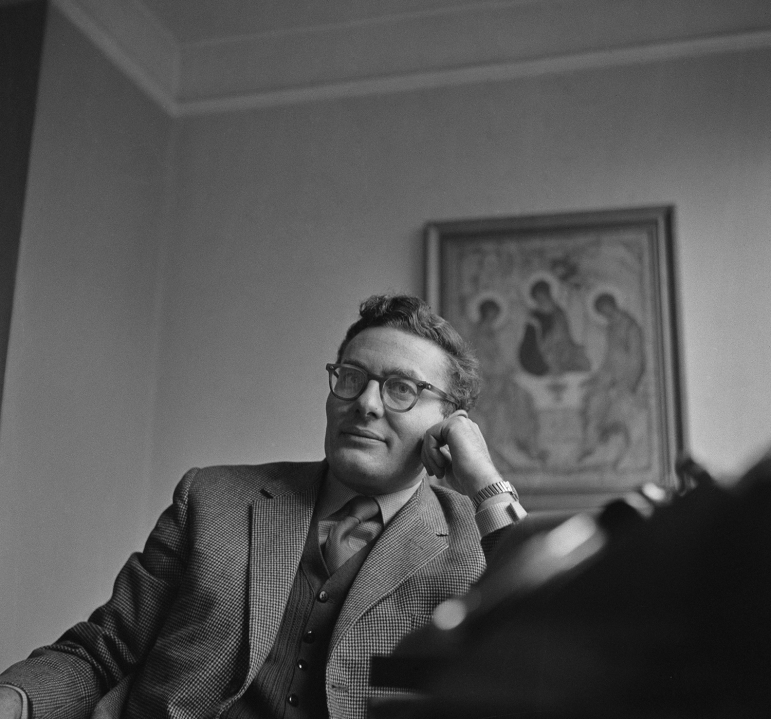
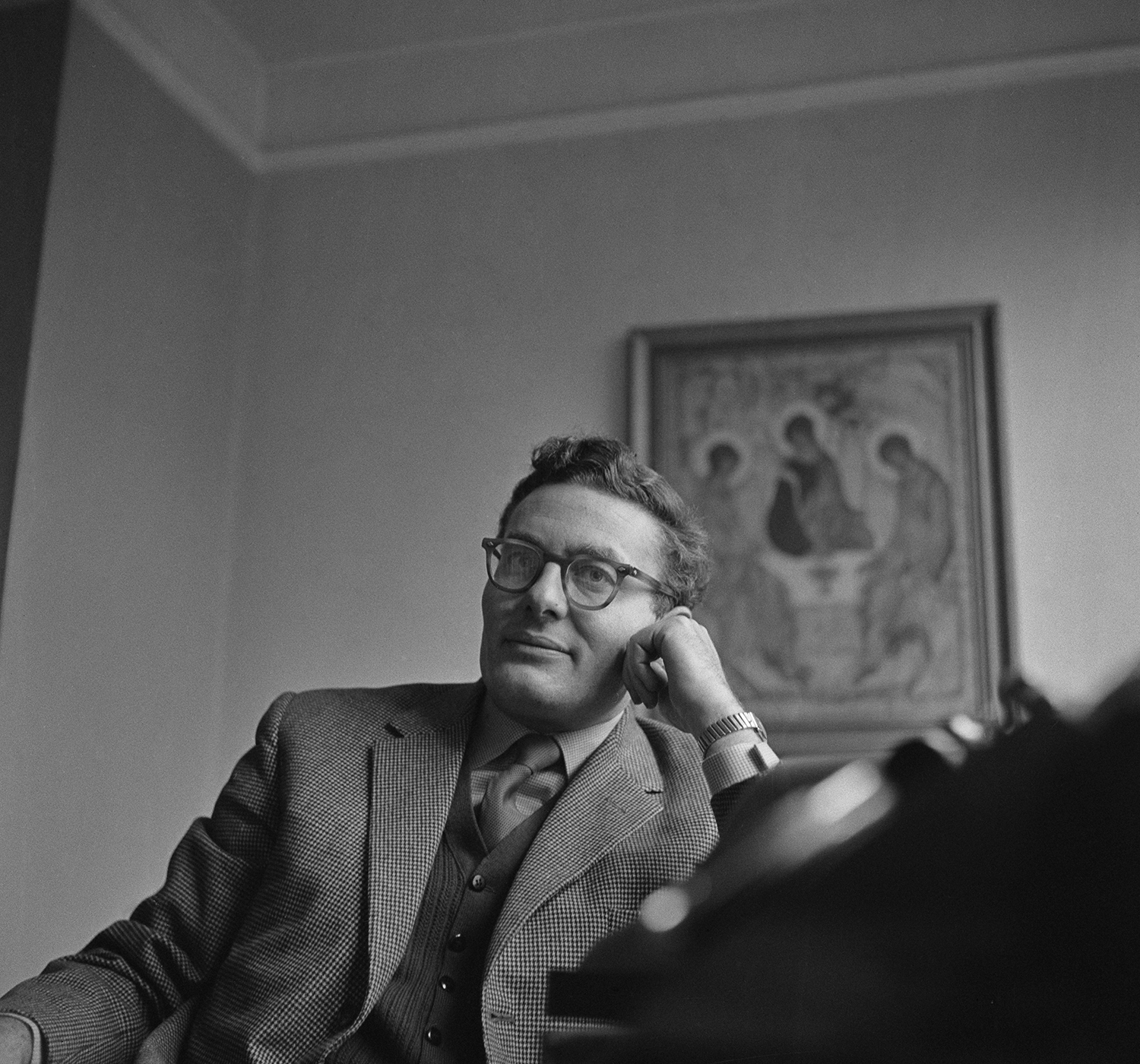
Commercial success has a way of corroding critical regard. The more popular a playwright becomes, the more the critical establishment becomes suspicious of their intellectual credentials. Consider Peter Shaffer. He collected Tonys, an Oscar, a Golden Globe, a CBE and a knighthood, and yet his reputation has contracted to a single work.
Shaffer’s Amadeus premièred at the National Theatre in London in 1979. A West End transfer followed, then Broadway. But it was Milos Forman’s 1984 film that propelled it into the stratosphere, embedding itself so completely in our cultural consciousness that the rest of his work has never quite escaped its shadow.

Shaffer’s work resists easy categorisation. He is never bracketed within the warring paradigms of the latter half of the 20th century: he is no kitchen-sink realist, no political fist-clencher, no in-yer-face maximalist. He is as comfortable in 16th-century Peru (The Royal Hunt of the Sun), as he is in a suburban psychiatrist’s consulting room (Equus) or in 1950s rural England (Five Finger Exercise).
Stoppardian and Pinteresque have long since entered the critical lexicon. Shafferesque deserves to join them
A particular theme persists beneath the chameleonic shifts across genre and geography: the collision between the Apollonian and Dionysian on the battleground of religion. Stoppardian and Pinteresque have long since entered the critical lexicon. Shafferesque deserves to join them.
In The Royal Hunt of the Sun (1964), the rigid Catholicism of the Spanish conquistadors clashes with the primal ecstasy of the Inca’s sun worship. In Equus (1973), psychiatrist Martin Dysart is called to cure Alan Strang, a disturbed teenager who has blinded six horses in the name of an imagined horse god. But the play’s anguish pivots on Dysart’s growing suspicion that in curing Alan, he will destroy the precious spirituality in Alan’s atavism, a spirituality that Dysart comes to realise he himself lacks. And in Amadeus, the measured diligence of Salieri is contrasted to the effortlessness of Mozart, a mercurial libertine graced, unfairly in Salieri’s eyes, with sublime talent. Mozart’s sprezzatura seems to grant him access to the divine that Salieri, despite his piety and toil, has been denied.
Shaffer’s long-time collaborator Peter Hall suspected that the play’s fictionalised rivalry between priggish Salieri and wunderkind Mozart was partly autobiographical. ‘His archives show that he was a nervous and restless writer,’ notes Shaffer scholar James Critchley. The London première of Amadeus looked markedly different from the New York transfer that followed. Shaffer even cut a character from Equus just two weeks before opening. Harold Pinter, on the other hand, was zealously protective about edits to scripts and saw a string of critical hits across his career. ‘Perhaps Shaffer’s plays are impoverished when read and need to be seen on stage to be fully appreciated. Whereas you can pick up Pinter or Beckett and you have a finished work,’ suggests Critchley.
The duality running through Shaffer’s work may owe something to biography. He was born a twin to a Jewish family in Liverpool; his brother Anthony was an accomplished writer in his own right, best known for The Wicker Man. The 1973 film hinges on the same collision between pagan ecstasy and repressive rationalism. Shaffer’s partner, Paul Giovanni, even composed the score for the film.
Shaffer’s sexuality likely also influenced his work. Early drafts of Equus in the archive are explicit meditations on dissident sexuality. Shaffer would not have wanted to be pigeonholed as a gay writer, but a homoeroticism feels interwoven into the male rivalries. ‘The polarisation between his male characters is suffused longing,’ says Critchley: the Salieri-Mozart rivalry, Dysart’s fascination with Alan Strang, Pizarro’s bond with Atahualpa in The Royal Hunt of the Sun all hinge on an obsessive intimacy between two men on opposite sides of an irreconcilable difference.
Critics began to cotton on to how he rehashed dualling opposites every time. ‘Peter Shaffer creates another envious outsider,’ wrote Benedict Nightingale of Shaffer’s 1985 biblical drama Yonadab in which the eponymous character also struggles to reconcile himself with the divine. But dismissing him on this basis fails to gauge how he moved with the tectonic shifts in the broader socio-political climate.
‘He was consistently on the crest of change, attuned to popular culture and the avant-garde to feed into his writing,’ says Critchley. Equus was written at a paradigm shift both for theatre and for society: the abolition of stage censorship in 1968 and the decriminalisation of homosexuality the year before. Shaffer was among the first to boldly inhabit that space, drawing on R.D. Laing and the 1960s anti-psychiatry movement.
Two London revivals will make the case for Shaffer this spring. Equus is seeing a revival at the Menier Chocolate Factory and Black Comedy at the Orange Tree. The contrast between the two could hardly be greater. Equus is a visceral psychodrama, while Black Comedy ‘is one of the funniest plays of the 20th century’, says the Orange Tree’s artistic director Tom Littler. It rests on the conceit that when the stage lights comes on, the characters are plunged into darkness. The same collision that animates his other plays is here refracted through physical comedy, order and chaos played out in light and dark.
Black Comedy is one of the funniest plays of the 20th century
There is also a distinct inheritance from Greek tragedy running through Shaffer’s work. ‘It unfolds in a single location, in real time, in just 75 minutes,’ notes Littler of Black Comedy. ‘Shaffer masters form in a way that not many other writers of the time manage.’ The Greek influence surfaces across his career in his preoccupation with ritual, ecstasy and sacrificial violence, but finds its most explicit expression in his final play. Premièring at the RSC in 1992, The Gift of the Gorgon self-reflexively traces a playwright who explores the power of violence in drama.
Shaffer is not as popular as his peers today, but his influence is just as tangible. ‘Hamilton is pure Shaffer,’ suggests Critchley, ‘wherever two male nemeses go toe to toe and end up destroying each other – that is Shafferesque.’ Shaffer died in 2016, the year Hamilton stormed Broadway.
That Shaffer’s own legacy should mirror Salieri’s feels perhaps too poetic. But with an Amadeus revival with Michael Sheen slated for London in 2027, and his lesser-known works returning to the stage, the wheel may finally be turning.
Equus is at Menier Chocolate Factory until 4 July. Black Comedy is at the Orange Tree until 11 July. And Amadeus is at New Theatre Cardiff from 9 until 27 March 2027 and at the Noël Coward Theatre from 17 April 2027 until 7 August 2027.






Comments