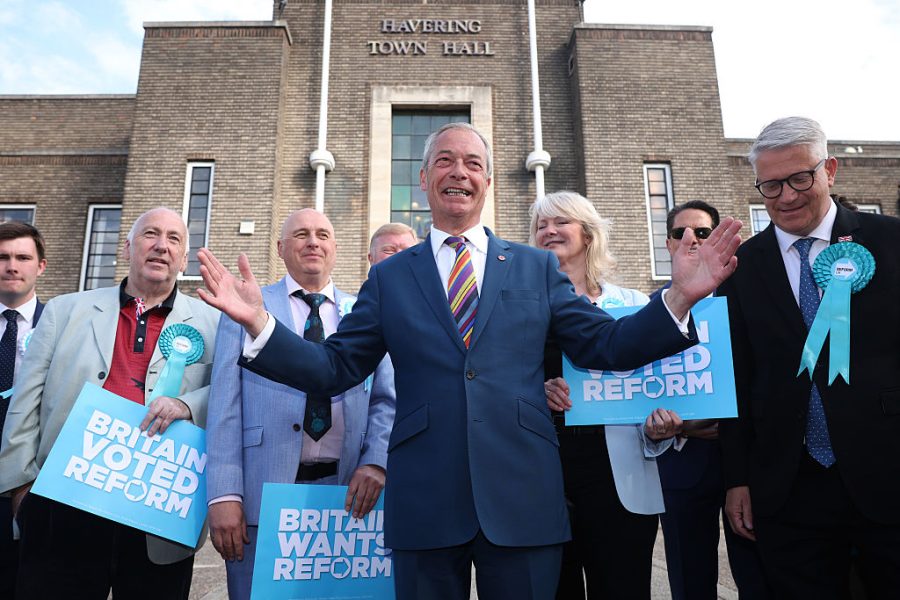
As the scale of Reform’s success in the British local elections became clear, the Reform Member of Parliament Danny Kruger noted, “What is happening is seismic…The public have decided they don’t want the failed consensus of the last 25 years.”
What is this “failed consensus”? Here is my take: what the voters have announced this week – in the most unambiguous terms since the Brexit vote – is that they’re calling time on the idea that we have to prioritize other people and other things over what is in the interests of ordinary working British people. The public will no longer allow a discredited, globalist notion of treating national self-interest as a second-order priority – which has found its most devoted proponent in Keir Starmer – to be foisted upon them.
This notion has become the guiding philosophy of much of the bureaucratic class. It found perhaps its most infamous expression in the words of the former Cabinet Secretary Gus O’Donnell when he said, in the context of immigration policy and the economy, “I think it’s my job to maximize global welfare, not national welfare.” Such an approach was always putting two fingers up to the people paying Lord O’Donnell’s wages. It has now clearly failed. The public simply won’t put up with it any longer.
Call it populism, the politics of national preference or anything else you like
Commentators have sought various framings to describe what has happened in British politics since the Brexit vote. To some it is of course simply grubby populism or an unfortunate political awakening by the great unwashed. Others have described what has happened as a backlash against the elites, though I’m not sure that is quite right when most people see business and tech elites – the Elon Musks and James Dysons of this world – as deserving of nothing other than respect.

During the Brexit campaign, Michael Gove astutely captured the mood when he said “people in this country have had enough of experts.” But, in my view, straightforward hostility to experts is not quite the right framing for our current moment. Not least when people are waking up to the realization that many of the country’s senior mandarins have only the shallowest of expertise in the areas over which they exert such vast control.
Theresa May’s distinction between “citizen of nowhere and citizens of somewhere” is helpful. Everything we have seen over the 22 months of misrule by Keir Starmer stems from the preference he stated in 2023 for Davos over Britain. People want a politics grounded in home, not a Prime Minister in it for a leaders’ family photo and a chilled glass of Chasselas.
What all these framings capture is a sense that an elite class, claiming an expertise they often don’t possess, and a moral high ground they do not deserve, has tried to tell us little people how things should be done. By making reference to spurious and outdated frameworks they often barely understand – whether international law or human rights – they have tried to dictate, in always the most supercilious of tones, that this is simply the way things must be. Rather than level with the public, and point out the range of options open to us on any given issue and the trade-offs involved, they have sought to present only one acceptable outcome.
An asylum policy that would require us to derogate or withdraw from international treaties or require the repeal of domestic legislation is not even presented as an available option. Such is the fear in the governing class that the public, if given a choice, might make the wrong one.
But the public have realized we do not need to prioritize economic immigrants posing as asylum seekers over women’s safety. We do not need to prostrate ourselves at the feet of shouty activists, whether Greta Thunberg or pro-Gaza mobs. We do not need to nod solemnly when the perpetually offended take exception to something in our culture.
We do not need to indulge outrageous demands for reparations from foreign countries. Nor fold in the face of international courts advising us to give away our own sovereign territory. We do not need to prize other concerns over our own interests – whether blind adherence to a rigid framework of international law that most serious geopolitical observers agree has become outdated, or an amorphous notion of our ‘international reputation’.
Put simply, we can put Britain first, and we do not need to feel any embarrassment about doing so. Indeed, it is only by doing so that this country survives in any meaningful, coherent, successful form and able to therefore continue to make a positive economic, cultural, and intellectual contribution to the world.
Call it populism, the politics of national preference or anything else you like. The electoral thumping delivered on May 7 shows Brits just want their own country to be put first. It’s extraordinary that it’s taken so many in the political class so very long to realize that simple truth.





Comments