
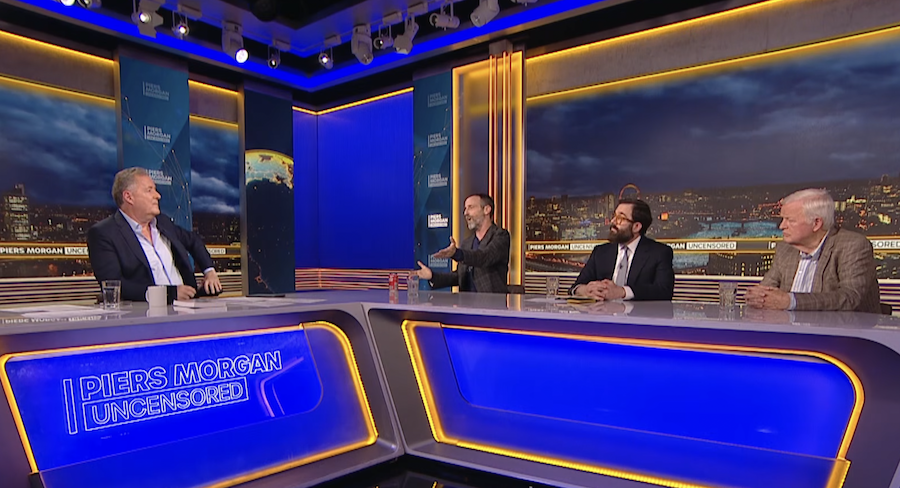
After the fourth invitation from Piers Morgan’s team to appear on his Uncensored show, I finally decided it might be time to accept. This programme, I was told, would be on American foreign policy and the war with Iran, following Morgan’s interview with John Bolton. That sounded, at least on paper, like the invitation least likely to lead to the circus of shouting and hatred the programme is known for. Three experts in a studio, responding to a former US national security adviser, sounded civilised. Almost old-fashioned.
Piers and I have a short but revealing history. I once criticised his show in these pages for its decline into algorithmic bear-baiting. He responded with an article entitled, ‘In defence of Piers Morgan, by Piers Morgan’, which described me as ‘slavishly pro-Israel’.
So it was hardly a surprise when midway through the show, he asked if I am ‘very pro-Israel’ and ‘partisan’. His evidence appeared to be a hasty inspection of my headlines in this magazine over the past couple of years, apparently without the inconvenience of reading the articles beneath them. This was a forensic analysis in the same sense that licking a thermometer is medical research.
Does explaining all this make me ‘partisan’ or ‘slavish’ to Israel? I don’t think so
My answer was that I am not ‘slavishly’ anything: I defend Israel when I believe the facts and the regional context justify it, and I criticise Israeli policy when I believe criticism is warranted. Sure enough, I often find the facts lead to a less instinctively critical position of Israel than those who want to trace just about every geopolitical disaster back to the Jewish state.
Sitting next to me in the studio was a man called Scott Horton, who has blamed Israel for a range of ills, from provoking 9/11 (‘Naftali Bennett is the cause of September 11th’) to threatening to nuke London, Paris, and Rome. Yet on the show there was no equivalent health warning that he was a ‘partisan commentator’, no caveat that he is a heavily biased anti-interventionist, no attempt to classify him as anti-Israel or reflexively hostile to American power, before he was asked to speak. In fact, former MP and British soldier Col Bob Stewart and I were introduced as ‘a special studio panel assembled in honour of the visiting Scott Horton.’

The typical format of Morgan’s programme is not to my taste, and I had decided that if I appeared on the show, I would not be one of the several furious heads appearing by video link, yelling until the algorithm purred. As all three of us were in the studio, I would do my best to resist excessive bitching and backbiting, focusing instead on contributing my own analysis as part of a wider discussion. Horton tested that resolution, and though I did call out his crackpot conspiracies during the show, we shook hands at the end of the recording and parted in a friendly manner. He later declared on X that I was ‘just some random piece of shit Zionist’. Charming.
The programme began with Morgan’s assertion in his introduction that there were ‘many reasons why Israel gets to blame all the credit for the Iran war’, before describing a conflict that had ‘so far delivered only grave costs’, described the Iran/US talks as being centred on reopening a waterway that had been open ‘for thousands of years’ and restoring Iran’s nuclear programme to the level it had been before Trump scrapped the agreement. This was essentially Horton’s position, too, and was laid out as the starting point for all our conversation.
It is not that Horton invents facts. Many of his questions are valid and scrutiny of reporting and propaganda is important. Yet he assembles a prosecution brief and presents it as a judge’s summing up. American error becomes causation. Causation becomes responsibility. Responsibility somehow migrates away from Tehran, away from Moscow, away from jihadists, away from any actor whose own ambitions, fanaticisms and brutalities are inconvenient to his theory. But in many situations these are the cause of the US or Israel’s actions. I cannot help but find such an approach conspiracist, and Piers Morgan’s frequent airing of such theories, especially alongside varied but realistic views from calmer experts, only works to give them increased credibility.
Horton’s treatment of the Iranian regime was one of the most revealing parts of the exchange. Rather than beginning from the obvious fact that Tehran is a brutal theocracy that imprisons, tortures, executes and murders its own citizens, crushes dissent, persecutes women, sponsors terrorist proxies and exports violence across the region, he seemed determined to cast Iran primarily as the reactive victim of American and Israeli policy – a grotesque distortion.
He questioned the number of protestors killed in the early part of the war, often reported to be 40,000:
It’s just not true. It was some Kurdish communists who were attacking in a protest that they kind of co-opted, a protest that was started by the United States, waging economic war against the currency. So it’s just a lie that they were so desperate to cling on to power that they had to use that level of ultraviolence to do so.
Whatever you think of US interventionism, it does not erase the agency or criminality of the Iranian regime. The people of Iran have repeatedly risked their lives to protest because they know what Horton’s analysis appears to minimise: that the Islamic Republic is not merely a misunderstood state under pressure, but a repressive revolutionary dictatorship whose victims include its own population.
Perhaps oddest of all, though, was our discussion of the nuclear issue, where the conversation threatened to leave the runway altogether. Once again, with Piers’s encouragement, Horton pushed the familiar line that Israel’s undeclared nuclear arsenal is the real scandal, that Washington effectively pretends not to know about it, and that this exposes the hypocrisy of confronting Iran, as though nuclear ambiguity in a democratic ally and nuclear deception by a revolutionary theocracy are interchangeable. They are not.
Israel has long maintained nuclear ambiguity. Iran signed the Non-Proliferation Treaty and has repeatedly been at the centre of disputes with the International Atomic Energy Agency over undeclared material, enrichment levels and inspection access. These are different strategic and legal categories. Pretending that the two cases are morally and strategically equivalent requires a determined squint.
Perhaps oddest of all, though, was our discussion of the nuclear issue
Though I explained that calmly, Horton claimed Israel had threatened to nuke London, Paris, Berlin and Rome under the so-called ‘Samson Option’ and added that Israeli leaders had threatened to nuke Western states if they abandoned Israel. The most lurid version of this charge concerns Martin van Creveld, an Israeli military historian whose 2003 remarks are often dragged out as proof that Israel has threatened to nuke European capitals. Van Creveld did say, in a bleak and provocative interview, that Israel possessed ‘several hundred atomic warheads’ and could launch them ‘perhaps even at Rome’, adding that Israel had the capability to take the world down with it before it went under. But that was not an Israeli government statement. It was not a prime ministerial doctrine. It was not a defence ministry communiqué. It was doomsday language from an academic known for being provocative.
No Israeli leader has announced a policy of nuking London, Paris, Berlin or Rome if Europe becomes irritating. The claim is bonkers. Israel’s survival depends on its alliances with the West. The idea that it would vaporise its own diplomatic, military and economic support base as an act of strategic pique is deranged.
Tehran, on the other hand, has had multiple senior officials and leaders openly call for the destruction of Israel – with ‘the occupying regime must vanish from the page of time’, repeated by presidents like Ahmadinejad citing Khomeini, IRGC commanders threatening to ‘raze Tel Aviv and Haifa,’ and chants of ‘Death to Israel’ as official policy.
Iran’s regime has also developed long-range ballistic missiles explicitly capable of reaching European cities, including London, Paris, and Berlin, while pursuing nuclear weapons technology in defiance of international agreements. Unlike Israel’s ambiguous last-resort deterrence doctrine, Iran’s threats have been routine, ideological, and aimed at annihilation of a UN member state as a core goal.
Does explaining all this make me ‘partisan’ or ‘slavish’ to Israel? I don’t think so. I stand by my work. Much of it has been sympathetic to Israel because much of the analysis, honestly conducted, leads there. Refusing to join the reflexive condemnation of Israel or the United States does not make you an Israeli government spokesman. It makes you unwilling to accept the lazy moral reasoning in which Western power is always guilty, anti-Western power is always reactive, and Israel alone must defend itself under conditions no other state would tolerate.
At the end, Piers half-joked: ‘Jonathan, continue to whack me in your columns. I actually think that it is quite brand-enhancing when you do it.’ I replied: ‘I know you do.’ That is the point. Piers thrives on this stuff, quite literally. Pandering to the crazies brings in the clicks from their followers. But it is not serious analysis or reasoned discussion when a view that is not reflexively and excessively hostile to Israel or America requires some warning from Morgan that it is ‘partisan’ or ‘slavish’.
There is only one slave in this scenario, and it is Piers Morgan, who is slavish to his brand. That brand is what the show is actually about. Not Iran, not the war, not Israel, and sometimes, it seems, not the truth. It is Uncensored, alright. But perhaps it is time to censor the fireworks and fantasy and focus instead on something a bit less controversial: reason.





Comments