
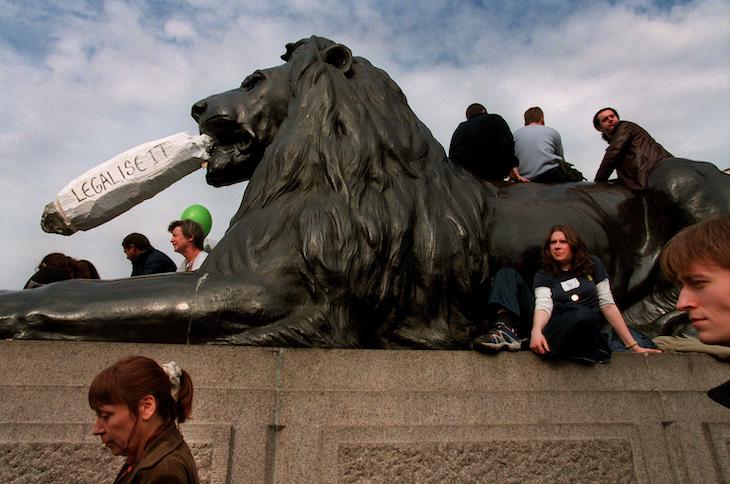
Yesterday, Zack Polanski told Sky News that ‘the war on drugs has clearly failed over and over again. In fact we have the highest drug deaths in Europe and for the past 14 years every single year drug deaths have increased.’ He made these two claims in response to criticism that his party has received for its policy on illegal drugs, which is, according to the Greens’ website, to ‘end prohibition and replace it with a system of legal regulation’.
On the first point, other countries in Europe have higher death rates. In 2023, England and Wales saw 93 deaths per million people overall, compared with 135 per million 15- to 64-year-olds in Estonia, 130 per million in Latvia and 94 per million in Norway. Although caution must be applied when comparing international statistics (as drug deaths are recorded and presented differently by different jurisdictions) it is accurate to say that England and Wales has one of the highest rates in Europe, or in western Europe – which is the formulation that most official sources use when contextualising the problem.
On Polanski’s second claim, that drug deaths have increased every single year over the past 14 years, the data does support his claim. Shockingly, drug poisoning deaths in England and Wales have more than doubled since 2010 and risen every year since 2012. Of course this evidence does not prove Polanski’s overall thesis that we are being too heavy handed in the war on drugs. Many metrics show enforcement falling over this time. As an example, the number of people sentenced for possessing a controlled drug fell by almost half between 2012 and 2018. The number of people arrested for cultivating cannabis also fell by over two thirds in this time.
As bad as things are in England and Wales, they are worse in Scotland. In Scotland, in 2024, there were 191 drug misuse deaths per million people, in England and Wales in the same year, the rate of drug poisoning deaths was 93.9 per million. Scotland has been attempting various harm reduction strategies for decades. In 2018, the Scottish government set out their strategy to create a ‘Human Rights-based, person-centred response to individuals and families experiencing alcohol and drug related harm’, and promised to take ‘vulnerable people out of the justice system’, calling for a ‘public health approach to justice’.
The public sector social justice phraseology in the Scottish system is reminiscent of the Green party’s official drugs policy, which calls for drug use to be ‘treated as a health and social issue rather than a criminal one’, and calls for of people caught with drugs to have access to support services, rather than be given criminal records.
Polanski presents the status quo from which he is attempting to break as being authoritarian and repressive. But his policy is really a doubling down on progressive drug policy, replacing wink wink decriminalisation with explicit legalisation. In his view, drugs should be available for consumers to buy in shops, instead of on the black market.
If the record for tacit legalisation is bad, the record for full legalisation is even worse. Across the United States, where the phrase ‘war on drugs’ originates, different states have taken a much more liberal approach to drugs in the past two decades, with around half of US states legalising cannabis and many progressive cities experimenting with open injection sites and other ‘harm reduction’ strategies. It is in San Francisco where this experiment was taken to its logical conclusion with disastrous results. Some 635 people died in San Francisco from unintentional drug overdoses in 2024, and areas like the Tenderloin became open-air drug markets. San Francisco is slowly turning the corner thanks to the efforts of the new mayor, Daniel Lurie, who has managed to reduce overdose deaths significantly by introducing new legislation to enable police officers to arrest those using drugs in public.
We are very fortunate that, whatever our own problems with rough sleeping, there is no British equivalent to Skid Row in Los Angeles. We should learn from the American experience and cast a very sceptical eye towards politicians who promise that the problem with drug addiction is that we have not been indulgent enough towards abusers.






Comments