
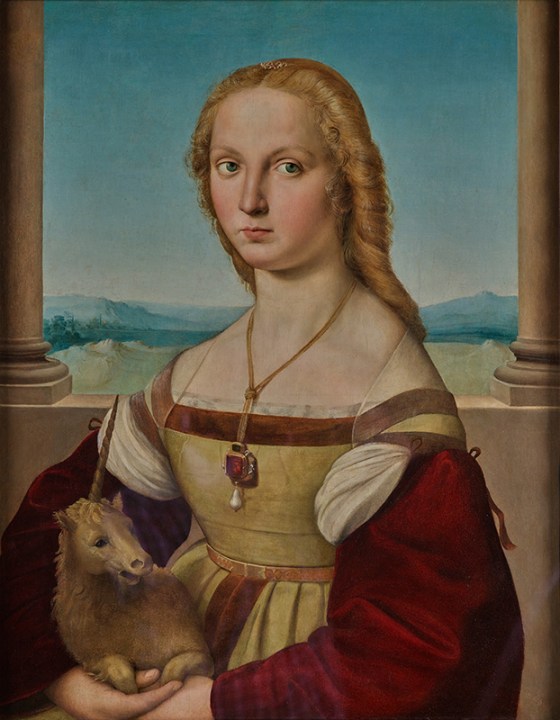
There can be resistance to Raphael. A bit unfair, really. Just as Renoir is considered the soft-edged Impressionist, Raphael (1483-1520), indisputably one of the three great artists of the Renaissance, is often eclipsed by his near contemporaries, Leonardo and Michelangelo. Is it because his works are just too beautiful, too ethereal, too perfect?
This view is a relatively new phenomenon. In the 19th century, Raphael had pole position because his paintings were so otherworldly. His romance with La Fornarina (the baker’s daughter, sitter for one of Raphael’s greatest portraits) only boosted his reputation further.
However, it turns out the 21st century is more inured to love’s dream. We prefer artists to be tortured souls. Raphael didn’t have the stroppy, anguished grit of Michelangelo, nor the polymathic genius of Leonardo. He was the nice guy you’d want to have round to dinner.
Carmen Bambach, the curator of Raphael: Sublime Poetry at The Metropolitan Museum of Art thinks this view sells Raphael short. She should know. Bambach has spent seven years gathering more than 200 works, making it the first comprehensive, international loan exhibition of the artist’s work in the US.
Raphael’s assimilation of classical harmony and perfect proportion is a thread that runs throughout this chronological show which follows the artist’s career from his birthplace Urbino to Rome, where he died aged only 37. Bambach presents a nuanced view of the artist. She has looked at Raphael’s paintings and beyond to include drawings – preparatory sketches and designs – and tapestries. After all, this is the curator who has a track record of finding insights into an artist’s work from underexplored, undervalued angles. In 2017, she curated Michelangelo: Divine Draftsman and Designer, a similarly groundbreaking exhibition at The Met, reinterpreting the artist’s career solely through his drawings. As a result of curating Sublime Poetry, Bambach says, “I am awed by Raphael’s originality and inexhaustible imagination as an inventor of figural compositions. His paintings show that he was a visual storyteller of tremendous eloquence, always depicting the actions of his figures just at the moment of climax of the story to create maximum visual drama.”
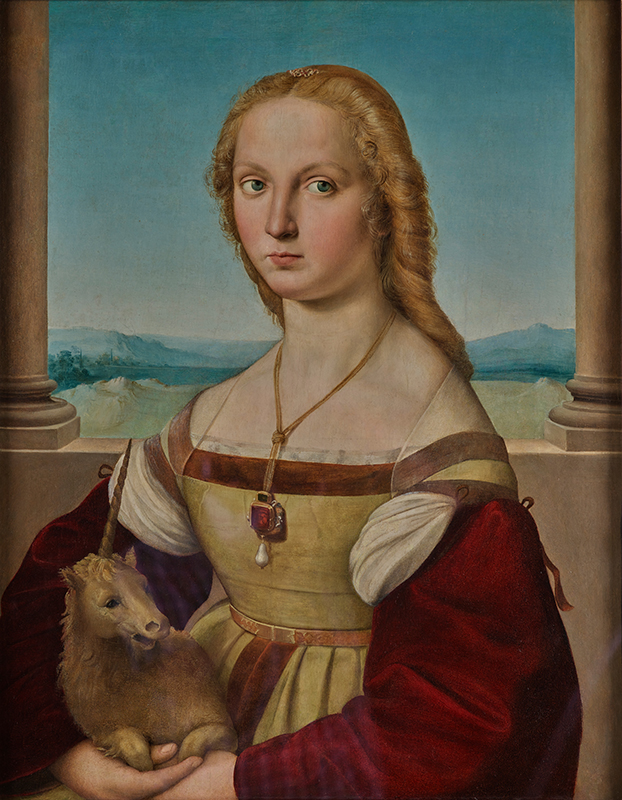
With Raphael, Bambach has embraced the notion of the tenderness and emotional depth of his work, but with the help of loans from European collections, she also aims to show his underlying intellectual strength and breadth. This was, after all, a man who was so passionate about classical architecture that in 1515, Pope Leo X appointed the artist as the commissioner of antiquities in Rome, his role being to preserve and study classical sculpture and ruins – sources that Raphael continually drew upon for inspiration. Sharp-eyed viewers can see details such as Mary’s blue leather sandal in his late masterpiece “The Virgin and Child with Infant Saint John the Baptist in a Landscape (The Alba Madonna),” the design of which has clearly been lifted from a sculpture of a goddess. Although this work has traveled a comparatively short distance from Washington, DC, one of the joys of this exhibition is that it will be reunited with the preparatory sketches from the Museum of Fine Arts, Lille. For all the astonishing portraits and altarpieces that have made the journey across the Atlantic – “Portrait of Young Woman with Unicorn” from the Borghese Gallery being just one – don’t be surprised if it’s the intense immediacy of Raphael’s drawings that skewer your heart.
It’s a landmark show. And given the fragile nature of the works, it won’t be showing again.
Raphael: Sublime Poetry is at The Metropolitan Museum of Art from March 29 until June 28, 2026





Comments