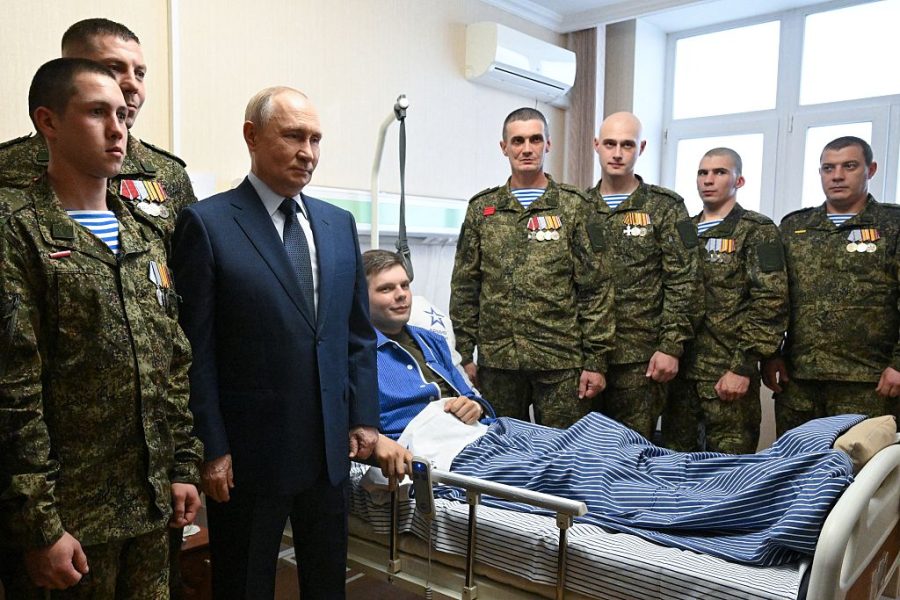
Despite the Kremlin’s insistence that its war machine remains robust, recruitment figures into the Russian army tell a different story. Moscow is planning to lock in 409,000 new contracts this year – roughly 1,100 recruits a day. However, according to the government initiative Хочу Жить – ‘I want to live’ – which helps Russian servicemen voluntarily surrender to the Ukrainian Armed Forces, between January and March the average number of contracts signed was approximately 940 per day. It appears that even in Russia’s poorest Eastern regions where military service has long functioned as a form of economic survival, increasingly lavish signing bonuses are no longer enough.
This matters because Russia’s losses are staggering. According to Ukrainian president Volodymyr Zelensky, in March alone, more than 35,000 troops were killed or wounded. And while the overall size of Russian forces in Ukraine has continued to grow (as of February, the Ukrainian military believes it to stand at approximately 712,000 personnel, including the operational reserve), this has been sustained only by draining strategic reserves – not by a healthy flow of new volunteers. Russia’s reliance on attritional ‘meat grinder’ tactics is starting to take its toll.
The strain is showing elsewhere. Regional governments, facing a combined budget deficit running into billions, have begun cutting enlistment and compensation payments. Cash bonuses paid upon signing a contract, as well as the amounts paid to families of the deceased, vary by region. For example, in the Kemerovo region, payments to family members of servicemen who die during Vladimir Putin’s so-called ‘special military operation’ were reduced from 3 million (£29,500) to 1 million roubles (£9,800) in February. Meanwhile, in Ufa, the Republic of Bashkortostan’s capital, signing-on payments to contract soldiers from the municipal budget were reduced from 700,000 (£6,900) to 300,000 roubles (£3,000) in January.
This is not a sign of strength
In response to the drop in recruits, the Kremlin is reverting to more coercive methods: pressuring businesses to supply men, targeting prisoners and debtors, and, of course, illegally expanding mobilisation in occupied Ukrainian territories. In the Russian region of Ryazan, for example, businesses have now effectively become conscription offices, required to deliver a quota of men to the front.
A decree issued by the region’s governor in March established a quota of two people for companies with a workforce of 150 to 300 employees. For companies with a workforce of 300 to 500 employees, the quota is three people; for businesses with more than 500 employees, it is five people. The governor is in charge of enforcing compliance with the decree.
The same pressure is now being felt in Russia’s universities. They are reportedly now required to ensure that around 2 per cent of their students join the army. And this is just part of a wider system: similar targets are also set for regions, state institutions and enterprises. It is likely that each organisation must meet its own ‘quota’ for recruiting new troops.

The authorities in Russia’s Khabarovsk Krai have, for example, sent out guidelines to educational institutions on how to carry out outreach work. It is known that similar events are taking place across the country: at least 90 have held in-person recruitment events with students. Particular attention is being paid to those in debt, whom the authorities are trying to persuade to sign contracts with the Ministry of Defence in order to ‘defend the motherland’.
In addition, students are subjected to psychological pressure: propaganda videos are shown and so-called ‘informal’ discussions are held. At the Novosibirsk College of Transport Technologies, the principal publicly called the students cowards for refusing to sign military contracts. After one of the students released an audio recording of this conversation, the situation gained widespread attention and escalated into a scandal.
The Kremlin has so far avoided a repeat of its chaotic partial mobilisation order in 2022 that sent hundreds of thousands fleeing abroad. But the turn back towards students suggests more coercive methods for recruiting are quietly returning.
This is not a sign of strength. It is a sign that state propaganda is losing its influence over the population.
Russia’s heavy frontline losses stem from its infiltration tactics using small groups, which, while allowing the Kremlin to advance gradually, are extremely costly. Ukraine’s effective use of FPV drones has transformed the entire grey zone along the front line into a deadly network of ‘kill zones’. This means that the cost of even minor successes is rising sharply.
To compensate for the losses, the Kremlin is broadening its search: recruiting into the army or luring tens of thousands of foreign citizens – particularly from Cuba and Nepal, alongside African and Asian countries – with false promises of jobs in Russia. They may be sustaining the war effort in the short term, but they are further eroding the long-term viability of Russia’s forces.
Official Ukrainian figures suggest the Russian army lost as many as 120 soldiers per square kilometre captured last year, whilst on the main thrust – the Pokrovsk sector of the front – Russian losses may have reached as high as 160 soldiers per square kilometre. This year, with the increased use of drones by the Ukrainian Defence Forces, each square kilometre occupied in the Donetsk region is estimated to ‘cost’ Russia 316 killed and wounded.
Meanwhile, Ukrainian strikes on logistics, artillery and air defences are slowing Russia’s advance. In the first three months of this year, territorial gains have already fallen to roughly half of last year’s pace. Moscow is being forced into difficult trade-offs. Through the rapid loss of experienced and trained personnel, the ban on soldiers surrendering, conscripting the sick and maimed, and often leaving the wounded to die without assistance, Russian troops are reducing the effectiveness of their own offensive and the quality of assault operations. If Ukraine can maintain this momentum for long enough, Russia may gradually lose its ability to conduct active offensive operations.
For Britain and its allies, this is the strategic window. Continued military support to Ukraine is not simply an act of solidarity; it is a means of accelerating structural weaknesses already visible within the Russian system. The longer Ukraine can hold the line – and impose costs – the more Moscow is forced into ever harsher, more desperate forms of mobilisation at home. As history suggests, the political cost to the Kremlin would be high.



Comments