
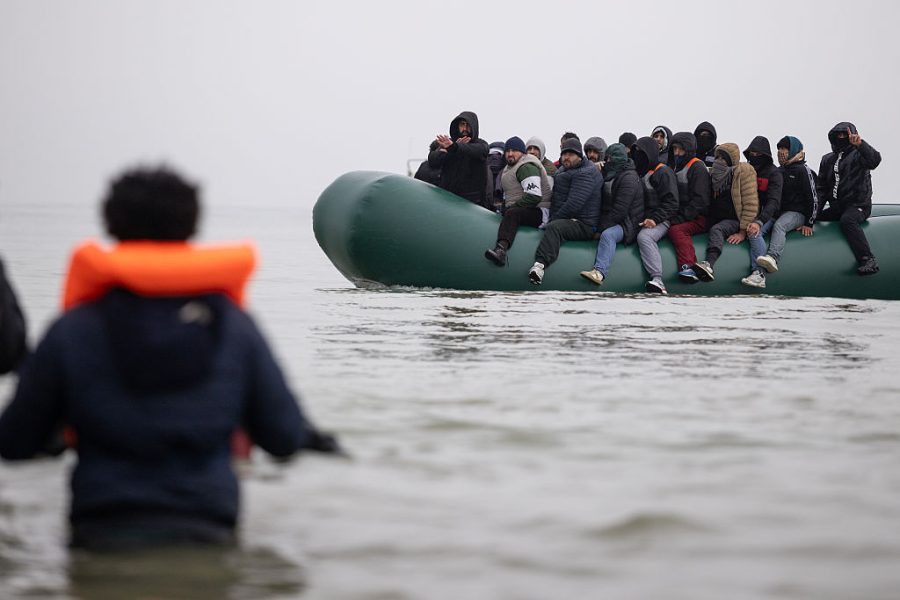
Belgium is becoming the new point of departure for the gangs who traffic migrants across the Channel to England. It is reported that small boats are being launched from the Belgian coast, which then sail west to France, collecting migrants as if they were passengers waiting for a bus.
The Belgian towns of Middelkerke, Nieuwpoort, De Haan and De Panne have all been identified as launch sites for migrant boats. According to Frontex, Europe’s border security agency, they began noticing a change in the smugglers’ tactics at the start of this year.
Last year, there were no recorded cases of small boats setting out from the Belgian coast but in the first two months of this year, five vessels were detected. The route is far more perilous, being twice the distance of the 20 miles that separate England from Calais. The powerful offshore currents between Belgium and England add to the danger. A spokesman from Frontex told the Times:
People smugglers are diverse in their origins but they all share a fierce determination
Available information suggests that these movements are not isolated. In some cases, boats may operate across maritime zones, including entering French territorial waters.
Last week a Belgian border patrol vessel tracked a small boat from a beach near Nieuwpoort to Dunkirk in France, a distance of 20 miles.
Britain and France are discussing an extension to the three-year small boats treaty signed in 2023 that expired at the end of March. Home Secretary Shabana Mahmood has agreed a two-month extension to the £475 million deal but it is reported that she is pressurising France to do more to reduce the tens of thousands of migrants who have reached Britain in the last two years.

Britain wants France to allow its vessels to intercept small boats before they reach UK waters and return those on board to France. The French police have long been accused by some British politicians and journalists of not doing enough to stop the small boats. It is facile criticism.
The police are confronted with well-organised gangs, who operate along a 150-mile stretch of coastline, from Ouistreham in the west to Dunkirk in the east. In recent years, some migrants have become increasingly violent towards the police, probably encouraged by the gangs, who are up to speed on the human rights constraints placed on the police by some politicians, newspapers and human rights groups.
Nonetheless, the police have scored some notable successes against the gangs. Last month, police in France, working with their counterparts in several other European countries, dismantled a network that had supplied boats to the smugglers.
Twenty-one people were arrested, part of an organisation that had imported nautical equipment from Asia to Turkey and then into Germany. The equipment was then sold to the gangs in France for €10,000 (£8,700); for this sum they received a boat and inner tubes – used as life preservers by the migrants, an engine, pumps and a quantity of gasoline. The four ringleaders of the network were Syrians.
A similar network was uncovered in 2024 and 19 people are awaiting sentencing in France for their involvement in importing boats and equipment to Europe. Most of the defendants come from Iraq, but Turks and Syrians are also among the accused.
At the start of this week, prosecutors in Boulogne-sur-Mer and Lille issued a joint statement saying that 15 people had been charged with people smuggling. The accused are suspected of belonging to a gang that trafficked migrants from the Horn of Africa to Britain. The statement explained that the investigations ‘have revealed the involvement of organised criminal networks, composed of Eritreans and Ethiopians, operating illegal crossings of the Channel in inflatable boats since 2024’.
People smugglers are diverse in their origins but they all share a fierce determination. Trafficking humans pays well. Europe will only smash the gangs if it shows the same determination.






Comments