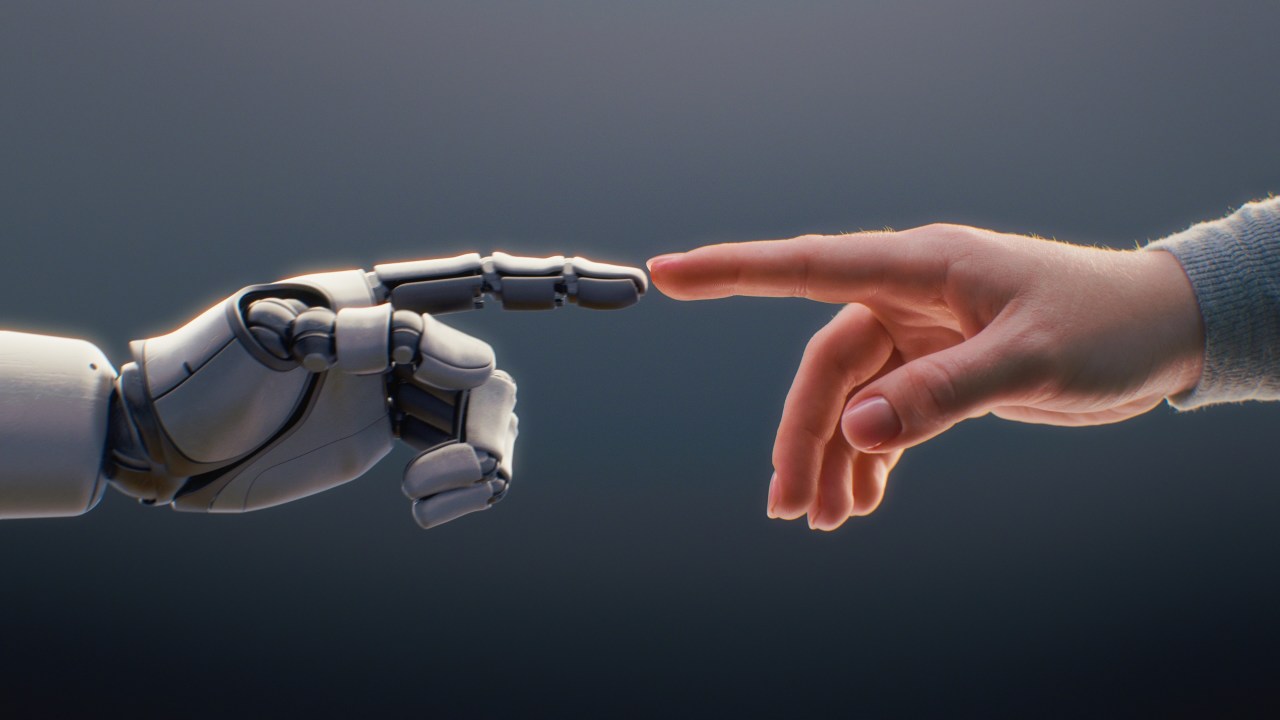
AI is set to take over all cognitive tasks in the next few years. Your hard-won career as a paralegal, data analyst, radiologist, coder or novelist is about to be hacked out from under you. So far, so apocalyptic. But what about the jobs that are primarily embodied? Sous-chef, rehabilitation nurse, plumber, dog-trainer? These are expected to lag behind, awaiting the next generation of robots. But there is an important further question. Who will train these robots? Answer: you will.
This is the concept of the arm farm. On an arm farm, practitioners of the aforementioned jobs – chefs, nurses, plumbers etc. – wear Go-pro helmets, pressure-sensitive gloves, even full motion-capture rigs, and do the jobs that the robots will ultimately usurp. Somatic data flows from the sensors: information on force and precision, timing variables, optimal trajectories. Over many thousands of iterations a profile accumulates, amounting to the ideal way to, say, make an omelet. Here we are not just talking spatula proficiency. We’re talking pan-time relative to heat, browning metric, wrist action (tossing, beating) and toaster multitasking. This is the final frontier: handling irregular, deformable materials (otherwise known as food).
The human traitors paid for this work are called (by the colleagues who would probably do it too if they were offered it) “coffin makers.” Because the occupational know-how the traitors divulge ensure that those jobs are dead and buried, never to be performed by a human again.
And of course it’s already here. Objectways is a company based in the USA and India that captures data from human workers to train robots. Its aim is “to blend advanced technology with human-in-the-loop expertise to deliver secure, high-quality AI data solutions.” What this amounts to is that a young woman in Chennai stands before a work station. She has a camera strapped to her forehead. Her job is to fold the same towel a thousand times. The towel must be retrieved from a pile to her left, placed on the work surface, smoothed down, folded once along the x axis, once along the y, and then placed on a pile to her right. The video data is then post-processed and sent to the AI, which learns how humans fold towels.
The human traitors paid for this work are called ‘coffin makers’
Tech giants Boston Dynamics, Nvidia and Tesla are watching, of course. At the moment their robots are rubbish at almost everything except dancing to Motown hits. But when there is a market worth trillions of dollars in the offing, you can bet they are investing heavily. After all, if they don’t, others will.
Ali Ansari, founder of San Francisco-based Micro1, says robotics data collection increasingly focuses on remote operations. Humans in haptic suits make the robot do something like making tea. The AI is fed data from failed attempts at doing this and learns, eventually, to achieve it. It may also, in future, need to partner with the junior doctor who is increasingly unable to understand burns. “I believe that we will have systems that are smarter than all humans combined, eventually,” says Ansari. “That, however, does not mean humans will become less important.” Sometimes, of course, the robots lie on the floor and convulse. It’s a good idea to get as far away as possible from them when they do this.
Brett Adcock is the founder of Figure AI. “Figure was founded with the ambition to change the world,” he says. “We envision a future where humanoid robots are the universal interface in the physical world… Longer term, humanoids will play an important role in many areas such as assisting individuals in the home, caring for the elderly, and building new worlds on other planets.” Figure is in the process of capturing real-world data from inside thousands of American homes, observing human movement to teach robots to negotiate the domestic arena.
In earlier industrial upsets, workers moved on to other jobs. For example, Silas Marner, once a weaver, could retrain as a leech-gatherer. Now, with arm farms in the mix, all possible physically-encoded knowledge is extracted, digitized and centralized. In practical terms it means you might never have to gather a leech again. Workers, having given away the last thing they could possibly have bargained with, are rendered cognitively and somatically pointless. They have been paid to eliminate their own livelihoods. There are no hobbies they can undertake, since the robots can write an opera or drink themselves to death far better than a human being ever could.
Not everyone thinks this way, naturally. Many hypothesize that people will be freed from tedious labor, find more time to spend with their families, and eventually have more opportunities to wake up at 4am to see an advanced robotic valet standing next to their bed holding a cordless drill. But who owns the data generated by the arm farms? This big-picture question has a bigger picture answer: Sam, Elon, Dario, Sundar and Demis. In the near term, arm farms expand and then disappear. The better the models get, the less new human data is needed.
What about the remote future (three to six years)? Many human beings complain that their sexual partners are unable to touch them in a satisfying manner. Here’s where the arm farm becomes uniquely personalized. Strap on your Go-pro and your pressure-sensitive glove. Generate data. It turns out that some of the skills for making an omelet are quite transferable. Handling irregular, deformable materials. Grip nuance. Finger tracking. Tool haptics. Tension or resistance intensification. Rhythm, crescendo, pan-toss. Now pass this data on to your humanoid operative, perhaps working remotely from Guangdong.
Finally, having trained AIs on the best way to fold towels, make tea, sauté onions and indeed ourselves, we will be left with the one question that cannot be outsourced: deciding whether any of this was a good idea in the first place.



Comments