
Javokhir Sindarov from Uzbekistan has dominated the first half of the Candidates Tournament in Cyprus, with an astonishing start of six points from the first seven games. That puts the 20-year-old 1.5 points clear of his closest pursuer Fabiano Caruana, and makes him a huge favourite. The tournament winner earns the right to challenge for the world championship title.
Hikaru Nakamura, one of the pre-tournament favourites, is all but out of the race after starting with just 2.5/7. Against Sindarov, he chose an ambitious sacrifice of two pawns in the opening, reaching a situation where the bishop pair – especially the one on d6 – are known to offer good long-term prospects. But the position remains double-edged, and after a dozen quick-fire moves, Sindarov had just played 12…O-O, a move that Nakamura had failed to anticipate in his pre-game preparation.
For a tournament like the Candidates, all participants enlist the help of other top players to analyse the openings they intend to play. Those analysts use chess engines extensively, such as the famous Stockfish, but they must also use their judgement to guess which moves are most likely to wrong-foot a human opponent.
Nakamura was almost certainly well-prepared for 12…e5 and 12…Nf5, which have both been played several times. But rather than just ‘reviewing the literature’, top level opening analysis should anticipate plausible alternatives. Sindarov’s 12…O-O is natural and hardly inferior, so it needed to be investigated. As it was, Nakamura was left unarmed in a wildly complicated position. After the game he condemned his analysts for their omission, though it must be said that chance plays an important role. Experienced players know that there are gaps in any opening repertoire, but they cross their fingers that opponents will not stumble upon them!
Hikaru Nakamura-Javokhir Sindarov
Fide Candidates Tournament, April 2026
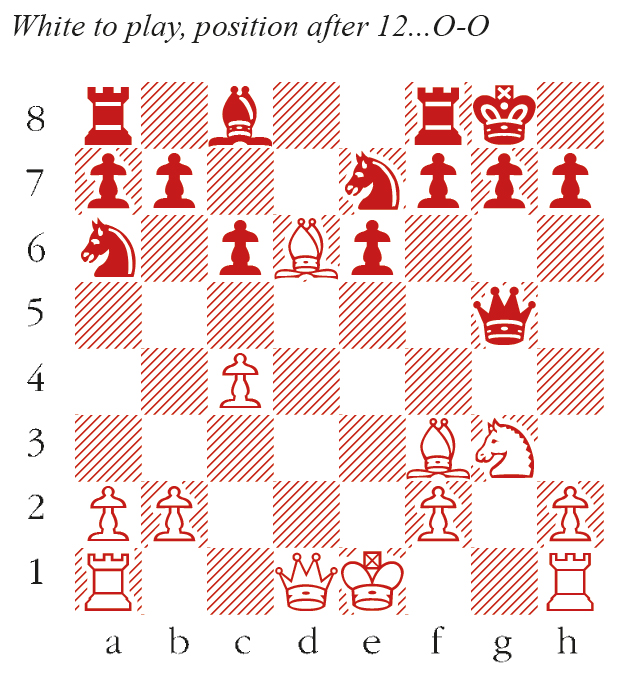
1 d4 d5 2 c4 e6 3 Nc3 c6 4 e4 dxe4 5 Nxe4 Bb4+ 6 Bd2 Qxd4 7 Bxb4 Qxe4+ 8 Be2 Na6 9 Bd6 Qxg2 10 Bf3 Qg5 11 Ne2 Ne7 12 Ng3 O-O (see diagram) 13 h4 Nakamura spent more than an hour deciding between this move and 13 Ng3-e4, and it seems he chose the wrong one. Without the computer’s assistance, it is extremely hard to anticipate that 13 Ne4 Qa5+ 14 b4 Nxb4 15 O-O is promising, despite the three pawn deficit. Qa5+ 14 b4 Nxb4 15 O-O Re8 16 Qd2 The most natural follow-up, but the quirky 16 Qe1! was stronger, because after 16…c5 17 Rd1, the freeing move Ne7-f5 is unavailable. c5 17 Rad1 Nf5! 18 Nxf5 exf5 19 Qf4 Nc6 20 Kh1 It seems that 20 Kh2! Nd4 21 Rxd4 cxd4 22 Rg1 still offers reasonable compensation, as the White pieces are so active, and the king on h2 instead of h1 ensures that 22…Re1 could be met by 23 Rxg7+! with a draw by perpetual check. Nd4 21 Rg1 g6 22 Bd5 Be6 Sindarov begins a series of exchanges in order to realise his three pawn advantage. 23 Bxb7 Ne2 24 Qd2 Qxd2 25 Rxd2 Nxg1 26 Bxa8 Rxa8 27 Kxg1 Rd8 28 Bf4 Rxd2 29 Bxd2 Bxc4 30 Be3 Bxa2 31 Bxc5 a5 The opposite coloured bishops offer Nakamura no respite here. 32 f4 f6 33 Kf2 Kf7 34 Ba3 Ke6 35 Bf8 a4 36 Ke3 Kf7 37 Bb4 h6 38 Kf2 g5 39 Kg3 Bd5 40 Ba3 Be4 41 Bc1 gxh4+ White resigns, as Black’s king will shepherd the a-pawnwhile White’s king is distracted by the h-pawn.






Comments