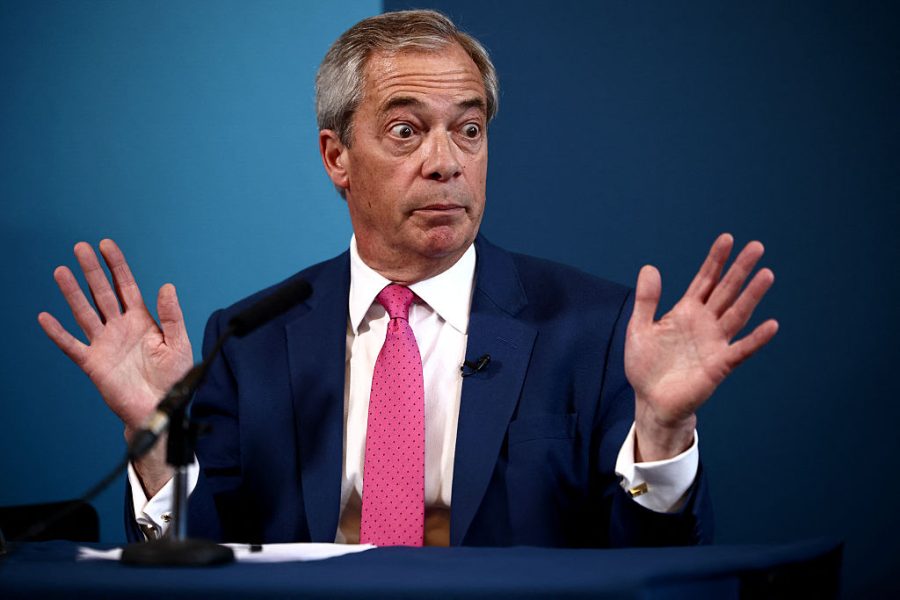
Nigel Farage, who celebrates his 62nd birthday today, has spent the best part of three decades positioning himself as the outsider who might one day break down the door of No. 10. It’s been a remarkable run and he can now declare, with an entirely straight face, that he is the most influential British politician of the 21st century.
Since becoming Ukip chairman in 1998, Farage has impacted the political establishment, public opinion and the media in seismic, weather-making ways. That he has done all this without getting close to actual power is, perhaps, the greatest post-war demonstration of effective (but not necessarily truth-based) political campaigning and communications.
It is also testament to Farage’s ability to scare the living daylights out of successive Tory leaders, forcing them into making fatal mistakes. And now this son of a stockbroker and Dulwich College old boy has Labour on the run with his faux man-of-the-people routine. In truth you couldn’t make Farage up. And that’s because he did it for us.
British politics is littered with figures who fell foul of over-familiarity
Now, with a prime minister whose days are numbered, a diminished opposition and some defection wind in the sails, HMS Nige should surely cruise effortlessly into office. Were the election to be called this side of the summer recess, I suspect that’s exactly what would happen. At the very least Farage would be PM in a messy (and temporary) coalition government. But he would have made it, and his photograph would take its place on the No. 10 staircase alongside Blair, Thatcher and Churchill.
But the election won’t be happening anytime soon even if, as is likely, Sir Keir Starmer is ousted prematurely. Which means that by the time Farage is poised for glory, he will be as familiar as a battered armchair and even further removed from the energetic changemaker that election success usually requires.
In Farage’s breakthrough year, Taylor Swift was nine years old. The highest-grossing movie that year was Titanic and one of the most watched TV shows was the final episode of Seinfeld. Which should be of particular interest to the Reform leader as he ponders the next stage of his campaign.
In the world of entertainment there’s a theory known as the ‘Seinfeld effect’. A phenomenon where a work that was once pioneering and revolutionary eventually becomes cliché and entirely predictable. Seinfeld broke all the rules of the traditional sitcom with its ‘no hugging, no learning’ rule, intricate plotting and observational humour. But it was so widely copied by, among others, Friends that any new viewer landing on it today is likely to think ‘I’ve seen all this before.’
Like Seinfeld, Nigel’s routine in 2026 offers no surprises. He may have been an anti-establishment original but now, in the words of Jerry Seinfeld himself, he’s more ‘yada, yada, yada’ … leaving his brand facing the ultimate campaigning threat – boredom.
Business, as well as entertainment, also offers some warnings. In 1998, Woolworths was pulling in millions of shoppers every week and achieving record profits. A pioneering home-of-the-bargain staple for a century, it failed to reinvent itself, and by 2009 it was done for.
British politics is also littered with figures who thrived on the frontline but who fell foul of over-familiarity. Neil Kinnock spent nine years dominating Labour’s internal battles, shaping the party and defining the opposition. By the time he reached the threshold of power, the country had moved on.
Across the Atlantic, John McCain built a formidable reputation over decades in the Senate: independent, combative, respected. But when the presidential moment came, he looked more like a veteran of past fights than the answer to a future one.
European figures such as Geert Wilders have ridden waves of insurgent popularity only to discover that prolonged exposure without delivery erodes credibility when it matters most. The outsider becomes just a bit predictable; the disruptor, just a bit too domesticated. The lesson is not that experience is a liability. It’s that long exposure without executive evidence creates a problem that tends to get bigger over time.
So, how does Farage reinvent? The defections of Robert Jenrick, Suella Braverman and Nadhim Zahawi et al were obvious attempts at a freshening up by association. I’m not sure that worked and I’d put some money on the fact Jenrick, in particular, is rather banking on the idea of Farage fatigue becoming fixed. But the branding of the senior team as an unofficial shadow cabinet was clever and an indication that Reform are aware of the dangers of staleness.
Farage’s best opportunity for renewal lies in his biggest area of risk: the economy. As we get closer to an election where many see him as the frontrunner, he will soon be under new levels of scrutiny.
Convincing us that he is to be trusted with the nation’s finances would be a first for Farage and a rebrand worthy of Madonna. His late conversion to maintaining the pension triple lock – a policy he’s always been against – suggests that others within Reform see the urgent need for a New Nige, especially if they are to increase support among older voters.
Farage has done well presenting himself as the antithesis of the quarter-zip-wearing tech bros who now rule the world – whilst wanting, naturally, to fill his pockets with crypto. But after three decades of same ol’ same ol’, he must – rather like OpenAI – quickly deliver an exciting, compelling upgrade. Fail to do that and Irritant-in-Chief will be his epitaph.



Comments