There was once a time when we were told that migration would make us rich, ensure our pensions were paid and that diversity made us stronger. Those arguments are dying, with the fiscal case demolished by the likes of the Migration Advisory Committee. Even the government’s latest cohesion strategy, ‘Protecting What Matters’, admits that diversity is ‘a problem to be’ approached. And now the Boriswave, the low-paid millions who arrived earlier this decade, are soon to be granted Indefinite Leave to Remain (ILR), giving them access to benefits and housing at taxpayers’ expense forever.
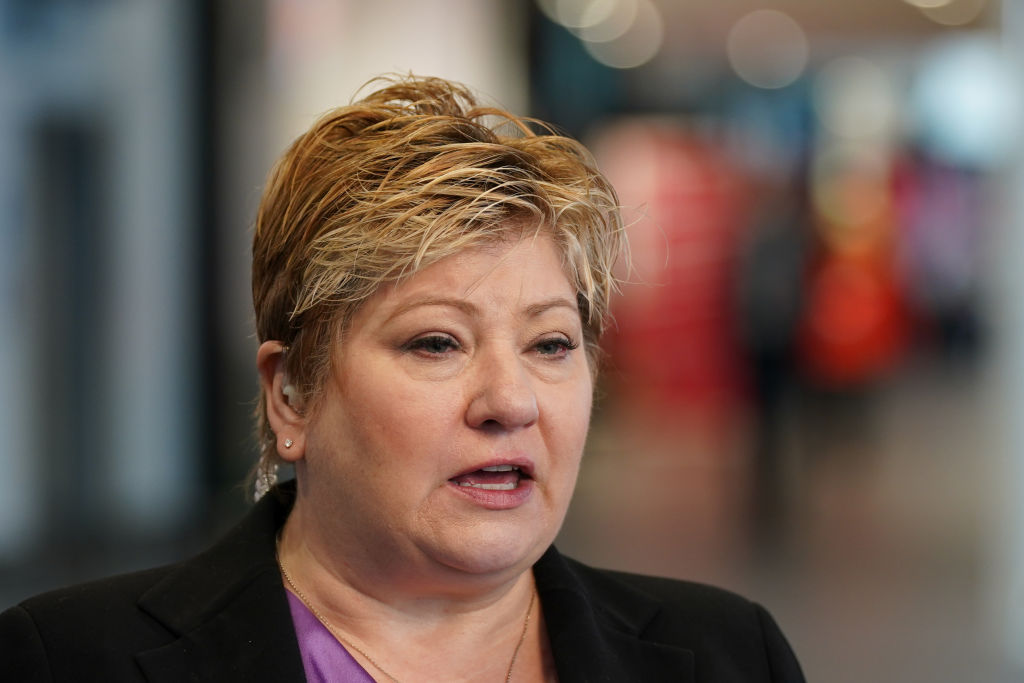
Thornberry has joined the fray, posting a video in which she speaks soft-voiced to camera, complaining that ‘we’ didn’t ‘make the positive case for migration’
This is why the Home Secretary Shabana Mahmood is urgently reforming ILR, and facing mounting opposition from Labour backbenchers. Under her changes, Boriswave arrivals, and others, would have to wait ten years for ILR, not five as is currently the case, and settlement will have to be earned.
Labour leadership hopeful Angela Rayner has described the reforms as ‘un-British’, and over 100 Labour MPs have signed a letter to the Home Secretary saying the proposals are unacceptable. On Monday, Emily Thornberry joined the fray, posting a video in which she speaks soft-voiced to camera, complaining that ‘we’ didn’t ‘make the positive case for migration’, and that Mahmood’s earned settlement model will be ‘cruel’.
Unfortunately for the Labour left and the open borders movement, Thornberry rather gave the game away, noting that ‘half of all migrant children currently live in poverty’ (relative poverty of course, not the real kind), and arguing that this is a reason we should give their parents ILR (and access to benefits) sooner. To make these claims she seems to be relying on an IPPR report published last March which states that of the ‘4.3 million children’ who ‘live in relative poverty’, ‘children from migrant families’ are ‘disproportionately impacted’ and ‘make up around a third of children in destitution’.
Half of all migrant children currently live in poverty – an already shameful statistic.
— Emily Thornberry (@EmilyThornberry) March 30, 2026
But the Earned Settlement model will see that poverty prolonged for 90,000 children in working migrant families.
That's why my community says the Government must think again. pic.twitter.com/S3lLioznr7
The IPPR define a ‘migrant family’ as one ‘where the parents are in the immigration system or are otherwise not born in the UK’. Their research shows that 45 per cent of children in migrant families are in poverty, compared to 25 per cent of other children. According to the IPPR, one of the major causes of this is migrants’ low wages. They’re not wrong. The average salary of migrants entering the UK collapsed during the Boriswave, with nearly 900,000 recent migrants now earning less than the median wage.
Stripped of the soft, emotive language, what Thornberry and the IPPR are admitting is that the Boriswave is made up primarily of low-earners, who will never be a fiscal benefit to the country. What we have done is import millions of people who, rather than paying our pensions, will always be a cost to the state. Now you, or I, or the Home Secretary might think that this is an unforced error which must be reversed. Indeed the Prime Minister himself has called the Boriswave ‘a one nation experiment in open borders’.
But the conclusion the IPPR and the Labour left draw is that we should give the Boriswave benefits so they aren’t in poverty anymore. It really is that simple, and that stupid. According to the IPPR, migrants with children shouldn’t be subject to the ‘no recourse to public funds’ rules, should be provided with 30 hours a week of free childcare and be given better housing. Meanwhile they also think asylum seekers, housed, clothed and fed at our expense, should be given a larger cash handout every week. Throughout the report are references to ‘hardship’ and ‘significant difficulties’ faced by migrants, but not a single reference to the impact on the British people of such boundless generosity.
These people are, frankly, either mad, wicked, fools or all three. Thornberry has been arguing that ‘nobody’ working in the care system or as a cleaner ‘should be in [relative] poverty’. If she truly wanted pay in these sectors to rise she would oppose mass migration which suppresses wages. But in the end all these people – the politicians, the think tanks and charities and the open borders activists – would rather see Britain impoverished than ever say ‘sorry, no, it’s time to go home’. It’s astonishing that we ever took the likes of Thornberry, Rayner or the IPPR seriously. It’s even more astonishing that they have decided to make their move just a month before local elections in which Labour are already likely to see their council seats devoured from the right, and just as small boat crossings are set to rise again. We should be grateful, I suppose, that their political instincts are as dreadful as their grasp of economics.





Comments