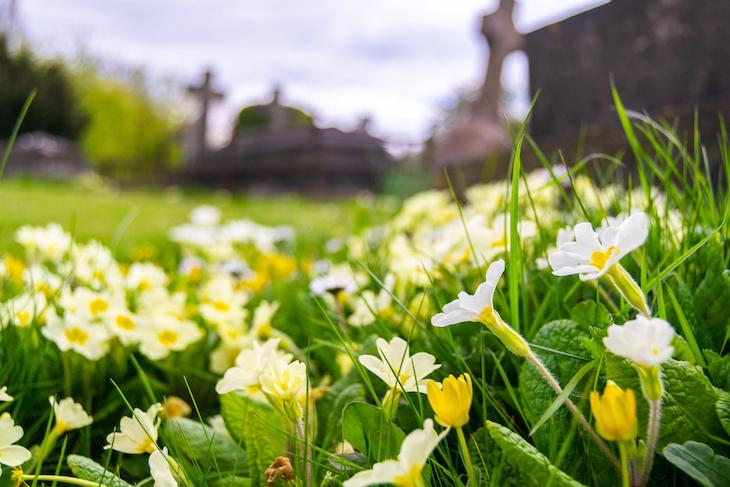
The hawthorn hedges are white with blossom; the countryside looks set for a wedding. Even in the small garden of my hospital, spring is inescapable. Cherry and magnolia bloom. Viburnum scents the air, young leaves come to the trees. Hospitals are where most lives begin, and where many end. Hospices shepherd only a small minority of deaths, about one in twenty, often those of the middle aged whose diseases are more predictable. Frailty is less orderly, and the fitful hazards of age bring many to the general wards where I work. More of us die in hospital than anywhere else.
What sort of spring wakes the hedgerows and the weeds, but not my boy?
In the Emergency Department I met the woman who became my wife. I recall meeting an impressive colleague who made the world feel more open, more various. She remembers meeting a man who persuaded her to order Chinese during a long shift, then, when she was summoned to a cardiac arrest, ate her crispy duck. Later our children were born in the same hospital.
When our son died he was brought to a cubicle in the Emergency Department where, as a young man, I had seen and stitched a hundred people. I saw him for the last time in the mortuary. His fringe, a mild but cheerful adolescent quiff, had been flattened. “But he hated it like that!” his sister cried out in despair. He was a corpse, and our son no longer.
A man, radiant after the birth of his son, was punched without warning by someone in so much pain they found another’s joy unbearable. Pilate released Barabbas and sent Christ to His Cross: the drowned and the saved. Bede said Easter was named for the pagan goddess of spring, of renewal. The Gospels tell us Christ died and rose again during Passover, which was always a spring festival. Winter is gone and a dead world has risen, but not all of what mattered most has returned. What sort of spring wakes the hedgerows and the weeds, but not my boy? In agony, faith fails. ‘My God, my God, why hast thou forsaken me?’

A reader once commented, beneath a piece in which I mentioned my son, that, after the death of his wife, he had slowly come to feel that it was he who had died, and that the world he lived in without her must be hell. His words stay with me. Christ’s cry on the Cross echoed the opening of Psalm 22. ‘Why art thou so far from helping me, and from the words of my roaring?’ If God did not suffer in His Son’s agony, He merits something other than worship.
In a corridor outside the lecture theatres I saw a man, grateful for quiet, sit and weep. A few moments later, doors opened, and out tumbled a hundred students, fresh from being told they had passed their exams, and become doctors. Their voices rang with elation. The sound must have been painful for him, but perhaps it helped. When my son was a baby he gave voice lustily just as I was on the phone to an elderly uncle, commiserating with him on the death of his wife, my aunt. I apologised for my baby’s cries and was shushed, and told the sound of new life brought comfort. The strength and pain of being young can’t come again, yet are for others undiminished.
Strange, to have built a life of memories in hospitals, in surroundings so ugly: scented by decay and long boiled food, packed with suffering, fretted by kindness. Life in hospital infects my thoughts long after shifts have ended, keeping my mind in stale corridors and viewless wards. But the work can also help. We are lost when we aren’t useful, and in times of despair, work is a sea anchor in a storm.
Slightly to my regret, I have grown out of the chocolate eggs I once loved, and which were what Easter meant to me when I was a child. The sun shines, the wards flood with light, the beds are always full of the old and the frail. We don’t get to choose. Whether we welcome it or not, whether we deserve it or not, Easter is here again, and spring with it. Somewhere children are feeling the joy that chocolate eggs once gave me. Good. I have watched a thousand deaths and seen many die content, knowing spring still comes for those they love. Macbeth, in what he knew was his final fight, said that while yet he lived the gashes looked better on others. Life without my son in it makes no sense to me, but the world is full of sons who gladden their fathers’ hearts, and it is good that this is so.



Comments