It’s funny that the George Orwell statue outside the BBC’s Broadcasting House has a quote etched nearby from a proposed preface to Animal Farm: ‘If liberty means anything at all it means the right to tell people what they do not want to hear’. It’s almost ‘Orwellian’ in itself – an act of blackwhite Newspeak – that the BBC, of all institutions, have long touted this as their mantra. In recent years, the British liberal establishment – whose propaganda wing is the BBC – have added laugh-or-you’ll-cry modern examples of doublethink, not least telling us that ‘A woman can have a penis.’ The blood runs cold imagining what Orwell would make of it.
Another both silly and sinister trait of the modern Western authoritarian state is insisting that you find someone funny when they’re totally not. Being an invalid, I listen to the radio a lot, and I’m amused to find that I actively seek out the comedy shows on Radio 4, especially the panel ones. They make me feel smug and superior because – while I’m not going to pretend that I’m part of any contemporary Algonquin Club – my mates and I are funnier over lunch than 99 per cent of professional paid comedians on radio and television are. Why is this?
People generally used to become comedians because they were born funny or learned to be funny, and found that they could make people laugh at an early age; from Dave Allen to John Finnemore, they had a talent to amuse.
A minority became comedians because they were angry – from Lenny Bruce to Bill Hicks – and had a talent to abuse. But the current crop of state-sanctioned comics appear to be neither. It’s a mystery why they chose their profession; a bit like me, an OAP in a wheelchair, having ambitions to be a prima ballerina. Of course, there are exceptions; I was addicted to the excellent Amandaland on BBC One, and it’s telling that literally half of the nominees in the BAFTA Actress in a comedy category are from it.
But generally now, people appear to become comedians because they want to natter, which the Cambridge Dictionary defines as ‘to talk continuously for a long time without any particular purpose’. You’ve heard of the Chattering Classes – modern comics are the Nattering Classes.
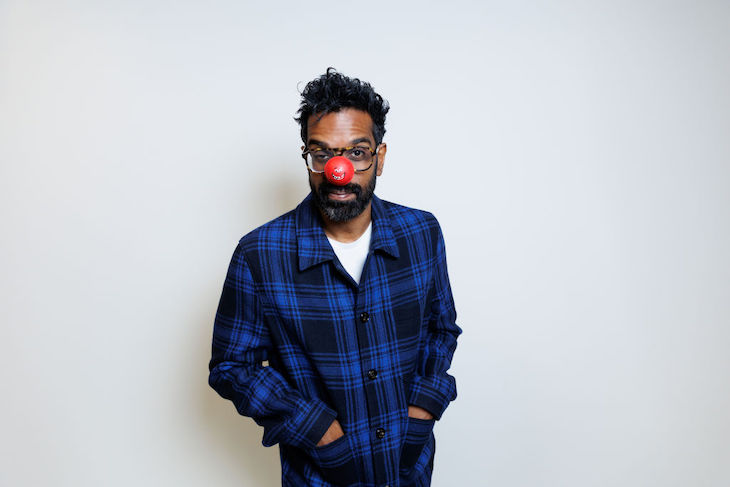
It’s not just a BBC thing though; two of the main culprits are Rob Beckett and Romesh Ranganathan, who have a nomination for their Sky Max show, Rob & Romesh Vs…; they have seemed to be everywhere for a long time now, nattering away and having a ball being paid to hang out with their bestie. But compare them to the great double acts of the past and they fall woefully flat. Radio 4 is full of such natterers; I’m sorry to say that the ladies are well-represented here, by the likes of Zoe Lyons, Shappi Khorsandi and Susan Calman, the latter of whom has such a soporific effect on me that I find myself eschewing the sleeping pills if I can time it to have her on the radio when I want to fall into the arms of Morpheus. What these broads don’t provide in laughs, they make up for in giving fuel to the old saw that Women Can’t Be Funny, possessing as they do the dynamism and provocation of a trio of twice-used tea-bags.
Most of the over-promoted drolls are male, on both radio and television. It’s lovely to see them fail
But, of course, most of the over-promoted drolls are male, on both radio and television. It’s lovely to see them fail. At least in doing so they give one a chance to have a good old-fashioned chuckle.
When The Mash Report was cancelled in 2021, I laughed at Nish Kumar for the first time, especially when he fumed to the Observer of his heave-ho: ‘It placates the British right. It gives the sharks a bit of blood…a person’s political leanings can have a bearing on what they get to do on television, which is unacceptable.’
I also giggled for the first time at Ranganathan and Frankie Boyle when their dire shows were binned by the BBC; as Patrick West wrote here at the time: ‘Satire should lampoon those who rule. Except BBC satire has for years shirked this duty. It no longer challenges the establishment – in academia, the civil service, the unelected House of Lords, the BBC itself. It’s instead been a staple of BBC satire to punch down, to mock and deride the conservative, middle-class, Brexit-inclined middle-Englander. Audiences have themselves become bored of the BBC’s repetitious, relentless belittling of ordinary Britons at the behest of a smug, self-satisfied elite.’
West goes on to nail Brexit – and the first election of Donald Trump in the USA – as the point where modern comedians basically gave up bothering to work at being amusing. In the grip of the Brexit Derangement Syndrome which affected so many poor souls in show business, they fell instead into public self-soothing by uttering the B-word and receiving the affirming groans from their audience. From there it was the slippery slope that led to the current woeful state of state-sanctioned comedy.
Radio 4 Extra is my escape from Radio 4, when I’ve finally had enough fun looking down on the clowns; it’s where ‘heritage’ comedy shows are given extra enjoyment by being prefaced with the warning that: ‘The following comedy reflects the broadcast standards, language and attitudes of its time.’
I’m looking forward to that time in the future when we are warned the same way before the re-broadcasting of the Nattering Classes’ ghastly output. Will we look back, from a sunlit hinterland when we have come out the other side of The Capture, and laugh at what happened for a few decades to comedy in a country which, ironically, prides itself on its sense of humour? Or will the BBC comedy department continue to see 1984 as a user manual rather than a warning?




Comments