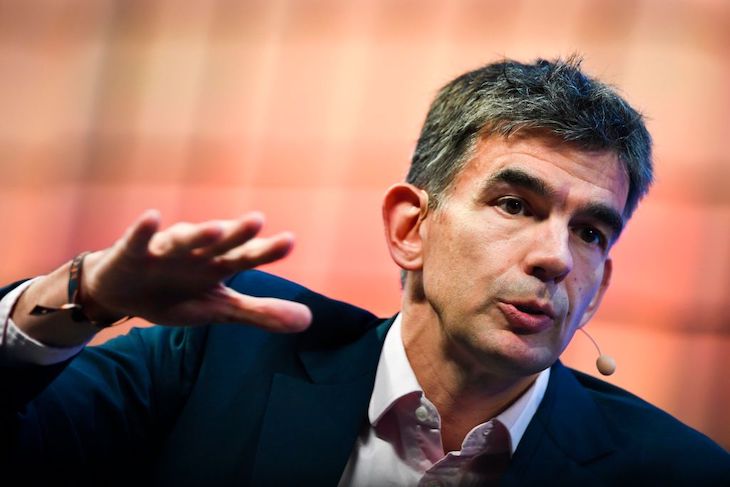
The BBC is in the headlines again – for all the wrong reasons. A TV drama on the fall of Huw Edwards, the corporation’s disgraced former chief news presenter, is due to start tonight. Rather than keep shtum, Edwards has lashed out at Channel 5 for failing to ‘check with me the truth’, thus ensuring even more bad publicity for the BBC. Yet instead of donning sackcloth and ashes in an effort to atone for its many flaws and follies, the BBC is doubling down on its sins by appointing a new director general who offers more of the same. The appointment of ex-Google boss Matt Brittin as Tim Davie’s successor shows that the Beeb is pretending it’s business as usual, when only a radical overhaul can save the Corporation.
Far less attention has been paid to another aspect of Brittin’s glittering career
It’s true that Brittin has an impressive CV. He’s a former Great Britain World Rowing champion. And Brittin worked his way up to become president of Google in Europe, the Middle East and Africa. It is this latter experience at the sharp end of the ongoing technological revolution that is being trumpeted by the Beeb as he takes over from the troubled reign of Davie to steer the Corporation into a shiny new AI-dominated broadcasting era.
Yet far less attention has been paid to another aspect of Brittin’s glittering career: as recently as January 2025 he was appointed non-executive director of the Guardian, house journal of Britain’s bien pensants; and twenty years ago, he was director of strategy and digital at Trinity Mirror, owner of the Daily Mirror, Labour’s chief cheerleader in the popular redtop press.
It’s a rather depressing sign if Brittin is regarded as the BBC’s answer to those critics who accuse it of being institutionally biased. The reality is that it is utterly impossible to imagine the Corporation choosing a chief executive with a background working for, say, the Daily Telegraph or the Sun. Brittin is unlikely to clash much with the other bigwigs at Broadcasting House, given that they are cut from the same cloth.
The trouble is that the dominance of a particular worldview at the BBC inevitably shapes the content that the Corporation puts out And the viewing and listening public has noticed: not only is the number of those paying the hated BBC tax – the licence fee – in steep decline, but according to a poll conducted last year, a majority of people (52 per cent) no longer trust the corporation. Just 28 per cent say they still repose faith in Auntie.
The BBC is thus squeezed in a double bind: it has been abandoned by many of those Brits who vote for right-wing or centre-right parties because too much of its output doesn’t represent them; at the same time, its future is threatened by the inexorable changes in broadcasting habits brought about by technical change. Ever more people – especially those from younger generations – no longer get their news from mainstream broadcast media, and no longer sit down of an evening to watch TV with the family in the traditional way.
The hapless Tim Davie was buried under a slew of scandals during his inglorious stint as DG: there were the appalling social media posts of the grossly overpaid football pundit Gary Lineker; the Gaza documentary narrated by the son of a Hamas official; and the creative “editing” of Donald Trump’s words before the riot at the Capitol that is still the subject of a billion dollar lawsuit by the US president.
But perhaps the most telling and significant scandal was the disgrace of Huw Edwards, the lugubrious Welsh news presenter who fell from grace only a year after solemnly informing the nation that Queen Elizabeth II had died. The fall of Edwards from cherished national icon to shamed sex offender was cushioned by the £200,000 doled out to him by the Corporation that he has yet to repay. The apparent reluctance of the BBC to lose his services was only finally forced on them by the slow grinding millstones of the criminal law.
Edwards will be played in tonight’s drama by Martin Clunes. Screwing his rubbery features into an uncannily lookalike impersonation of gloomy Huw, the star of Doc Martin and Men Behaving Badly plays the role straight. But in truth Edwards’ story is not the stuff of a soap opera: it is an all too appropriate symbol of the decline and fall of a once beloved friend whose time has irretrievably gone. Good luck to Matt Brittin trying to sort out the BBC. He’ll certainly need it.
An earlier version of this article attributed the claim that a majority of the public no longer trust the BBC to research commissioned by the Department for Culture, Media and Sport. In fact, that figure came from a poll conducted by Find Out Now, a member of the British Polling Council





Comments