‘The road was frozen… Komako hitched up the skirt of her kimono and tucked it into her obi [broad sash]. The moon shone like a blade frozen in blue ice.’
When I think of the kimono (literally: ‘a thing to wear’) my thoughts turn to Yukiguni, the 1948 book by Nobel Prize winner Yasunari Kawabata. The novel is set in a city close to Minakami Onsen, a spa town where I used to rent a mountain cabin. For me, Kawabata’s images of kimono-clad women scurrying about in the snow were very real. However, my best memories of kimonos were in the epicentre of the craft, Kyoto, where I would dine with geisha at traditional wooden machiya houses in Gion, Kyoto’s pleasure quarter.

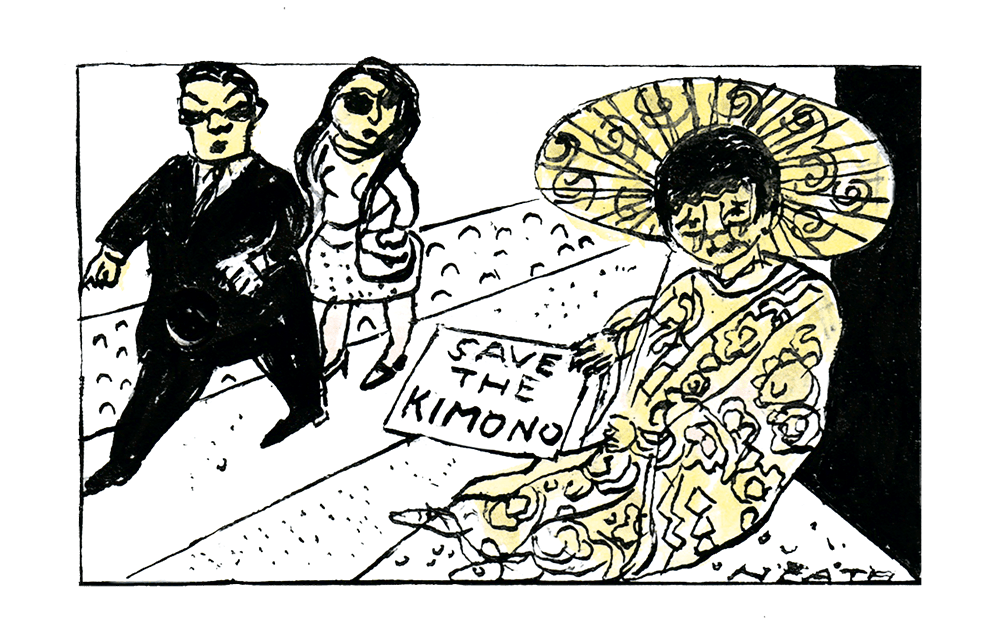
By the 1980s kimonos were a dying fashion. The only people who seemed to wear them were guests at grand weddings at the Imperial Hotel and lift greeters at Japanese companies. As daily wear they disappeared; not surprising given that, if worn properly, it can take an hour to put one on.
The result has been a steady loss of the plethora of crafts that constitute this collaborative art form. From the output of mulberry-leaf-feeding silkworms, weavers in Kyoto produce the jacquard-style narrow bolts which are then cut into eight rectangular pieces and sewn together to produce the kimono’s T shape. Other crafts, to name just a few, include paste-resist dyeing, silk painting, tie-dyeing, gilding and embroidery.
The historic skills of proper kimono making lie with just a handful of craftsmen, now in their dotage. Apprenticeships have almost disappeared. As such, when new kimonos are made, not including the polyester tat for foreign markets, the prices are astronomically high. Handmade designs can cost from £5,000 to £80,000.
Yet out of this bleak landscape for one of Japan’s great arts, the shoots of a revival can be spotted. Perhaps in reaction to the minimalist clothing of designers such as Issey Miyake and Yohji Yamamoto, Japan’s bohemian fashionistas are championing the wearing of kimonos mixed with western clothes. Sheila Cliffe, a British expat, has become a well-known Japanese TV personality for her East-meets-West kimono style. Traditional kimonos and obi, bought for a song in Kyoto, are also being recycled. Saya Mizuno, an Anglo-Japanese artist, combines old kimonos and obiswith boots and turtleneck sweaters, while film star Yo Yoshida, who last year starred in the adaptation of Kazuo Ishiguro’s A Pale View of Hills, is known for wearing berets with kimonos.
Foreigners have tried to muscle in on the kimono name. When Kim Kardashian launched a shapewear brand called Kimono, the uproar in Japan at her cultural appropriation was such that she had to back down. There was no such backlash when Japanese men adopted western-style suits in the early 20th century; they became known as sebiro after Savile Row.
Beyond the retailing of pastiche kimono-esque garments, the kimono revival has yet to reach England. It will. But it may not have been helped by the fanatical anti-Brexit lawyer Jolyon Maugham, who, on Boxing Day 2019, announced on X that he had clubbed a fox to death while wearing his wife’s silk kimono.






Comments