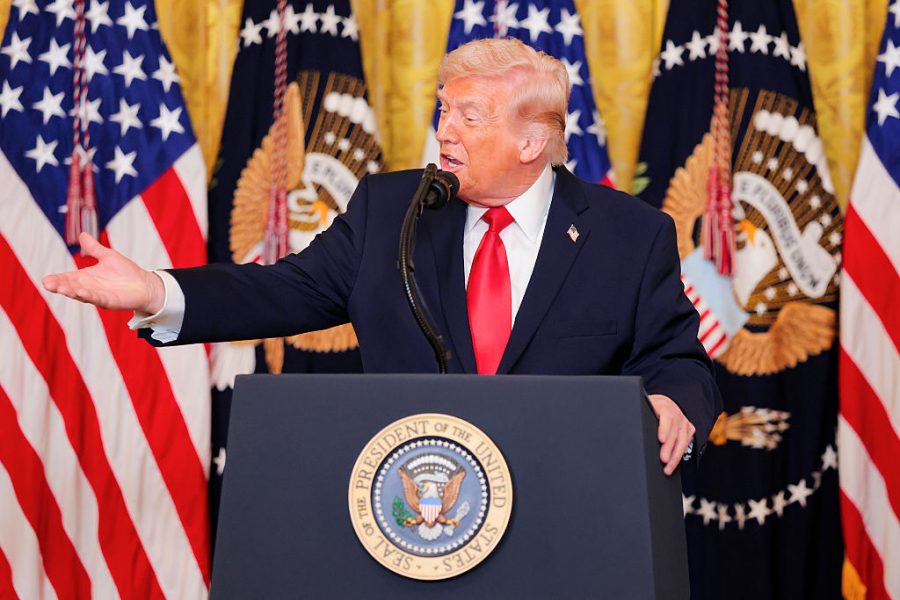
With world attention focused on the US-Israel assault on Iran, US Secretary of War Peter Hegseth delivered a speech last week at the inaugural Americas Counter Cartel Conference in Florida. Hosted in a part of Miami that shares its name with an addictive benzodiazepine (Doral), the event on 5 March brought together 17 ‘American’ countries who were urged to sign a joint declaration on the need for direct action against criminal cartels. Notable drug-affected countries such as Brazil, Colombia and Mexico were not present.
Hegseth was clear that if those countries lacked the resolve to tackle the drugs menace head on, the US was prepared to go it alone. A few days earlier, Donald Trump had hosted his own summit called the ‘Shield of the Americas’, urging another 12 hemispheric partners to commit to destroying the drug cartels. Military power, not criminal justice, was the US President’s proposed method of choice.
The most interesting element of Hegseth’s opening speech last week, though, was how drug wars and cartels have given the Trump administration a fresh opportunity to reframe America’s relationship with its southern counterparts. From the 1970s, the self-declared ‘war on drugs’ was about blocking drug flows and disrupting production in the field. In Trump’s first administration, the focus was on building a ‘beautiful wall’ and reinforcing US-Mexican border security. In the second Trump term, the spectre of ‘narco-terrorism’ is now used to justify both direct action against Venezuela, field campaigns and a grander project around hemispheric dominance.
Trump’s appeal to a ‘Greater North America’ is a psychological chokehold
President Trump had, according to Hegseth, ‘redrawn the strategic map from Greenland to the Gulf of America – we call this map the Greater North America’. This suits a White House agenda that will use drugs and delinquencies on the part of smaller neighbouring states to show where the US must be ever-present.
Back in December 2024, ahead of his return to the White House, Trump had been vaguer: Canada, Greenland and the Panama Canal were linked together via an argument about security and mobility. Trump was concerned about a possible Chinese takeover of the Panama Canal and Beijing’s growing engagement in the High North. Small states, including Canada, could not be trusted with that security responsibility.

Trump has coveted Greenland for months, citing multiple reasons ranging from missile defence and homeland security to dissuading China and Russia from ever seeking a foothold in and around the island. His arguments for annexing or purchasing the territory get endlessly recycled in a way that would be familiar to those who followed Putin’s justification for acting against Ukraine. For the Danes and Greenlandic community of 57,000 it does what it sets out to achieve: exhaustion and confusion.
With Trump’s demands for Greenland to be handed over to him rebuffed in February, his focus has once again pivoted southwards. Trump’s message is that what happened in Venezuela in January could easily happen if another member of the American neighbourhood fails to do the US’s bidding. The White House’s Operation Southern Spear – aimed at disrupting ‘transnational criminal and illicit maritime networks’ – could easily be repurposed and directed towards another neighbouring country. What links Trump’s pursuit of Nicolas Maduro in Venezuela, narco-terrorism and his quest for Greenland is the aim of hemispheric security.
Since its opening in 1914, the Panama Canal has been a vital transit point between the Atlantic and Pacific Oceans. Forty per cent of all US container traffic uses it and it handles between 5 and 6 per cent of global maritime trade. In January last year, Trump announced that ‘China is operating the Panama Canal, and we didn’t give it to China. We gave it to Panama and we’re taking it back.’ He also implied that shipping lanes in the Arctic were becoming more attractive to Beijing, Russia and others who might be hostile to US interests. Trump has since complained that Panama has been overcharging the US for transiting the canal and warned that if unremedied, this was grounds for snatching back control.
What Trump and his administration have recognised is that one way to retain hemispheric hegemony is to re-establish control of strategic chokepoints rather than waste time pursuing grand wars. The focus on Gaza, Panama, the Strait of Hormuz and even large islands such as Greenland is predicated on the assumption that the US can assert its sphere of dominance and will ruthlessly patrol the security perimeter.
Beyond ‘Greater North America’, it projects power in and around those parts of the world where an increasingly maritime-focused China has enhanced its presence – Beijing now commands the largest naval forces in the world. Israel is a helpful if unpredictable accomplice given its proximity to the Suez Canal and Strait of Hormuz.
In his speech at the Americas Counter Cartel Conference, Hegseth made a simple but rather sinister pitch. Latin American could become part of this American security perimeter and leave their designation as members of the ‘global south’ behind. But the price of admission is high, higher than before.
Venezuela and the Maduro regime experienced a direct military assault on the basis that they stood accused of complicity with narco-terrorism. US troops are currently in Ecuador working with local counterparts in drug-busting operations. Copper in the Andes is running in short supply, thanks in part to the AI data centre revolution and the clean energy transition. Securing access to minerals as well as extracting and processing substances like copper, lithium and zinc is a long-term challenge. Columbia could be next on the US direct target list, not just because of the White House’s drug concerns: like Ecuador, it is also a critical minerals hotspot.
But Trump’s appeal to a ‘Greater North America’ is more than a framework designed to divide the world into blocs. It is a psychological chokehold. It started off with placename changes, such as renaming the Gulf of Mexico as the ‘Gulf of America’ and straightforward demands to join his gang, before graduating to direct action against those who disobey or fail to fall into line.
Trump’s propensity to be an armchair geographer is deeply sinister: bringing the Americas into the US sphere of dominance; creating chaos and mayhem so that other special friends can pursue their own ‘greater’ projects; and threatening and intimidating Europeans with trade wars, tariffs and tutelage. Africa and large parts of Asia are simply ‘the global south’, best avoided unless they possess strategic minerals or butt up against chokepoints that might impede US military and commercial interests. Ideally, the US would find all the minerals it needs within its own hemisphere.
In ten days’ time, Danish voters will head to the polls to pass judgement on their prime minister, Mette Frederiksen, who stood up to President Trump over Greenland. If she wins, I suspect the US will turn its attention back to the island with a vengeance, and it will expect Denmark to recognise that it has no place in this new Greater North America. Where this leaves countries like France and the UK with their overseas territories and departments within Trump’s sphere of interest remains a moot point.


Comments