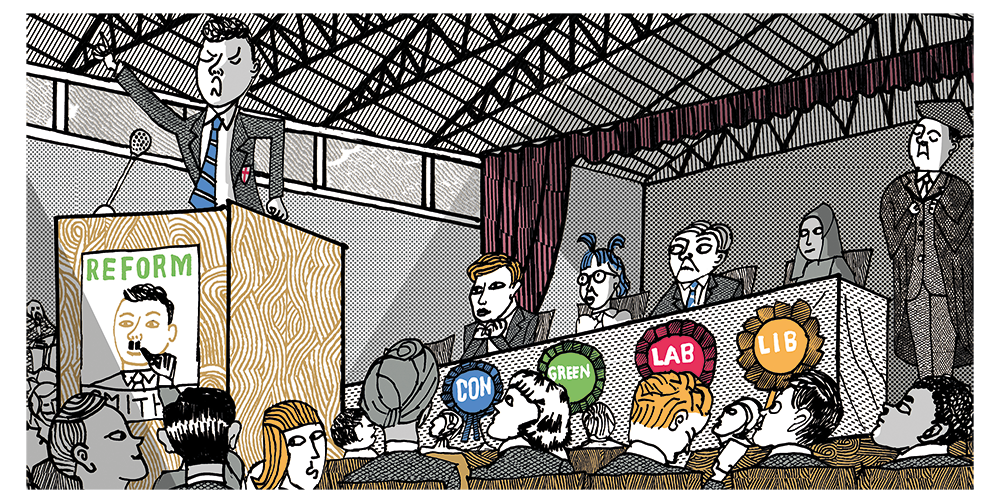
The 2005 election campaign was brutal. All the major parties succumbed to infighting, the hustings were hostile and the drip-drip of poisonous briefings reached a nadir when a Ukip candidate was compared to Hitler. One special adviser was found crying in the loos. More than two decades may have passed, but the Sherborne School mock election certainly left its mark on those who witnessed it first-hand.
I remember it well. In fact, I was that tearful special adviser. I was working for the Labour party (sadly not endorsed by Tony Blair) and during one hustings managed to persuade the crowd to walk away when the Ukip candidate – a close friend of mine in the same boarding house – stood up to speak. I stayed back to watch him deliver his carefully crafted speech to an empty courtyard. The remorse was immediate – and too much for my 15-year-old self to bear. But my God it was all good fun, and we learnt more about politics in that frantic week than we ever could have done in the classroom.
Lesson one: there are consequences to practising the dark arts. Stay clear if you haven’t got the stomach for it
Lesson one: there are consequences to practising the dark arts. Stay clear if you haven’t got the stomach for it.
Lesson two: politics is about personalities as much as policies. ‘We realised we needed influential backers,’ one school friend who supported the Green party recalls. ‘So we got the 1st XV onside by offering them free curry – alongside pristine ice caps and decarbonisation, obviously.’
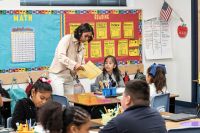
Mock elections, I’m delighted to discover, remain a central part of the syllabus at many schools. There is simply no better way to teach pupils about democracy. A mock election encourages young people to debate; to grapple with complex policy and present it in a palatable way; to engage with divergent views; to experiment with public speaking; and, finally, to experience the privilege of voting at the ballot box (even if it is in the chemistry lab).
With the Labour government reducing the voting age to 16, these mock elections have never been more important – a consequence-free dry-run for youngsters whose real votes in the next general election will be crucial.
Fortunately, things have calmed down a bit since my time at school. Jack Reilly, head of politics at Highgate School in north London, says he is alert to ‘students being antagonistic towards each other. We try to steer them away from that and explain that this is a chance to discuss policy, to become more informed about the parties.’ My cheeks burn a little when he adds that ‘it’s not about trying to put down other candidates’.
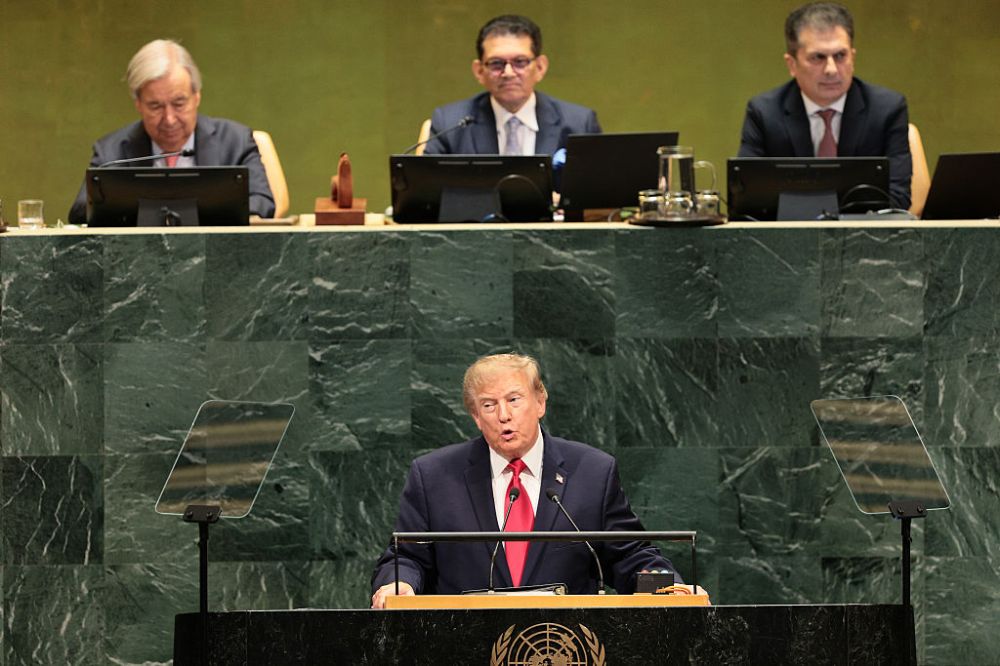
Today’s mock elections seem to be less about party politics and skulduggery and more about the democratic process. A thought experiment, not a popularity contest. Sherborne School for Girls held one in 2024. Five teams were assigned to represent five political parties. The teams were led
by a Year 12 pupil, who stood as the candidate, and a younger pupil who acted as the team’s researcher. ‘I really wanted the girls to think about what the different parties were offering the electorate,’ says Kristina Young, who teaches politics at the Dorset school. ‘To get used to listening to different views and voting depending on what they had learned, thereby developing their own political opinions.’
Kate Crawford, then a Year 12 pupil who took part in the election, and now studying economic policymaking at university, adds: ‘Being assigned to a political party that wasn’t fully consistent with my own views stretched me to consider different perspectives and broaden my understanding of multi-dimensional political issues.’ Another pupil, Wizzy Wordsworth, who is also going to study politics at university, agrees: ‘It was a unique opportunity to really immerse myself in a party I didn’t necessarily support, to try to understand their policies and why they would be beneficial.’
Mock elections bring politics to life for pupils. If teachers commit to recreating the theatre of a real election, the sense of occasion is infectious. ‘The night before the election, we held a leaders’ debate where each candidate was put through his paces by the pupil version of David Dimbleby in a packed assembly hall,’ remembers Rob Le Poidevin, assistant head and politics teacher at Sherborne School for Boys. ‘It was great to see the enthusiasm it generated.’ At Highgate School, they had paper ballots – different colours for each year group, so voting trends could be analysed – and pupils doing the count to recreate the sense of urgency and anticipation of polling day. Wordsworth remembers ‘a real buzz as everyone [at Sherborne School for Girls] went to cast their votes at the polling station’.
I was struck during our 2005 election by friends who had shown no interest in politics suddenly throwing themselves into the campaign. It was all we talked about that week. ‘I don’t know the younger groups that well, I don’t know how much they talk about politics,’ says Reilly. ‘But once there’s a school election going on, I get people from those years approaching me and asking questions.’
This is invaluable at a time when young people’s political views are increasingly shaped by social media. Reilly noticed during the most recent school election in 2024 that pupils whose politics are influenced by ‘videos they’re seeing on TikTok… and are a bit skewed in one direction or another’ were engaging in real-life debate with their peers. ‘Those discussions open up,’ he says.
These mock elections can have a lasting impact, too. I learnt a hard lesson that spring day in the loos of the gymnasium, but one Year 10 pupil at Sherborne Girls says that she was so invigorated by the mock election that she is ‘now studying politics for A-level, as I found myself wanting to know more
and expanding my insight on the news and global issues’. Westminster and the front bench await.



Comments