He’s 12 next month, my eldest son, but he’s rejected the ‘movie night’ party I’ve suggested, and he doesn’t want any of his new friends from senior school to come for a sleepover. And I know why. Our television is a modest one, not the size of one of the screens flanking the main stage at Glastonbury.
I recently went to pick up my son, who was at a new friend’s house. They were playing Mario Kart on a screen that took up about half a wall of the living room. Neither looked up when his mum let me in, so I stood in front of them. ‘Hello? Hel-LO?’ ‘It’s so hard when they’re on screens, isn’t it?’ exclaimed the other mum, as her son manoeuvred Luigi around Brain Rot circuit on Bilge Island with slack-jawed expertise. When I said to his friend that he’d have to come to us next time, my son looked rueful and said, apologetically: ‘Yeah, no gaming at ours. My mum’s a Screen Grinch.’ I don’t think the friend responded.

No, I can’t offer your child the tweenage equivalent of a crack pipe when they come over. But we have table tennis, trees to climb, dogs to play with, a makeshift football field. On wet days, there’s table football, a house made for hide-and-seek, a drum kit, record player, stacks of records and board games and hundreds of back issues of the Beano. If that isn’t enough, I can put on a film for them, a full-length feature film, and make popcorn.
But it isn’t enough and, worse, I think it’s increasingly an embarrassment for my son.
I think of it as the Great Screen Divide, but actually, so many parents have succumbed to what they say is the inevitable (‘The world’s changed, hasn’t it!’). It’s not so much a divide as a tiny rump of renegades and rebels holding out against the odds.
My son would claim that he’s deprived. On a cross-Channel ferry trip to see the Normandy beaches, he was the only child who wasn’t plugged in to a smartphone or tablet. During the four-hour crossing we played backgammon, looked at maps to plan our itinerary, read our age-appropriate D-Day books (Dominic Sandbrook’s Adventures in Time for him, Antony Beevor for me). We walked about on deck enjoying the feel of the sun on our faces and the wind in our hair.
I say this not out of smugness, but horror. Presumably most of our fellow passengers were educated people and yet they had abandoned their kids to gawp gormlessly at screens while they did likewise.
It isn’t easy being a Screen Grinch; my kids would far rather have a smartphone than all of the above. At home we’ve blocked YouTube from every TV and device after realising they were using it to consume vast amounts of AI-generated slop. Roblox is banned. They’re allowed to do a little Minecraft or coding as a reward, but the withdrawal symptoms are so bad that I avoid this as much as possible. Years ago, as an incentive, I told my eldest I’d buy him a games console when he got his Grade 3 French horn. That time is perilously close and I’m trying to persuade him to choose a puppy or an air pistol instead – so far, with no luck.
If, like me, you’re weakened by the constant running battles at home and with schools over the ubiquity of screens, take heart from the work of Jonathan Haidt and Dr Jared Cooney Horvath. They have backed our instinctive unease with robust scientific evidence. Read Haidt’s The Anxious Generation, on how smartphones are rewiring our children’s brains to the detriment of their mental health. Read Horvath’s The Digital Delusion which blows up the claims of ed tech that it improves children’s learning. Buy copies for your friends and give them to headteachers and governors who’ve introduced the joyless reading app, Sparx, set homework on iPads or are wavering about instituting smartphone bans at school.
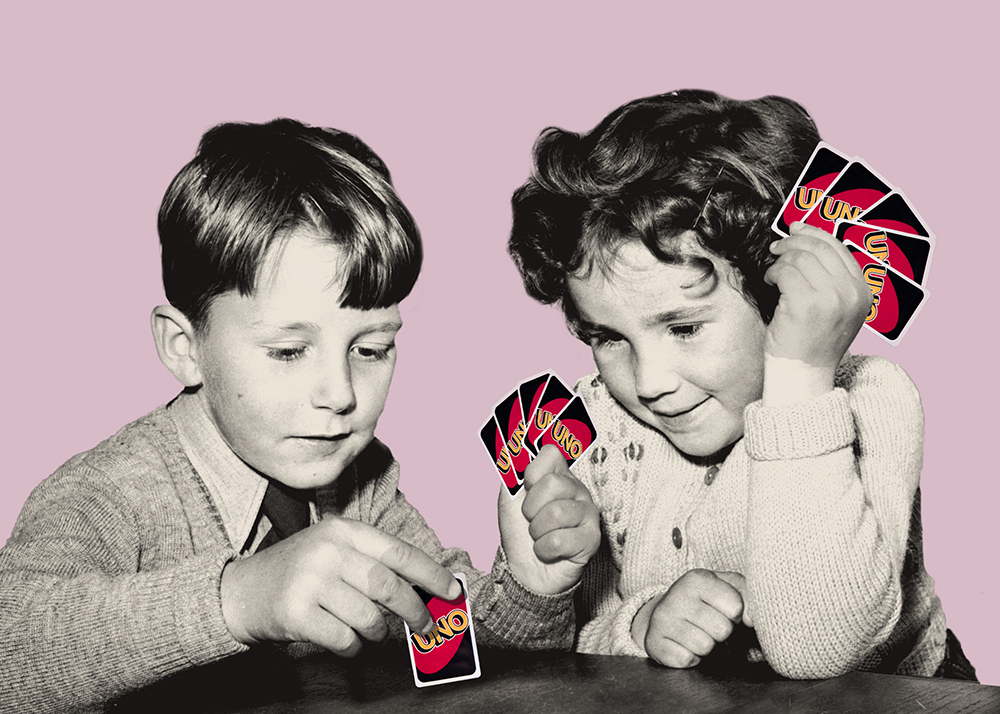
Hold your nerve. Be proud that yours are the only kids on the train playing Uno
I’ve bought Horvath’s book for my daughter’s primary school, after the local authority supplied her with a new iPad and some apps ‘that might help her’. She is six years old, has cerebral palsy and is on the 99th percentile for ADHD. She won’t be using the iPad. Just imagine if the local authority (which we are taking to court over its refusal to cough up for the meaningful Send support she is entitled to by law) had spent the cost of that iPad on human help for her to access the curriculum.
There are signs the tide may at last be turning. In the trailer for the new Toy Story film, Rex the Dinosaur exclaims ‘Extinction, not again!’ as his young owner, Bonnie, unwraps a villainous, frog-shaped tablet called Lilypad, which rapidly absorbs all her focus while she discards her old playthings. ‘What are you, some old man’s toy?’ Lilypad sneers at Woody.
So hold your nerve. Be proud that yours are the only kids on the train playing Uno, the only toddlers colouring in the café. Buy them guitars, not games consoles, buy them books, flip phones and vinyl. Be proud to be a low-tech parent. Stand up and say: ‘Hi, my name is X. And I am a Screen Grinch.’






Comments