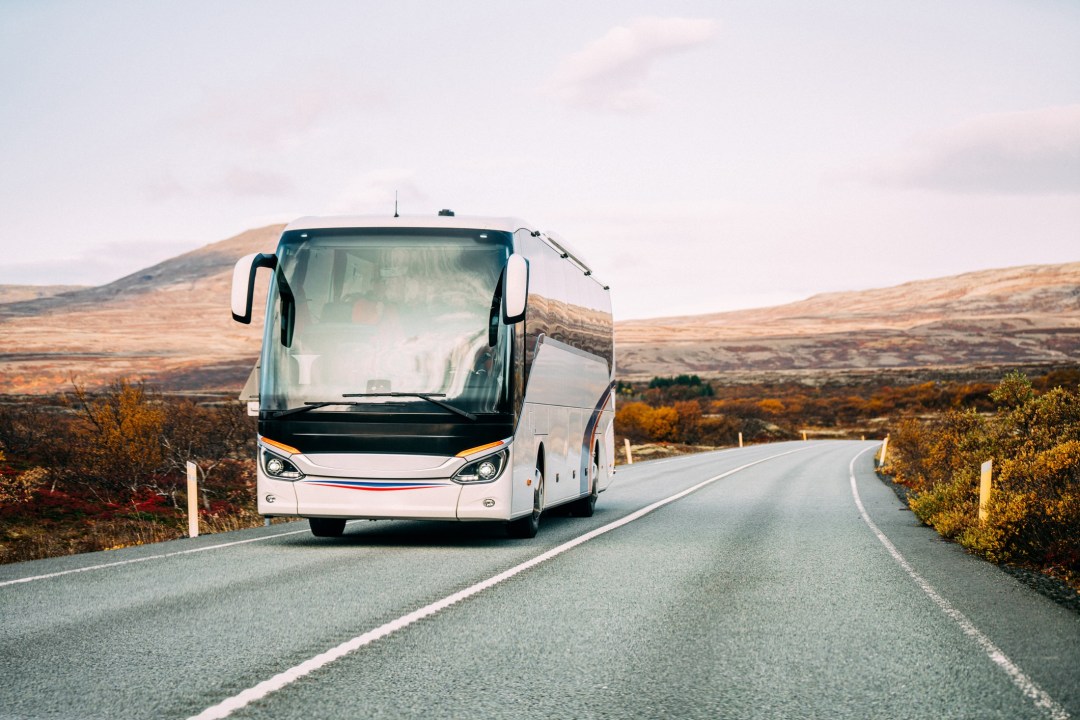
Loelia Lindsay, socialite and former wife of the 2nd Duke of Westminster, is said to have remarked: ‘Anybody seen in a bus over the age of 30 has been a failure in life.’ Well, I’m turning 59 soon and I still use buses. So, by that reckoning, success has so far not only eluded me but given me the widest possible berth.

In my defence, I live in Bristol, which has the worst congestion outside London. Driving here during rush hour is a kind of psychological torture. It’s also a war of attrition between the local council and motorists, with roadworks popping up overnight like molehills. Almost anything is preferable: walking, cycling or the bus.
Admittedly, bus travel isn’t glamorous. There’s no bus equivalent of the Orient Express that I’m aware of. An Agatha Christie murder mystery set on the No. 47 wouldn’t have quite the same romance. However, despite their lack of cachet, buses do have practical benefits. Unless you live in the sticks, there’s probably a bus stop within easy walking distance and a fairly regular service. And they’re relatively affordable. We live near a main artery into the city, so getting to the centre is easy, and the return journey costs a modest £6.
A big advantage of bus travel means having your own lane to zip down, bypassing the worst of the congestion. If you stray into them as a motorist, you’re busted – as my wife has discovered to her detriment on two occasions recently. Buses are also more environmentally friendly than cars. While diesel buses still produce emissions, they’re more efficient per passenger. Many bus companies now operate electric, hybrid and biogas fleets – the ideal steeds for green travellers.
But there are downsides. For example, despite a recently imposed Public Spaces Protection Order (PSPO), my nearest bus stop remains a meeting point for local street drinkers. Refusing requests for spare change isn’t an ideal way to start your day. There’s also a peculiar intimacy about bus travel. If it’s busy, personal space is at a premium. You can end up shoulder-to-shoulder or knee-to-knee with fellow travellers. If feet are resting on a seat, it’s awkward having to request their removal. Not to mention the ubiquitous coughing, sneezing and people listening to music without earbuds while you sit in silence, stewing at their lack of consideration.
Trains are my favourite mode of transport, as long as you avoid peak hours and they run on time. But they’re expensive. Unless you’re a millionaire, book three months in advance or have an employer paying, the cost can be prohibitive. And there are practical considerations, too. Bristol once had a perfectly good train system. But the Beeching cuts of the 1960s put paid to that. The old railway track near me is now a cycle path. And the trams stopped running during the war after a direct hit took out the power station.
As it’s just over a year until I reach 60 – a watershed moment, signifying career goals mostly reached, retirement and incipient old age – I’ve inevitably been taking stock of my life. With a brace of degrees, a successful marriage that has produced two beautiful children, a lifetime of mostly gainful employment, and a wide circle of friends, it hasn’t been an unmitigated disaster. I also recently attained the rank of 6th Dan in Aikido. Then again, as I’ve been practising the martial art for 32 years, it may in part be due to the power of plodding.
There’s no first-class accommodation or quiet coach… Bus travel is travel at its most utilitarian
So the fact that I occasionally travel by bus doesn’t concern me greatly. As a benchmark for measuring my life’s success, it seems a poor one. Of course, people can be a bit sniffy. When we took what now seems a slightly unhinged decision to send our children to private secondary school, we inevitably had to cut costs. That included selling one of the cars and using alternative means of transport wherever possible. When, after catching two buses to meet friends for a night out in Clifton – one of the posher parts of Bristol – I arrived looking harassed, there were chortles and cries of: ‘Why on earth didn’t you just get an Uber?’
But that’s what helps make bus travel so democratic. You’re all in it together. There’s no first-class accommodation or quiet coach. No buffet car or trolley service. It’s travel at its most utilitarian. Indeed, when I read about the Cornish village of Mousehole which said goodbye to its bus service of 90 years earlier this month, I couldn’t help but agree with my colleague Andrew Watts’s assessment: these links to the outside world are a lifeline to struggling communities. As a measure of our own lives, buses may seem trivial; as a measure of the community’s, they’re indispensable.
The quote attributed to the former Duchess of Westminster (and often misattributed to Maggie Thatcher) is probably apocryphal and may have originated with the poet Brian Howard. It’s amusing, but it’s not a maxim to be lived by. Unlike mine, Loelia Lindsay’s life was one of parties and high society, not public transport. But, as my seventh decade nears, I’m less interested in arriving in style and more in simply arriving at all.



Comments