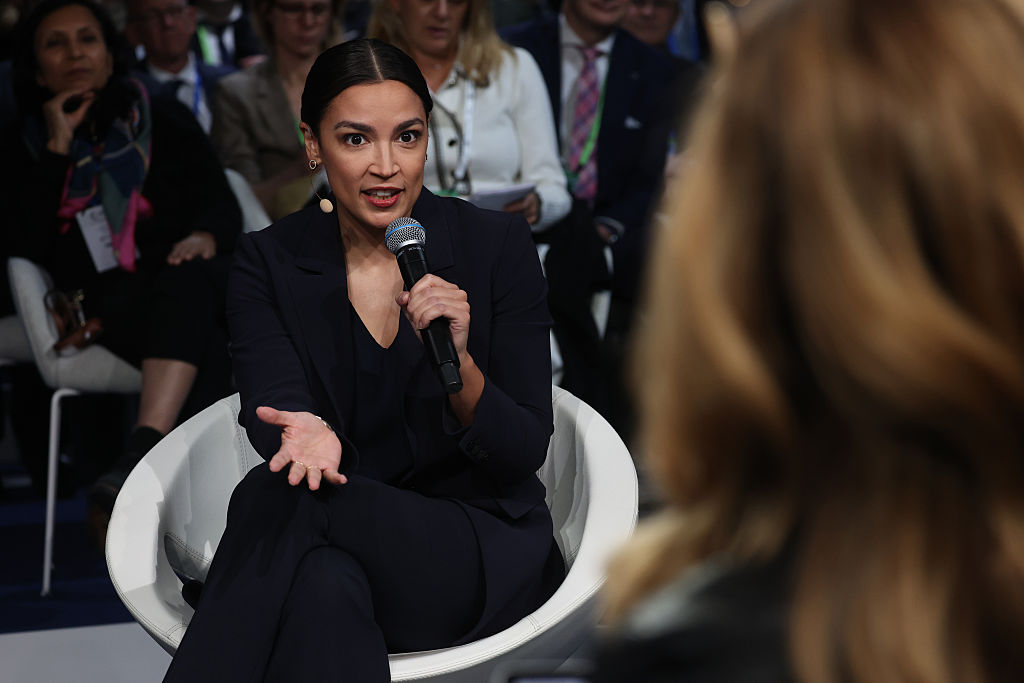
While all eyes and ears at the Munich security conference will be on US Secretary of State Marco Rubio on Saturday, it was America’s Democrats who were able to enjoy their moment in the spotlight on Friday. The party was out in force: Californian governor Gavin Newsom, member of Congress Alexandria Ocasio-Cortez and Michigan governor Gretchen Whitmer were among the high-profile party delegates on panels at the Bayerischer Hof hotel, where the conference is held.
Campaigning for the next Democratic party presidential primary isn’t expected to kick off in earnest for another year. Nevertheless, it was an opportunity for Newsom, Ocasio-Cortez and other rumored 2028 presidential candidate hopefuls to flex their credentials and demonstrate to voters back home – as well as US allies in Europe – what exactly fresh blood at the top of the Democratic party would offer.
Perhaps unsurprisingly, with European delegations at the conference unsettled by the increasingly fraught relationship that has evolved between them and the administration of Donald Trump, the top Democrats seized their chance to bash the President. Trump, Newsom said, “is doubling down on stupid.” The Californian governor was speaking on a panel discussing climate change; the American president, he added, was “trying to recreate the 19th century” with his pivot back towards fossil fuels. “Never in the history of the United States of America has there been a more destructive occupant of the White House.”
Newsom made headlines last month at the World Economic Forum in Davos when he declared that he “should have brought a bunch of kneepads for all the world leaders” who were “rolling over” and allowing Trump to have his way on a number of issues, alluding to the President’s tariffs, climate policy, the defense of Ukraine and desire to grab Greenland. Today in Munich, Newsom doubled down: “Call this guy out. Stop with the timidity.”
Making a reference to the infamous occasion in 1938 when the British prime minister flew to Munich to meet with Adolf Hitler in an act of appeasement, Newsom continued: “We’re all becoming Chamberlains in this space. People have to stand up.” The moderator of the panel didn’t press Newsom on quite where Trump fitted into that particular analogy.
While certainly not as inflammatory in what she said, Ocasio-Cortez was similarly direct in her criticism of the Trump administration. Speaking on a panel exploring the rise of populism, the congresswoman declared that this was a moment in time where “we are seeing our presidential administration tear apart the transatlantic partnership, rip up every democratic norm”. Joining Whitmer later on a panel discussing the “seismic shifts in US foreign policy”, Ocasio-Cortez expanded on her point, theorising that “as the president struggles at home, in my view, he is making rash decisions globally.”
If these particular Democrat politicians had been hoping to keep their intentions of treating Munich as a mini primary under wraps, they failed spectacularly. Both Newsom and Ocasio-Cortez swerved questions on their presidential ambitions, but crucially didn’t deny that they existed.
Nevertheless, this cohort of Democrats will have been pleased at the statesman-like treatment they received from their hosts in Munich. Ocasio-Cortez and Whitmer fielded a number of leadership-relevant questions: What does victory in Ukraine look like? Should the US ever send in support to Taiwan? Would they support strikes on Iranian nuclear facilities if diplomacy fails? Their answers were sufficiently predictable – no discussions about peace in Ukraine without Ukraine; hope that neither the situation in Taiwan and Iran escalates – but the fact they were asked at all counts for something.
All three acknowledged that the world had changed. “Donald Trump is temporary,” Newsom said. “He will be gone in three years.” Whitmer, meanwhile, talked of “reconciliation”. The breakdown in trust between America and its European partners isn’t “a permanent, irredeemable change,” she insisted. “It will take time to rebuild [trust] but I am confident that we will do that.”
But, at a conference whose focus is on how Europe can continue to decouple itself from America in the realms of economy, defense and security, few in Munich are likely to mirror Whitmer’s confidence. It’s very easy to talk the talk, but the Democrats have a long walk to walk if they want to make good on their words to Europe.
 Lisa Haseldine
The Democratic primary in Munich





Comments