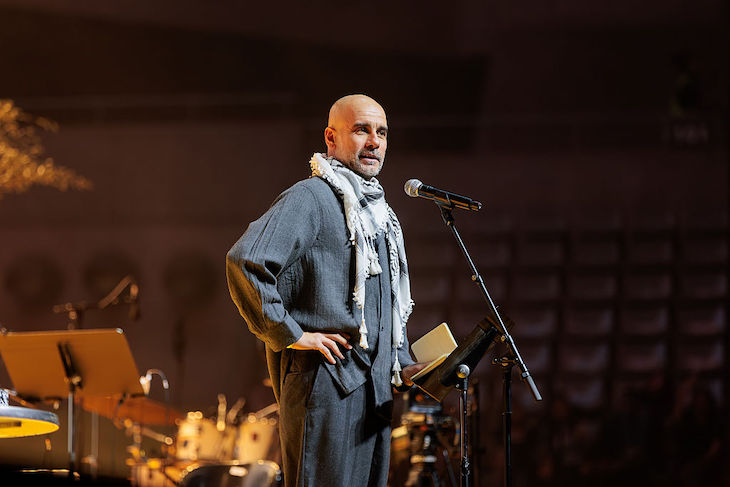
It will be refreshing to see Pep Guardiola back in the dugout today. The Manchester City manager has been rather busy off the pitch lately, taking centre stage as he flexes his self-importance: first on the thorny subject of Gaza, and then lashing out at the rules that apply to every football club but which he appears to think shouldn’t apply to his own team. Who does he think he is?
Has that success gone to Pep Guardiola’s head?
Despite being in the middle of the season – and the fact his team are trailing league leaders Arsenal – Guardiola popped up in Barcelona last month to address a rally in support of Palestinian children. Wearing a keffiyeh, naturally, the City boss implored world leaders to do more to support the people of Palestine. He called for a ‘step forward’ as he made what he said was ‘a statement for Palestine and…a statement for humanity’.
After returning to his day job, Guardiola used a press conference last week to condemn the ‘genocide in Palestine’. That intervention led Manchester’s Jewish community to urge Guardiola to be to be ‘more careful with his future language’. The Jewish Representative Council of Greater Manchester also accused him of a ‘total failure’ to display solidarity with Manchester’s Jewish community in the wake of the Heaton Park Synagogue attack last year. That act of terrorism, which unfolded just a few miles from City’s stadium, left two people dead.
Guardiola hasn’t only been talking about Palestine. He has also referenced America’s ICE controversy, criticising the Trump administration after the killings of Renee Good and Alex Pretti by agents in Minneapolis. ‘What happened in Russia, what happened…in Sudan’ also got Guardiola fired up.
Perhaps buoyed by the sympathetic response from the usual suspects, he then went on to address matters on which he is more qualified to talk about. He suggested that his recently-acquired defender, Marc Guehi, should be allowed to play in the Carabao Cup Final even though competition rules mean he cannot because he signed for the club too late.
Then again, Man City and rules are not always happy bedfellows. The club is still dealing with 115 charges relating to financial fair play rules which could see them fined or even have points deducted, though the general feeling among fans is that they will not. City strongly deny wrongdoing, and say they are supported by a ‘comprehensive body of irrefutable evidence’.
Guardiola is no stranger to political outbursts. A steadfast supporter of Catalan independence, in 2018 he was charged – and later fined – by the Football Association for wearing a yellow ribbon in support of Catalan prisoners, prohibited under FA rules as a political gesture.
Yet he is more than happy to manage a club which is the pet project of Sheikh Mansour, vice-president of a UAE regime which regularly chucks citizens in jail for little or no reason; and Guardiola was happy to endorse Qatar’s successful 2022 World Cup bid, despite that nation having an appalling human rights record, not least when it comes to the treatment of migrant workers.
As a club manager, Guardiola is generally considered the best and most successful in the world. There’s no doubt that his style of play is exceptional. His tiki-taka football can be exhilarating to watch. But then again he has the players who can pull it off thanks to the enormous resources provided to him by his side’s mega-rich owners.
In 2008, having never managed any other club, he took over as Barcelona’s first team coach and led them to the Spanish treble, aided in no small way by the prolific goalscoring of Lionel Messi, Samuel Eto’o and Thierry Henry and defensive lynchpins of Carles Puyol and Gerard Pique.
Guardiola then moved to Germany’s most powerful team, Bayern Munich, winning everything in sight before joining Manchester City ten years ago when they were already the richest and best side in the Premier League; he kept them at the top, aided by copious amounts of money and their ability – thanks to their cheque book – to sign ready-made, fully-developed players.
As the boss of the richest club in the world, it was easier for him to pinch the likes of Kyle Walker from Tottenham, John Stones from Everton, Riyad Mahrez from Leicester – and, in January, Crystal Palace captain Guehi. But how would Guardiola fare at a poorer, less successful side? No one will ever know. Could he have done the same with Brentford? Would he have been able to turn Hamburg into a treble-winning side? Or get Marseilles to play beautiful football and win trophies?
Manchester City, like Chelsea before them, have bought their way to the top of the tree. Much as I’d hate Arsenal to win the league, that blow is softened somewhat by the fact that their success comes at City’s expense.
Sam Allardyce was pilloried when he said ‘I’m not suited to Bolton or Blackburn, I would be more suited to Inter (Milan) or Real Madrid. It wouldn’t be a problem to me to go and manage those clubs because I would win the double or the league every time. Give me Manchester United or Chelsea and I would do the same, it wouldn’t be a problem.’
But perhaps ‘Allerdici’ – he joked that if this were his name he’d have got a top job – has a point. Guardiola will no doubt feel he has nothing left to prove. He can be as arrogant as he likes because he is a superb manager and was an excellent footballer, even if his career was the sporting equivalent of being born with a silver spoon in his mouth.
But has that success gone to Guardiola’s head? Man City’s manager appears to have fallen into the same trap as Dawn French, or billionaires such as the environmentalist Dale Vince, who think their success in completely unrelated walks of life make them worth listening to when it comes to geopolitics. It doesn’t. Pep should pipe down on politics – and stick to football.



Comments