Mussorgsky’s Boris Godunov is back at Covent Garden, and there are ninjas. This isn’t a spoiler. There hasn’t been a note of music at this point, and it’s almost the first thing you see. A ginger child in a weird mask is playing with a spinning top when the black-clad assassins stalk on and slit his throat. Cue gasps. Well, the director is Richard Jones, after all; quirky, garish and occasionally macabre is what he does. And the (alleged) murder of a child pretender to the Russian throne is the horror that drives the entire plot, at least in the first (1869) version of the opera, which is what we’re given here.
In other words, this is the first and shortest form of Boris, substantially different from the more familiar 1872 revision which was the only version Mussorgsky actually saw staged. It’s essentially a first draft, and it’s increasingly popular with directors, being lean, raw and all those other austere qualities that so flatter modernist tastes. You suspect they’d gladly lose the Coronation Scene too, if they could get away with it.
Terfel lunged at his big soliloquies with a jagged, baleful edge to his voice
Jones runs its seven scenes without an interval, in a single 140 minute stretch. For all his struggles with his material, it’s hard to imagine that Mussorgsky ever intended that, but here we are regardless. Prostate sufferers, be warned. The other consequence of using the 1869 version is that the whole perspective shifts, and an epic drama of rulers and people becomes a claustrophobic study of the title character’s mental disintegration, with the doomed Tsar Boris (Bryn Terfel) as a figure somewhere between Macbeth and King Lear. Mussorgsky’s characterisation is so powerful that the result is almost as compelling: certainly, you leave the theatre feeling wrung out.
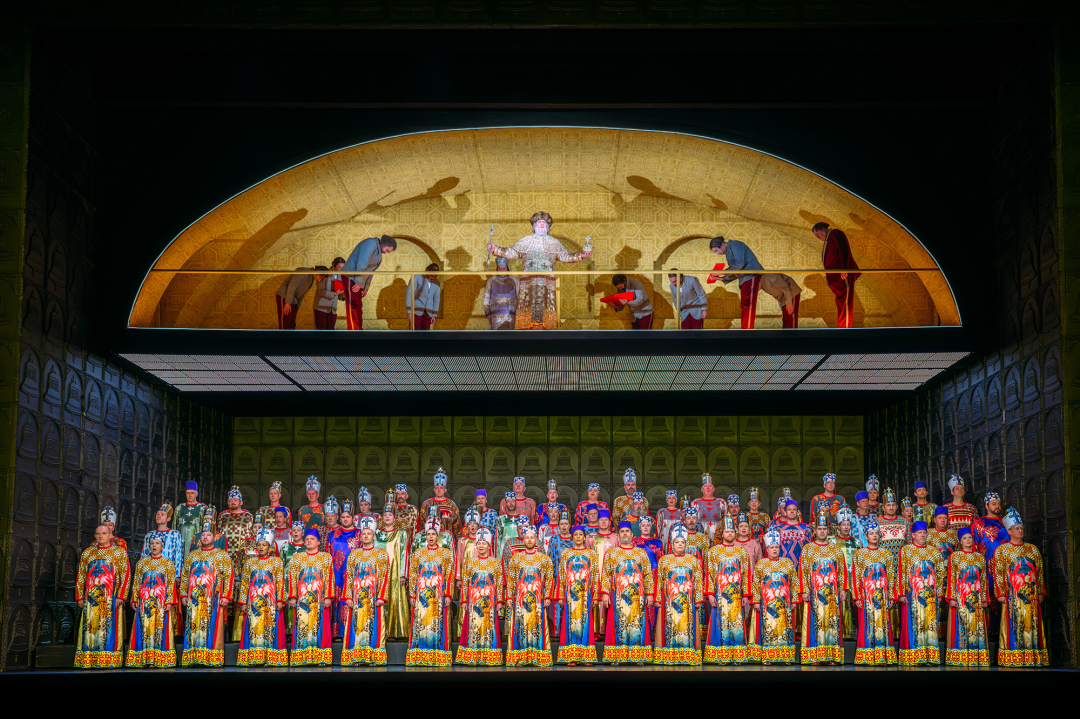
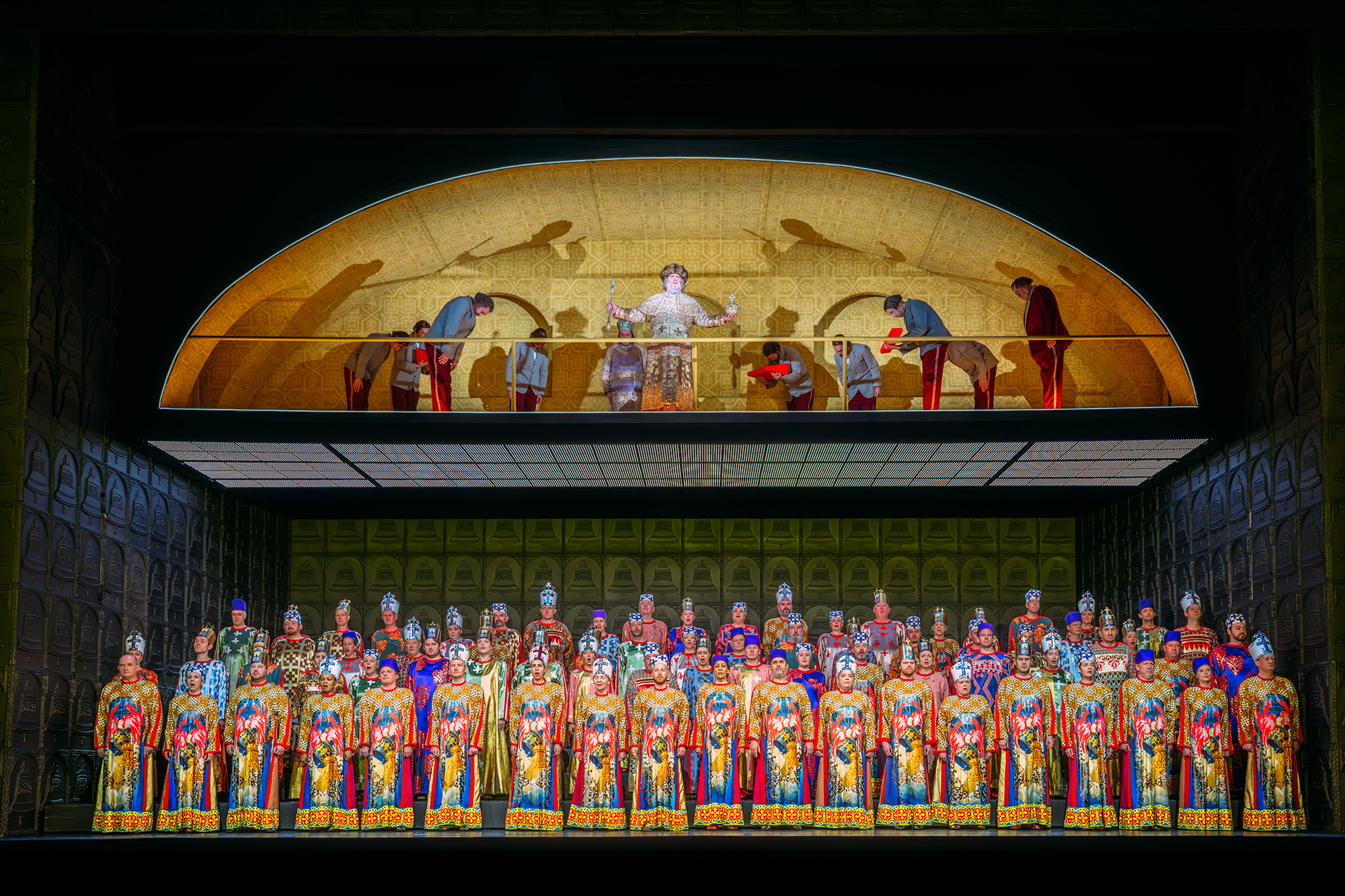
None of which feels like an obvious fit for Jones’s Ikea aesthetic. I’d previously seen this 2016 staging only on screen, where the blocky colours and flatpack visuals of Miriam Beuther’s set designs didn’t really come alive. Add Jones’s cartoon touches – the spinning top, the ninjas, the rolling billboards conveying historical information – and it felt like a parody: a profound psychological tragedy delivered with an ironic smirk. Unsurprisingly, it works much better in the theatre, with the split-level set conveying a real sense of court intrigue and public turmoil. The chorus strides this way and that, generating an energy that can be channelled, but never fully contained.
Still, there’s little atmosphere or intimacy here; no visual sense of dark chambers and darker consciences. Jones doesn’t give the cast much to work with, acting-wise – there’s a lot of pacing about and hand-waving. A few years back in Die Meistersinger Jones and Terfel produced some of the most moving and subtle acting I’ve ever witnessed in an opera, so this is presumably intentional, or a defect of the current revival (which Jones has not directed). Let’s give it the benefit of the doubt, and assume that the intention was to leave the expressive heavy-lifting to the music. Mark Wigglesworth conducted, delving into the black, loamy subsoil of the score and leaving silences that hung heavy in the air. Oboes wailed, bells juddered and the whole thing generated a gripping cumulative power.
As for Terfel, he’s still a tremendous presence, lunging at his big soliloquies with a jagged, baleful edge to his voice, and softening into a desperate tenderness as he talks with his (equally doomed) son Fyodor (Robert Berry-Roe). John Daszak was a forceful Prince Shuisky; Adam Palka (the monk Pimen), Mingjie Lei (the Holy Fool) and Jamez McCorkle (Grigory) all leaned vigorously into their respective characters. Perhaps we could have used more concentrated force – more Slavic pitch and sulphur – from the chorus, but they certainly sounded haunting in the distance. At the end, we were left with Terfel as the dead Tsar, lying shaggy and inert like some fallen lion, and Mussorgsky’s music, which broods and lingers like few other operas. That’s almost enough.
In Liverpool, Andris Poga conducted the Royal Liverpool Philharmonic in a new concerto by Dobrinka Tabakova for the Latvian accordionist Ksenija Sidorova. Sidorova is a phenomenon, a sonic magician; and if I’m honest I’d rather hear her play than many contemporary pianists. Certainly, she seemed to make light work of the concerto, which was driven by lively minimalist rhythms and ended with a gradually building dance entitled ‘Ancient Patterns’.
The audience was enthusiastic, and Sidorova responded with an encore: a transcription of Albeniz’s Asturias which in its rippling, glittering filigree and sudden wild flashes of colour basically blew the concerto out of the water, leaving the unfortunate (and possibly unfair) impression that Tabakova had played it safe. True, plenty of modern concertos fight shy of fireworks, but when the soloist is a virtuoso of Sidorova’s brilliance, it feels like a lost opportunity. What’s wrong with a bit of the
old razzle-dazzle?






Comments