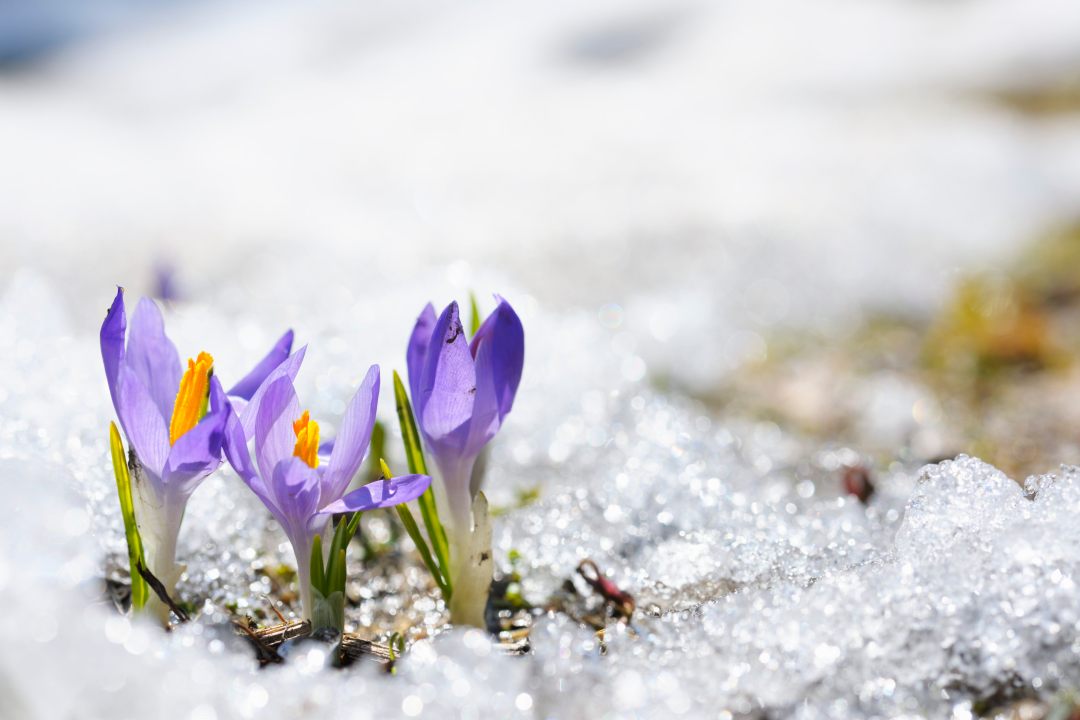
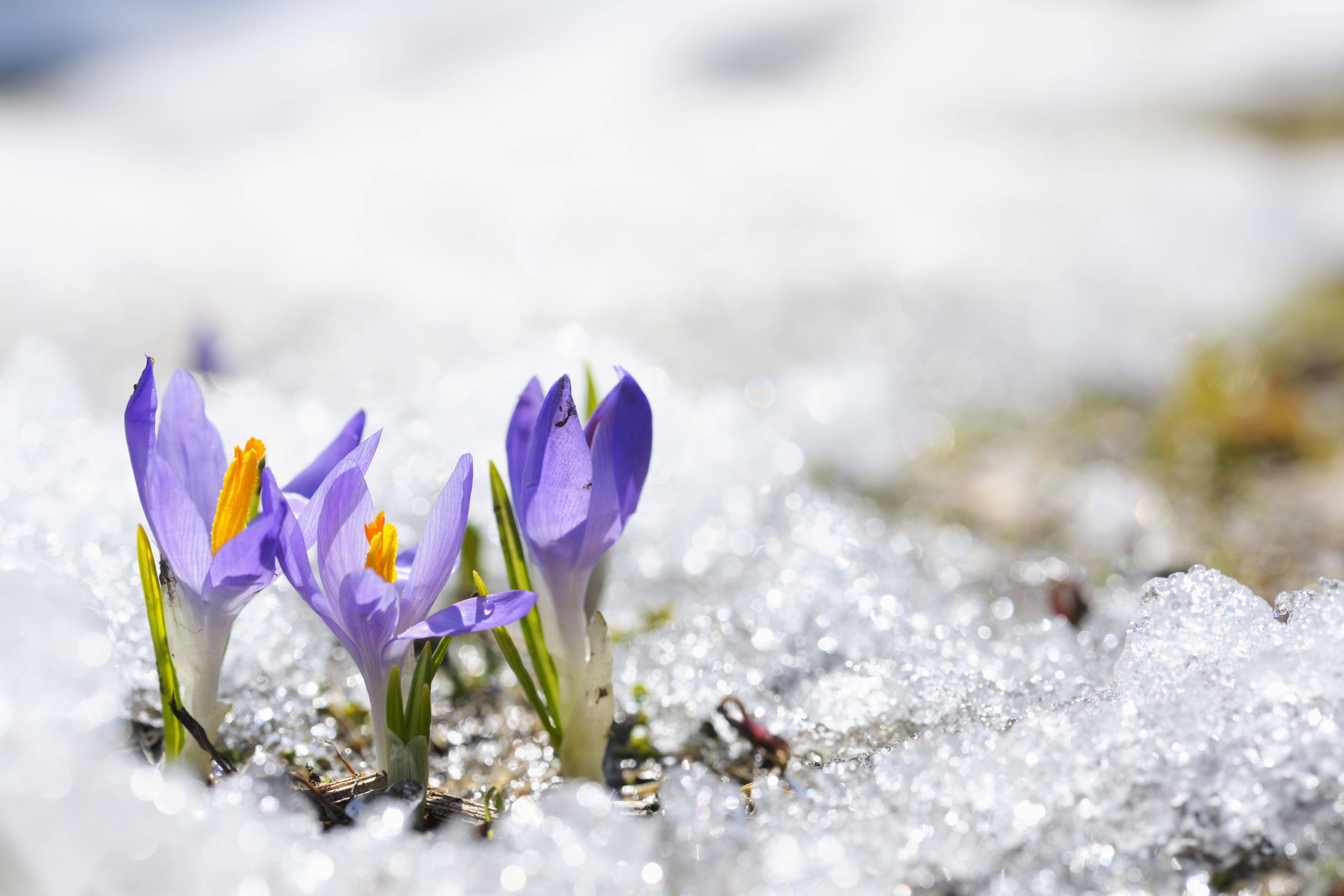
By the calendar it is winter, but the days are longer and the birds are singing. Snowdrops are scattered around the front door, and crocuses have already broken through on my lawn. Mostly they are slim and pale, but when the sun has shone they have opened their purple cups to its warmth. Virginia Woolf compared the yellow anther within to a lit match.
In defiance of the calendar, spring shows its face. Hellebores droop with dappled flowers. Kneeling in damp earth to trim back their old leaves reveals their profusion. Catkins are on the trees, magnolia buds are splitting with promise, the scent of the daphne cuts the cold air, and the blade-like leaves of spring bulbs, ‘the green fuse that drives the flower’, push up along the grass bank beside the road.
How hard it is not to feel one’s spirits lift, and how curious that we should still be so influenced by seasons. Technology has weakened the links between the weather and our survival and even our comfort. Paul Fussell’s The Great War and Modern Memory, which showed how men of all ranks understood the trenches through poetry, noted that half the verse in Quiller-Couch’s Oxford Book of English Verse mentioned flowers. Fussell thought it stemmed from what their return meant to those who had endured a British winter in the days before central heating.
There is an apocryphal story that W.C. Fields would attach labels to his roses reading: ‘Bloom you bastards! Bloom!’ In early spring the flowers need no encouragement. They bloom regardless, and in doing so, encourage us. We know spring will return, but we do not always feel that it is true. ‘Every February since 1940 I have found myself thinking that this time winter is going to be permanent,’ wrote Orwell. And that is why bulbs and birdsong are so heartening.
Man that is born of woman has but a short time to live, and his days are full of trouble. ‘He cometh forth like a flower, and is cut down: he fleeth also as a shadow, and continueth not.’ One does not need to believe in resurrection and eternal life to find spring invigorating, full of hope. Noticing the small changes in flowerbeds and hedgerows reminds us that the world is greater than ourselves, and that love continues even when what we feel most sharply is its absence. Why life should feel more hopeful and easier to bear when our own unimportance is brought home to us, I cannot say. But it seems to me to be true.
Patrick Leigh Fermor, during the second world war, found himself sitting high in the Cretan mountains with Heinrich Kreipe, a German general he had kidnapped and was escorting off the island. Kreipe, defeated and sad, watched dawn break over Mount Ida and, ‘half to himself’, murmured Horace: ‘Vides ut alta stet nive candidum Soracte.’ Fermor recognised the opening line, and recited the rest of the ode from memory. When he finished, their eyes met. ‘Ach so, Herr Major!’ said Kreipe, after a silence.
See Mount Soracte shining in the snow.
See how the laboring overladen trees
Can scarcely bear their burdens any longer.See how the streams are frozen in the cold.
Bring in the wood and light the fire and open
The fourth-year vintage wine in the Sabine jars.O Thaliarchus, as for everything else,
Forget tomorrow. Leave it up to the gods.
Once the gods have decided, the winds at seaWill quiet down, and the sea will quiet down,
And these cypresses and old ash trees will shake
In the storm no longer. Take everything as it comes.Put down in your books as profit every new day
That Fortune allows you to have. While you’re still young,
And while morose old age is far away,There’s love, there are parties, there’s dancing and there’s music,
There are young people out in the city squares together
As evening comes on, there are whispers of lovers, there’s laughter.
My son was born in February and would have been turning 18. For his 16th he asked to go to the Chelsea Flower Show. Our house and garden are full of his plants, and some are in the churchyard, surrounding the wooden cross on his grave, which we have not yet been able to replace. Perhaps this spring we will face the finality of a gravestone, and an epitaph. And into the turf around his grave, which I hope to share, I will put crocuses.



Comments