
This government knows that if it doesn’t turn the tide on migration it is destined for electoral oblivion. The Home Secretary has said that ‘illegal migration has been placing immense pressure on communities’, and that ‘asylum hotels…are blighting communities’. This is why the government is determined to close the asylum hotels. But its ‘solution’ is nothing of the sort. Instead, asylum seekers living in hotels in or near British towns are being moved to former military bases near British towns.
It has not been normal, in recent English history, for quiet market towns to see such protests
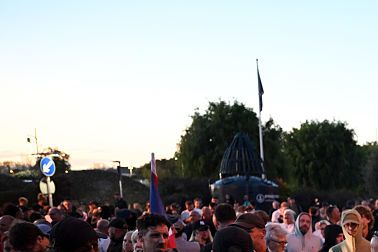
One such place is the Sussex market town of Crowborough. The Home Office has issued a statement explaining that last week ‘the first 27 migrants have been moved into’ Crowborough training camp, and that the site will soon be housing 500 ‘single adult male illegal migrants who are claiming asylum in the UK’. These migrants will not be confined to the base but will be allowed to wander into the town. This decision has already proved deeply unpopular with locals, with thousands of them protesting this weekend against the decision.
Crowborough is not a place which is used to protests. Independent journalist Jack Hadfield has covered migration-related protests across the country. He told me that ‘Crowborough is probably the most pleasant town I’ve visited to cover an asylum centre protest. Situated in the rolling East Sussex hills, the leafy middle class town just southwest of Tunbridge Wells is probably the last place you’d have expected to see a “far right” protest pass through it’.
Indeed, according to the Guardian, even deeply establishment locals supported the march. They spoke to Helen and John Tate, ‘a lawyer, former senior civil servant in the Home Office and deputy parliamentary ombudsman’, who complained that ‘as far as the Home Office is concerned we have no say in the matter’. His wife went even further, saying that were it not for ‘a bad knee…she would have joined the march’. Meanwhile at the protest the English middle classes chanted ‘deportation, no accommodation’, ‘stop the boats, send them home’ and ‘who’s streets? Our streets’.

Hadfield described the mood as ‘defiant’ and noted that ‘the vast majority of attendees at the protests were local, with merely a handful coming from out of town. Those few non-locals included campaigners on the hotels from other communities… they’ve been protesting for 13 weeks now.’
It has not been normal, in recent English history, for quiet market towns to see such protests. What they show is quite how much the mood of the English people has shifted, and how little the British state understands them. The Home Secretary has said that ‘Crowborough is just the start. I will bring forward site after site until every asylum hotel is closed’, as though the problem is the hotels.
This suggests that she, and the government have entirely misunderstood the problem. While, of course, people don’t like the thought of illegal migrants living in luxury, the root of people’s anger is not the use of hotels, nor even the conversion of family homes into houses in multiple occupation (HMOs). The real problem is that these men are here at all. In towns across the country, locals fear that these men are dangerous and will commit awful crimes.
That fear is entirely justified. Week after week we hear reports of asylum seekers convicted of horrific crimes. Just today we have learned of that Sheraz Malik, a Pakistani asylum seeker has been convicted of two counts of raping of an 18-year-old girl in a Nottinghamshire park. Malik’s immigration status could not be reported until today because reporting restrictions were imposed in September last year.
It makes no real difference to people if dangerous men are housed in a hotel on the outskirts of their town or a military camp just outside it. While the Home Office has promised ‘robust safety and public-protection safeguards’ including screening migrants ‘against policing, criminality and immigration databases’, the reality is that these men throw their identity documents away before arriving in Britain, and there is no reasonable prospect of discovering what crimes they may have committed in their homelands.
The real solution would be to do what the protestors at Crowborough chanted for – ‘stop the boats, send them home’ – but that would require the government to recognise that it does not have to be bound by the ECHR, nor the Refugee Convention, and that it can change the law to be whatever it desires. But this government, wedded to international law, remains bound in a cage of its own making, and so we will see ‘site after site’ being opened, and no doubt ‘protest after protest’, and crime after crime. This will only end when we are governed by people who are willing to do what is necessary to keep our people safe.





Comments