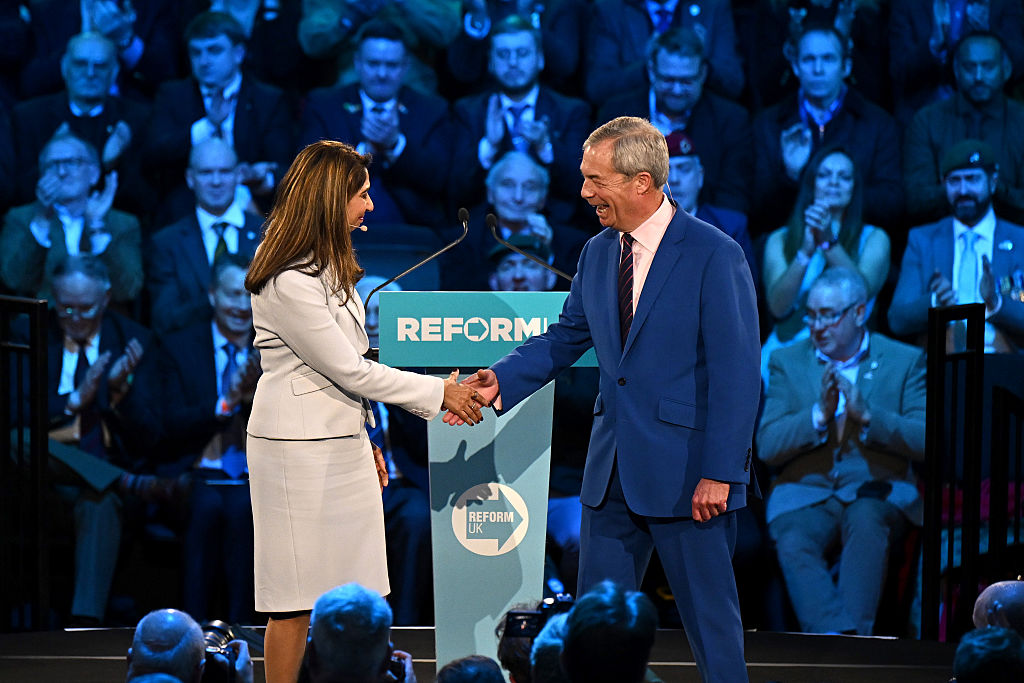
That sound you can hear is panic. In the past week, articles have appeared by leading Conservatives including Danny Finkelstein, Charles Moore and Michael Gove attacking Reform for a range of crimes, from backwardness, to policy weakness, to (in the case of Moore, scurrilously) anti-Semitism. The onslaught is getting heavier, and more bitter. Suella Braverman’s move to Reform today caused Conservative HQ to publicly question her ‘mental health’, before withdrawing the slur when someone more senior saw it.
The Tory establishment is in the last ditch, and has now resorted to what soldiers call Final Protective Fire – a barrage of artillery aimed at the very edge of its own position. The tactic is risky, but the alternative is being overrun and destroyed.
There is another option: the honourable surrender, and then peace, and a combined fight against the real enemy.
The split on the right is not the fault of Reform. It is the direct consequence of Conservative party failure, of successive leaders who followed the advice of Lords Gove, Moore and Finkelstein to favour unity over clarity, continuity over change, and the system over the people.
The proper response of Conservatives to the crisis the country is in is to admit their responsibility for it. In the case of the leading offenders (the ones who imposed net zero, surrendered to Stonewall, threw open the borders and let welfare spending soar) the proper response is to retire from politics. For the rest (including Kemi Badenoch, who is by no means the worst of them) they should make the humbling journey I made last September, and Rob Jenrick, Andrew Rosindell and Suella made this month. Like Emperor Henry IV before the Pope at Canossa, they should stand barefoot in the snow to seek – and receive – absolution from Nigel Farage.
The only thing holding up the Tory party now is nostalgia for an institution which has served its members, and the country, well. But this attachment is now an indulgence the country cannot afford. It is also unhistorical.
Every hundred years or so the main party on the right – variously the Tory party (from the 1680s), the Pittite Whigs (from the 1780s), the Conservative Party (from the 1830s), the Conservative and Unionist Party (from the 1910s) – transmutes. It becomes something new, with a different institution, different MPs and different leaders – and so the cause is carried forward. The process is underway again.
The new institution is Reform and its new MPs are coming from outside politics. An insurgent force of people with no attachment to the legacy parties is stepping forward in the true spirit of public service, offering their skills and experience to the task of fixing Britain. Businesspeople and entrepreneurs, farmers and financiers, leaders in education and healthcare, former (and serving) military officers and civil servants, and wave after wave of local councillors are standing up to volunteer for their country.
These people counter the slur that Reform ‘lacks experience’, ‘isn’t serious’, or is a ‘one man band’. It’s also absurd to claim that we ‘have no plan’. We are developing the most comprehensive programme for government that any party in modern times has offered the voters. And by the way – contra the patent Tory nonsense that we want to spend more on welfare – the plan includes deep cuts to the benefits bill, with £9 billion of savings already announced. When we come to the next election we will be ready with legislation, a set of new ministers and civil servants, and reforms to Whitehall – the what, the who and the how – that will transform the British state.
The fact that the Tory party has now dragged itself to a similar position as Reform on a number of topics is not, as Lord Gove argued in last week’s Spectator editorial, a reason for a deal between the parties. Superficial policy alignment obscures a deeper distinction.
Unlike the Conservatives, Reform recognises the depth of the crisis we are in, and the need for enormous, galvanic force to rescue us. Ordinary people far from London know that Britain – ‘this crippled island’, as the singer Sam Fender, North Shields’ Bruce Springsteen, calls it – is broken.
Genuine conservatives care for the country, not for the Conservative party
But Kemi, the hostage of her party, denies it. She cannot admit the depth of the crisis the country is in, let alone accept the atonement necessary to make amends.
An electoral pact is the easy request of affluent Tories untouched by the crisis that ordinary families face across Britain, and too proud to make the penitent journey to Canossa. Lords Gove, Moore and Finkelstein once derided Reform as an irrelevant fringe phenomenon; later as an irritant which, at best, posed a minor threat to some marginal Tory seats. Now that their party faces total extinction, they suggest Reform is impolite and unpatriotic not to join forces with them.
To attach ourselves formally to the party that broke Britain and won’t admit it would utterly betray our supporters – and make the task of national renewal impossible.
The only way to unite the right is for all genuine conservatives – voters, members, MPs – to join Reform. Genuine conservatives care for the country, not for the Conservative party. Genuine conservatives should do the right thing and try to help Reform become what it needs to be, a party ready for government.
My message to my former colleagues – those who agree with Reform, but imagine they can stay as Conservatives and survive – is this. The country needs you. But before they trust you you must pass through the fire. Shrive yourselves of the sins of 14 years. You’ll find it, as I did, cleansing – and you will be part of the future, not the past.
Nigel Farage has extended an open invitation to Tory MPs and former MPs to join us by 7 May, when local elections will determine which party should go forward, with the combined mass of the Right behind them, to contest the general election.
Conservatives should do the right thing for the country, and for our common cause.






Comments