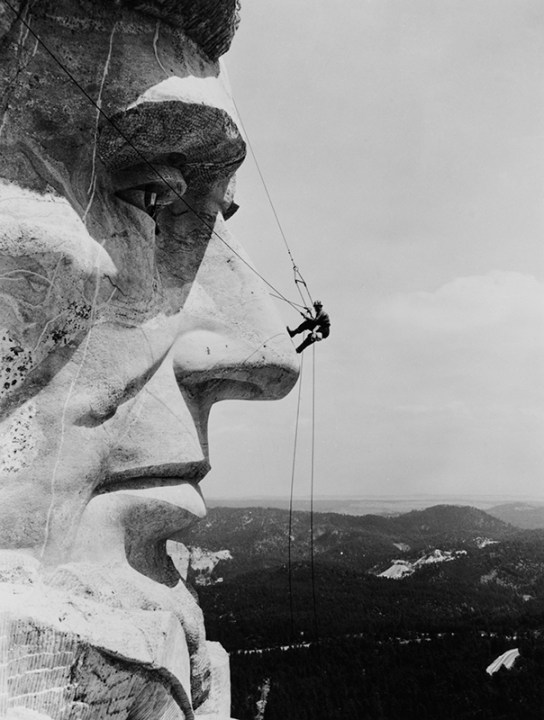

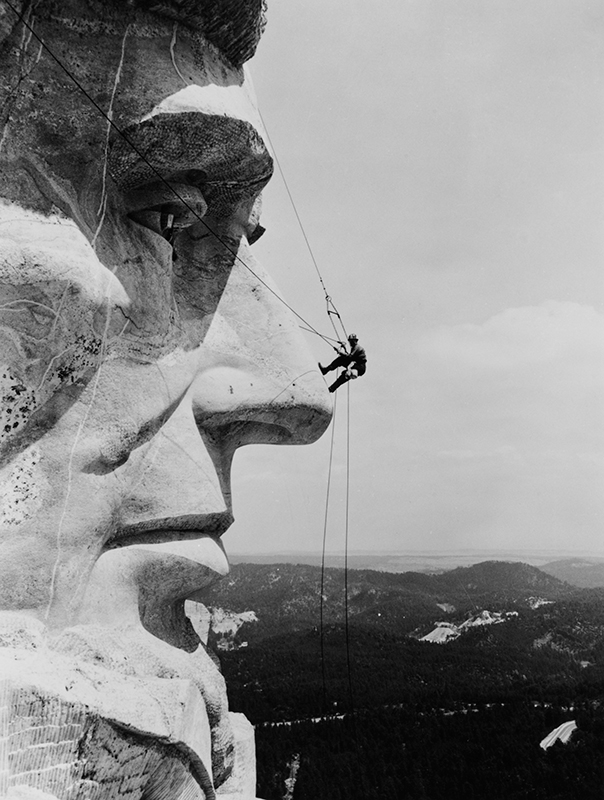
Personally, I regard Mount Rushmore as an excrescence on the mountain and a monument to the horror that Edward Abbey called industrial tourism. Beyond that, it is an expression of a naive piety and a patriotic sentimentalism that no longer exists in America. Matthew Davis correctly views the presidential sculptures carved into the face of Mount Rushmore in the Black Hills of South Dakota by Gutzon Borglum in the 1920s and 1930s as very much a period piece, an expression of popular American patriotism in the early decades of the 20th century. His “biography” of the mountain is equally a cultural work reflective of its time.
Preeminent among Davis’s concerns in writing this book was to determine, “What is a memorial for?” The question prompts a fair amount of pseudo-meditational pondering here, as well as the complaint against Borglum that he was unable to “transcend his times.” After all, Davis reflects, “The best artists operate on springboards, feet firmly planted in the present, ready to jump forward in style and ideas, pushing us as a humanity [sic] toward a new aesthetic and intellectual horizon.” (Is that really the aim of a true artist? It seems to me, rather, that this and similar notions have been responsible for most of the bad art that has been inflicted on the world over the past century and a half.)
The tragic nature of history is no secret but to persist in treating it as scandal, as the left does, guarantees trouble
In Borglum’s case, Davis believes that his work suffers from “his inability to think about the Black Hills not as a staid artistic canvas but as a breathing ecosystem imbued with meaning and history long before he stumbled upon the mountain in August 1925.” Hence his failure to include the face of a Sioux hero among those of the Great White Fathers represented there.
Yet Borglum was not concerned to memorialize the history of the Sioux but instead his own people in America. How “inclusive” can a memorial really be and still memorialize something? Davis never says, but from his description of the naturalization ceremony held at Mount Rushmore on July 3, 2020, and presided over by President Trump, one gathers that his views on the subject are latitudinarian. “That Rushmore reflects a certain version and vision of American history doesn’t sit well with me.”
Perhaps there’s room in the Grand Teton National Park to accommodate all the other ones someday. One hopes, however, that before a future artiste sets to work to deface an entire mountain range, he (or she) takes time to reflect on the fact that a multicultural nation implies that all of the cultures included in it, not that of the white European one alone, should be considered responsible for their sins and shortcomings (as well as their contributions) and held accountable equally for them.
Much of A Biography of a Mountain is a highly tendentious, already well-known, yet admittedly readable history of the Sioux people which I, having a much wider and deeply personal experience of the Navajo and Tohono O’odham tribes in Arizona, appreciated. Nevertheless, the implications of Davis’s account are wholly unrealistic. For instance, he takes Washington to task for attempting, through its western agents, to train the Indian reservations away from their native cultures and persuade them to assimilate to that of the white man. But to do otherwise has been – to the extent that the alternative was tried – to condemn the tribes to the perpetual penury and suffering experienced today by the residents of the Pine Ridge Reservation in South Dakota. Might may not make right, but it makes fact.
Leftists like Davis cannot accept this truth, while never ceasing to demand some sort of reparation, even revenge, for perceived historical injustices. But the demand of the Sioux protesters today – “Land Back!” – is patently irrational. In George MacDonald Fraser’s conscientiously researched Flashman and the Redskins, the author has Lieutenant Flashman of the British Army reflect, in regard to the conflict between the white man and the red one in the 19th century, as follows:
It doesn’t help when the two sides regard each other as greedy, brutal white thieves and beastly treacherous red vermin. I’m not saying either was wrong. The Indian’s tragedy was that being a spoiled and arrogant savage who wouldn’t lie down, and a brave and expert fighter who happened to be quite useless at war, he could only be suppressed with a brutality that often matched his own. It was the reservation or the grave; there was no other way.
Davis attacks Donald Trump for his address at Mount Rushmore in which he condemned “a merciless campaign to wipe out our history, defame our heroes, erase our values, symbols and memory of our national heritage,” and announced his intention to deploy federal law enforcement to “protect our monuments, arrest the rioters and prosecute offenders to the fullest extent of the law.” In the opinion of a Sioux rancher retired from the National Park Service, Trump’s words were divisive and designed to “pull the [hatred] out.” Davis concurs.
The tragic nature of history is no secret, but to persist in treating it as scandal, as the left does, guarantees trouble for everyone. Today, the United States stands at a political and cultural impasse that appears to be insurmountable. A multicultural nation, finally, is no real nation at all.
This article was originally published in The Spectator’s February 2, 2026 World edition.




Comments