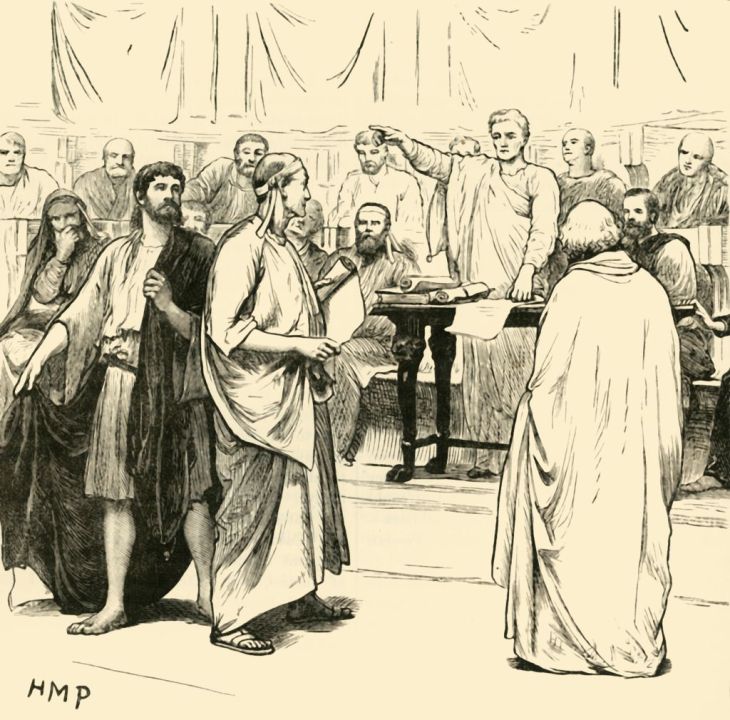

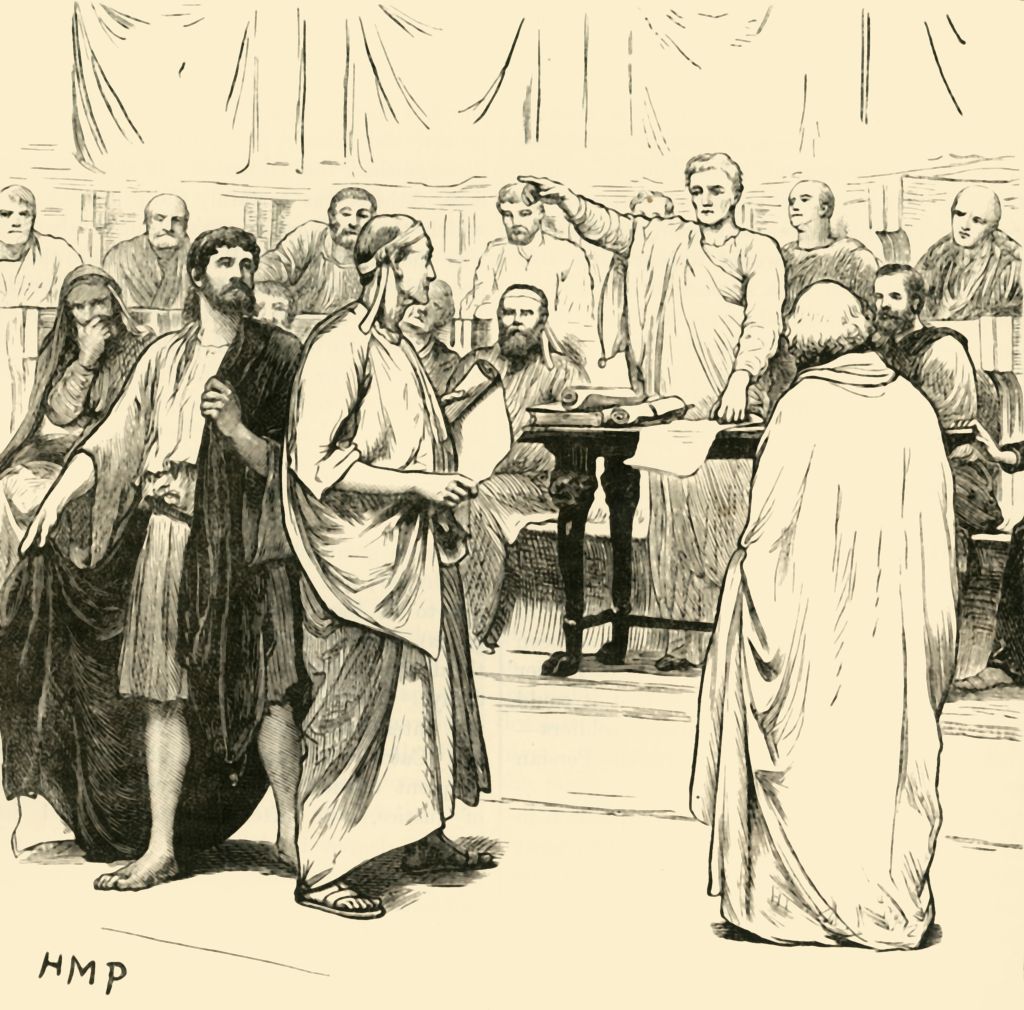
The scene is the imperial palace on the Palatine Hill in Rome in the 2nd century. The philosopher Favorinus is waiting to greet the emperor Hadrian when a grammarian corners him and launches into a lecture on the grammatical qualities of the word penus, meaning “provision.” “Well and good, master, whatever your name is,” Favorinus replies wearily. “You have taught us more than enough about many things of which we were indeed ignorant and certainly did not ask to know.”
A thousand years later, the Muslim polymath Ibn al-Jawzi tells of an Arabic grammarian, notorious for punctilious use of archaic language, attempting to negotiate with a carpenter. “What is the price that this pair of doors costeth?” the scholar asks. “Two pieces of shitteth, oh you idioteth,” comes the reply.
Naming your book On Pedantry might be thought a preemptive move against potential criticism
As Arnoud S.Q. Visser reveals in his thoughtful and gently entertaining cultural history of the phenomenon of pedantry, as long as there have been men whose business is knowledge – and we are largely talking about men here, aren’t we? – there has been a subset of those men who can’t help but lord their expertise over others.
The term “pedant” doesn’t appear until 15th-century Italy, where it referred to a professional teacher of Latin grammar, literature and rhetoric. It soon made the leap to the stage where the pedant became a stock character – a type of fool, unkempt, pompous and misguidedly confident in his own erudition. Pedants feature in 47 Italian plays over the following century, often speaking a ridiculous mock-Latin. “Master, with this infernal way of talking in grammouldian, with all these catacombries and smellegant latrinities, you infect the air, and make yourself a laughing stock,” the pedant Manfurio is told in Giordano Bruno’s The Candlebearer.

But Visser’s survey actually begins in the 5th century BC with the Sophists who, in Plato’s account, regarded argument as a contest to win – “a quarrel rather than a conversation” – not a means to learning the truth. In Plato’s Euthydemus, Socrates tells of two Sophists whose stock-in-trade was “refuting whatever may be said, no matter whether it is true or false.” Such figures, Visser argues, are the first pedants avant la lettre.
Naming your book On Pedantry might be thought a preemptive move against potential criticism. What could any critique of it be but pedantic? Perhaps it is even a trap for unwary reviewers. If so, I will blunder in. Visser’s working definition of pedantry is “the excessive use or display of learning.” But, as the example of the Sophists illustrates, much of his material really exemplifies the inappropriate use of learning, which is not quite the same thing.
In trying to define the acceptable uses of intellectual skill, Plato laid the foundations for centuries of philosophical boundary-policing. Similar contentions characterized the rise of scholasticism around the turn of the 12th century.
One leading exponent, Peter Abelard, was scathing about the traditionalists’ intellectual qualities. “He had a remarkable command of words but their meaning was worthless and devoid of all sense,” he said of Anselm of Laon. “The fire he kindled filled his house with smoke but did not light it up.” But Abelard’s reliance on human reason, Bernard of Clairvaux countered, meant that “mere human ingenuity [was] taking on itself to solve everything, and leave nothing to faith.”
Arguments about the primacy of reason re-emerged in the US after the American Revolution, as the country sought to throw off the shackles of European thought. Benjamin Rush, who signed the Declaration of Independence, thought all classical learning “a formidable enemy of human reason.” Who was more absurd, he asked: “The Chinese who press the feet into deformity by small shoes, or the Europeans and Americans who press the brain into the obliquity of Greek and Latin?”
Visser describes On Pedantry as a study of “how intellectuals are cast as outsiders” and in places it becomes a survey of wider anti-intellectual currents, typically framed as a form of democratization. Others wondered how democratic such arguments really were. For example, the African-American classicist William Sanders Scarborough saw traditions of learning as an emancipatory force which would create an “aristocracy of intelligence and character.”
It is these debates about the value of scholarship that most engage Visser. He is much more interested in wider criticisms of intellectual practice, whether from fellow intellectuals or from the citizenry, than in pedantry per se. The final chapter is largely devoted to the changing image of the professorial class in film. The new horizons for pedantic point-scoring and one-upmanship opened up by the internet are touched on but mostly underexplored.
On Pedantry will perhaps find its widest readership among somewhat masochistic intellectuals, self-styled or otherwise. But there is much for the rest of us livelier mortals to enjoy – and much to ponder in an age of rampant hostility to the idea of expertise.
This article was originally published in The Spectator’s February 2, 2026 World edition.




Comments