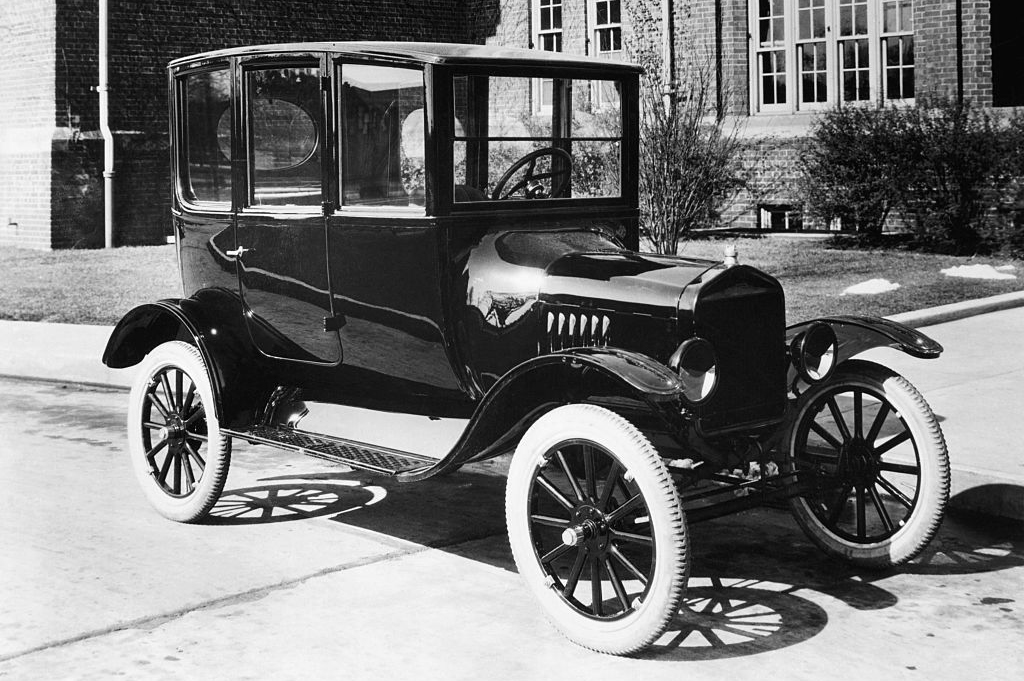
The beginning of Crucible, the writer and Oscar-nominated director John Sayles’s eighth novel, opens with a feint. A couple of journalists are taken for a mock-perilous test drive at the presentation of Henry Ford’s latest automobile. On their return, what starts as a humorous Q&A becomes increasingly restrictive as it becomes clear there is to be one narrative only: the company’s, or rather, the founder’s. This familiar combination of showmanship and control may feel ubiquitous now, but the audacity of Ford and the outrage he provoked was to change the face of American industry.
Crucible moves between two narratives, both involving rivers: the lives of those at the vast River Rouge Michigan factory complex – “the Rouge” – and Fordlandia, Ford’s disastrous attempt to create his own rubber supply and workers’ city in the Brazilian Amazon. Against a chaotic backdrop of wider culture which includes the Wall Street crash, Prohibition, the Lindbergh kidnapping, Joe Louis and Diego Rivera, Ford’s world is insular and tightly controlled. This pressure means it is, inevitably, waiting to explode. Sayles handles the frequent ugliness of unstoppable modernity and power with a deftness which reflects our technological and political present. The novel’s headline-courting protagonists attempt to execute their own variations of Fordism, but regarding people as lower than processes is ethically and socially fraught.
The opening Q&A takes on a different light with the knowledge that beginning in 1919, Ford published a local paper, the Dearborn Independent, to amplify his dislikes and promote his views – including anti-Semitism. Some of Ford’s dislikes appear comically random (bankers, fat people, jazz, Hollywood films) but paint a picture of a man keen to control both his narrative and the wider world’s.
While focusing largely on the hardships experienced by Ford’s employees, Crucible is not without bleak humor. When a character’s wife remarks that his foundry job “sounds like Hell,” he replies: “In Hell you got all Eternity to burn, and you can take your time. Mr. Ford got us on the clock.” There are many clouds but few silver linings for Crucible’s characters. Opportunities are less a choice than survival for those on the margins, desperate to hang on as the world accelerates. But the margins, as Sayles astutely shows, are precisely how and where Ford’s world comes to life.
Sayles manages the impossibility of writing an account of Ford’s empire without the gratuitous inclusion of contemporary stereotypes and prejudices. Some may flinch at the bigotry with which Ford, his cronies and employees alike refer to the Jewish, black and other minorities they deal with on a daily basis, but the context remains clear. Rather than erase this for the sake of an inoffensive but unrealistic story, Sayles opts for a complex, nuanced picture of everyone involved. After all, a great man’s mythology is dependent on the scores of largely invisible people who bring his innovations to life, as well as those who clash with him. Their bonds with each other are more important than their connections to Ford.
Historical novels risk falling into a trap of becoming a literary folly with passing regard to the source material, but Sayles has intimately researched his subject. Crucible is a carefully realized model of a world where the writer’s precision is in harmony with the director’s vision. A subplot featuring Jim Rogan, a sawmill operator sent to Brazil, is based on his real-life counterpart John R. Rogge, who was said to have had a “keen ethnographer’s eye.”
Sayles utilizes this to vivid effect in showing us a “promiscuous” and “ravenous” Amazon which is its own Hell, nevertheless existing on Ford’s clock. In giving us a study of Ford via the lives of the people in his extended universe, Crucible is a feat of storytelling. Through this polyphonic account, Sayles avoids the clichéd presentations of genius.
Ford himself rarely appears, and when he does it is in contradictory fragments. These fragments show a man more emotionally attached to his right-hand “enforcer” Harry Bennett than his son Edsel. He despises experts while remaining oblivious to the inevitable results of their absence. He is also a visionary obsessed with creating an industrial utopia in the jungle, but is indifferent to the plight of his workers closer to home.
A glimpse of a more relatable humanity comes at a lunch with Rivera, who was commissioned to paint what become the “Detroit Industry Murals” (1932-33). Among them was one titled “Vaccination” which the muralist thinks is “likely to offend.” Industrialist and artist bond over progress and process, which reveals the deep curiosity of the man synonymous with a very American kind of empire. Amusingly, Rivera’s politics are less an issue than his physicality, with Ford excusing the former with the thought that communists don’t like bankers either.
Any account of Ford, fictitious or biographical, is one of America itself. It must reflect both race and politics, with the challenge being how to combine such an abundance of information with an engaging story. Despite the constant Damoclean specter of the present dangling over Crucible’s pages, Sayles is resolutely uninterested in casting a reductive eye on his subject. Entertaining and intelligent throughout, this is the literary equivalent of Rivera’s panoramic murals: a colorful testament to the people and ideas which change the world in both grand and insignificant ways.
This article was originally published in The Spectator’s February 2, 2026 World edition.





Comments