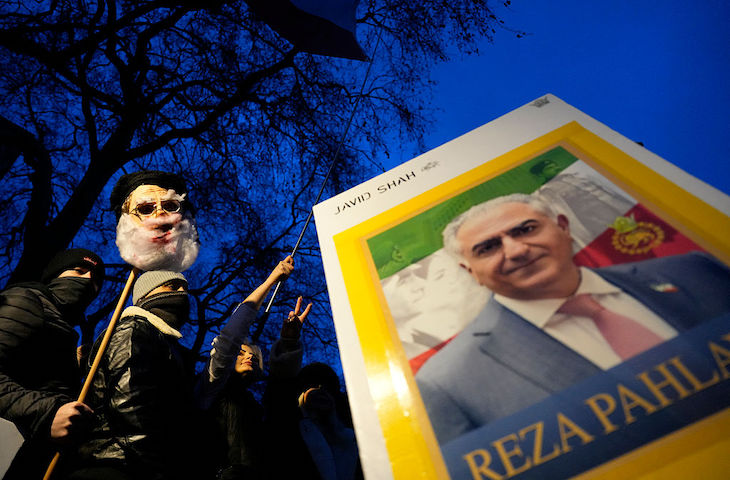
When authoritarian regimes start to wobble, outside observers often reach instinctively for the single, familiar idea of ‘the alternative’. It is a human reflex, but a dangerous one. In Iran, as the clerical theocracy shows signs of fracture and the country’s crisis deepens, some Western voices have begun to flirt with a thought that feels neat and historically legible: the return of the Shah’s son. That would be a profound mistake.
Iran doesn’t need a restoration
Iran’s tragedy since 1979 has been that an autocracy was replaced by another autocracy. The lesson should be plain: changing the personality at the top is not enough. What matters is the nature of the state and the source of its legitimacy. Iran does not need a restoration. It needs a foundation for a democratic future.
It has been argued that Reza Pahlavi could play a unifying role, perhaps as a symbolic constitutional monarch. But this misunderstands both Iran’s recent history and the political psychology of revolutions. The last Shah was not a constitutional monarch in the British sense. His rule was marked by coercion, political exclusion, and the suppression of opposition. Whatever one thinks of the scale of Iran’s material progress during that era, the Shah’s state was not built on consent, but on control.
That history has not evaporated. A monarchical restoration project would reopen it, harden old resentments, and fracture an opposition that already faces immense pressure from a regime skilled in infiltration, intimidation, and narrative warfare. It would also hand the clerical establishment, or whatever remained of it, an easy propaganda weapon: that the only available alternative to religious tyranny is the return of dynastic rule backed by foreign sympathisers.
Most popular
Steven Edginton
Invented claims of lynchings and racist violence are irresponsible — and dangerous

That, in turn, would make it harder for Western governments to support a democratic transition. Even sympathetic policymakers would hesitate if the transition were presented as a contest between rival strongmen or alternative historical myths. The result would be a vacuum, and recent history tells us that vacuums in collapsing states are rarely filled by moderate, benevolent democrats.
The West should therefore be clear about what it will support in Iran: not a person, but principles. Not a dynasty, but a democratic programme. Not nostalgia, but a fresh start.
This is where the National Council of Resistance of Iran and its associated movements have a relevance that demands serious consideration. The NCRI’s purpose is not to crown an heir or anoint an exiled leader, but to argue for a defined, democratic transition.
NCRI president-elect Maryam Rajavi’s ten-point plan has the virtue of stating, plainly and publicly, what a post theocratic Iran should look like.
Its essentials are those of any genuine democracy: free and fair elections, political pluralism, freedom of expression, separation of religion and state, equality for women, protection of minorities, an independent judiciary, and the abolition of the death penalty. It commits to a non-nuclear Iran and to peaceful international relations. Above all, it places legitimacy where it belongs: with the Iranian people, expressed through the ballot, under the rule of law.
One can debate any opposition movement’s internal arrangements, history, and tactics. That scrutiny is healthy. But the strategic question now is simpler and more urgent. If the clerical regime weakens further, what does the international community recognise as the direction of travel? What does it encourage, and what might it inadvertently sabotage?
If the West allows itself to drift into a lazy restoration narrative, it will do active harm. It will divide the opposition, validate the regime’s ‘foreign plot’ storyline, and obscure the real imperative that has driven so much Iranian courage over recent years: the demand for citizenship over servitude.
A serious transition policy begins with three propositions. First, there must be no deal-making with the state’s security apparatus in the hope of order at the price of justice. Iran’s future cannot be built on impunity for those who have enforced repression.
Second, there must be no externally-imposed settlement, whether in the form of a restored monarchy or a contrived ‘national unity’ figurehead. The Iranian people have earned with their blood the right to choose who governs them.
Third, Western governments should align themselves explicitly with democratic criteria, and measure would-be transitional authorities against them: elections within a defined period, an independent judiciary, the protection of women and minorities, and a clear break between religion and state.
Iran stands at an historic threshold. If it crosses it, the decisive question will not be who returns from exile, but whether the new political order is built on law, consent, and accountability. The West should not look for a Shah. It should look for the architecture of a democracy.
If we have learned anything from the contemporary Middle East, it is that stability purchased at the price of legitimacy is never stable for long. Iran deserves better than a choice between two pasts. It deserves a future.






Comments