Ysenda Maxtone Graham

The perils of prep

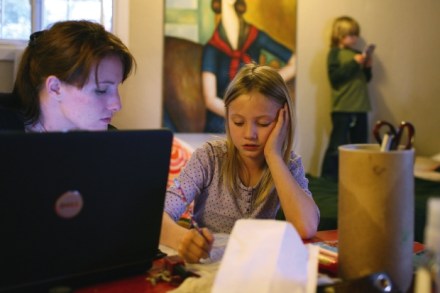
‘We will have to look at how we are doing things. Will we even be doing prep?’ So spoke Eve Jardine-Young, principal of Cheltenham Ladies’ College, this summer, galvanised to speak out by the alarming increase in depression among teenagers. It was brave of her even to question the need for prep: in our age of competitive league tables, it seems heresy to suggest any kind of decrease in daily output from students. But she is right to question it, and I hope her tentative question will soon be transformed into an untentative statement: prep should not be routinely given, and it should only be given if there’s a compelling reason for doing so. This would get rid of the vast majority of prep that children are set at the moment.

The breast test

How should a new mother feed her baby? You might well imagine that was up to her. While some mothers take to breast-feeding as if their bosoms have been waiting all their lives for it, others find it exhausting, excruciating and demoralising. Sacrificing every waking hour to nature’s cause, they still produce a mere soupçon of milk, not nearly enough to satisfy a ravenous baby. So isn’t it sometimes better to bottle-feed, with formula milk? Beware. To do such a thing, in our guilt-ridden, competitive age, is seen as stepping into an abyss of last resort. Never mind that your baby will stop crying at last, fall blissfully asleep: the goody-goody breast-feeding mothers in your NCT group will mentally vilify you as a slovenly baby-poisoner.

Pop psychology

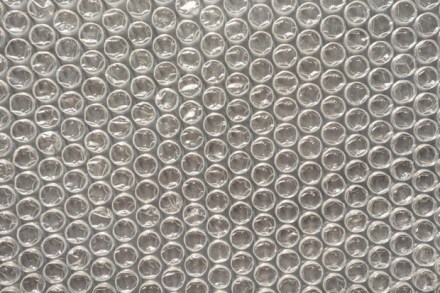
It’s not quite as bad as we feared: Sealed Air, the company in New Jersey that makes bubble-wrap, is not yet discontinuing poppable bubble-wrap. But its newly designed sibling, non-poppable bubble-wrap, surely spells the end for the real thing: it’s cheaper to ship, because it leaves the factory airless and thus can be ‘flat-packed for your convenience’. The companies who receive it will need to buy an expensive pump to fill the reams of polythene with columns of air, and that air will be beyond the popping power of human fingertips. Panic broke out among the bubble-wrap-popping millions across the globe on hearing the news of the threat to their habit earlier this month. The pastime is universally adored.

Some animals are more equal than others

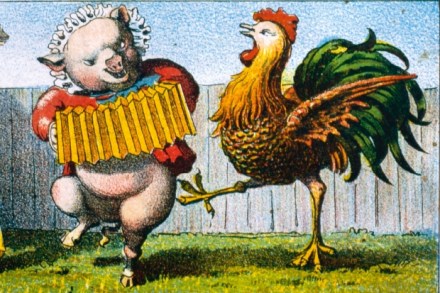
Here are two parallel books, both by Americans, both 260 pages (excluding indexes) long, both using ‘likely’ as an adverb. One looks at the history of the world through the story of the chicken; the other does the same through the story of the pig. Which would you prefer? I found the chicken one harder going — like ploughing through one of those brilliant but exhausting New Yorker articles that never seem to end, for which the journalist with too generous a budget has spent years interviewing hyper-specialist scientists in labs and ‘facilities’ across the USA — but I found the pig one sadder.

Privet sorrow

It is said that the road to hell is ‘paved with good intentions’. Well, so is the typical front garden in what used to be our green residential streets. In the last ten years, 13 per cent of the lush greenery in British front gardens has disappeared; 4.5 million of our front gardens are now entirely paved over. We used to laugh at overgrown front gardens populated with bearded garden gnomes; but those are surely preferable to grey rectangular deserts of nothingness, mere off-street parking spaces for the car. An exemplary front garden has been created for this week’s Chelsea Flower Show, demonstrating how parked cars and plants can and should live together in harmony.

Brian Sewell does some donkey work: how Britain’s best-known art critic put his ass on the line

I suppose all children’s authors write the stories they would have liked to read as children. But in the case of this novella about a sensitive man called Mr B who rescues a donkey in Peshawar, names her Pavlova after the ballerina, and brings her overland all the way back home to Wimbledon to meet his dogs named after women painters of the 20th century, this feeling that the target reader is the childhood author himself is overwhelming. You learn more about the young, sweet, aesthetically precocious Brian Sewell while reading it than you do even about Persian carpets and the dusty towns on the old Silk Route. This is the old Brian Sewell telling a story to the young Brian Sewell. Both are soppy about four-footed animals, so the bringing-a-donkey-home storyline is ideal.

In praise of messy old kitchens

‘I love my new kitchen heart of the home let’s fill it with friends happy.’ So says the thought bubble in the current ad for the estate agents Rightmove, part of their ‘Find your happy’ campaign. Don’t even get me started on the lack of punctuation — or the use of ‘happy’ as a noun. What I’m worrying about is the kitchen itself. Glimpsing Ed Miliband’s second kitchen last week, we came face to face with the drabness of today’s hyper-hygienic kitchen. Is the kitchen really ‘the heart of the home’ in Rightmove’s imaginary domestic paradise, or is it in fact one of those spotless, minimalist, metallic kitchens, all hard surfaces and sharp corners?

The truth about private school admissions

In recent years I’ve started putting the verb ‘to get in’ (when it refers to the action of being offered a place at a sought-after school) into capital letters: ‘To Get In’. It seems to merit capitals, so much has it become the defining verb of one’s child’s success and therefore future happiness, as perceived by the desperate parent. ‘He Got In to Eton.’ ‘She Got In to Latymer.’ Or (whispered only to one’s most trusted friends), ‘He didn’t Get In to St Paul’s.’ I suppose it’s quite amusing that being able to Get your child In to the private school of your dreams is the one prized item that the fee-paying middle classes cannot simply buy. The Getting In system is a meritocracy.

It takes a village (or six): the battle for rural churches

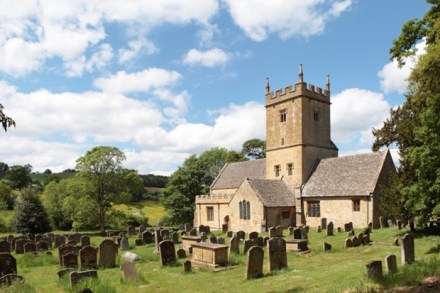
Some of the longest job descriptions belong to rural Church of England clergy. ‘So what do you do?’ ‘I’m the Rector of Aldwincle, Clopton, Pilton, Stoke Doyle, Thorpe Achurch, Titchmarsh and Wadenhoe.’ Every one of these place names evokes an ancient Pevsner-worthy church, smelling of candlewax, damp hymn books and brass polish. Though many villages no longer have a shop or a pub, most do still have a parish church used for regular services — even if only on the first and third Sunday of the month. You push open the creaky door, and last Sunday’s hymns are still up on the hymn board.

How to stop being scared of full stops

Typical mother-to-mother email, January weekday, 2015: ‘Thanks so much for helping out yesterday, Jamie had a great time with you all, thanks also for bringing his games kit home, let me know if you need me to help tomorrow… xx’ Emails and texts like this, flitting across the ether in their thousands, demonstrate the free-flowing currency of helpfulness — mother going the extra mile for mother, in her Volvo, every day — in school-run land. But have you noticed the appalling punctuation? The use of the ‘weak comma’, or ‘splice comma’, where there should be full stops? My guess is that you have, especially if you are over 45 and went to a good school: one at which you were well punctuated.

Bish bash Bosphorus: Elif Shafak’s saga of love and death in Istanbul is crammed with incident on every page

If you like to curl up by the fire with a proper, old-fashioned, saga-style tale about a boy and his elephant in Istanbul in the 1500s, The Architect’s Apprentice might be suitable for you. My heart sank slightly when the review copy arrived: a 452-page brick by an Orange-Prize-shortlisted Turkish author and ‘global speaker’ who ‘blends western and eastern methods of storytelling’ and has 1.6 million Twitter followers. But I resolved to get caught up in the novel and did.You have to suspend all need for irony and modernity and latch on to Jahan, the Indian boy who is the central character. As a child Jahan stows away on the evil Captain Gareth’s ship in order to stay with Chota, his beloved white elephant who nearly dies on the journey.

A beautiful speaking voice is a window to the soul

Recent text from a female friend. ‘I’m in love with Neil MacGregor.’ To which I reply, ‘But of course! Up there with the Dean of Westminster and Frank Gardner.’ The same day, walking in Kensington Gardens, another friend admits, ‘I think I’m in love with Neil MacGregor.’ We mourn the fact that MacGregor’s Wikipedia entry tells us he’s ‘listed in the Independent’s 2007 list of most influential gay people’, so the director of the British Museum is, sadly, out of reach to womankind. It’s his beautiful speaking voice that does the trick. I like the way, in his Radio 4 series Germany: Memories of a Nation, MacGregor pronounces ‘Germany’, with a sounded ‘r’.

In search of dead men’s bones

Skulls, femurs, ribs, pelvises, piled on top of each other in a chaotic heap: this, Denise Inge discovered, was what she and her husband John were living on top of in their pretty house in Worcester Cathedral Close, into which they had recently moved when John became the diocesan bishop. The house is on top of a medieval charnel house that can be reached by opening a trap-door in the cellar. Inge opens her book with these words: I live over dead men’s bones. Dead women’s, too, for all I know. Every day when I leave my house to escort my children to school, I walk over them.

It’s not easy for a middle-aged woman to get inside the head of a 12-year-old innkeeper’s son in 1914

Esther Freud wrote dazzlingly in the first person through the eyes of a five-year-old child in her first novel, Hideous Kinky (1992). What made that book so captivating was the young narrator’s sweet, naïve total acceptance of the chaotically nomadic existence her hippy mother brought her to in Morocco. The first-person voice was enchantingly concise, always noticing colours, as little girls do (‘the red and green town’), and unquestioningly stating the facts: ‘Bea and I waited at the Polio school while Mum looked for somewhere else to live.’ Freud’s latest novel, Mr Mac and Me, is also written in the first person through the eyes of a child: a 12-year-old boy in 1914 called Thomas Maggs, the only surviving son in a large and poor innkeeping family near Southwold.

Decline and rise again

Verb says to noun, ‘Would you like to conjugate?’ Noun replies, ‘No, I decline.’ A nice witticism for Latin-lovers brought up on L.A. Wilding’s Latin Course for Schools; but do today’s prep-school Latin pupils have any idea what a conjugation or a declension is? Some do and some don’t, is the answer, and it all depends on which textbook your teacher uses and how much he or she believes in the importance of grammar over the importance of enjoying a story. The story of Latin teaching in this country over the last 130 years has been one of reaction and counter-reaction; and there are signs of a counter-counter-reaction on the way. First, there was Kennedy’s Latin Primer (1888).

The vote on women bishops is a triumph for our diplomatic Archbishop

The result of Monday’s vote on women bishops, the Archbishop of York stipulated, must be greeted in silence, as is the convention at the General Synod. This, perhaps, was a misjudgment: it would have been more natural, surely, to allow an instantaneous mass-whooping for joy and an outbreak of uninhibited Anglican hugging, rather than to force everyone to sit tight through two or three tedious extra amendments and then to make them all stand up and start singing and swaying to ‘We Are Marching in the Light of God’, which was what happened. But, say those who are delighted with the outcome of the vote, the Archbishops of York and Canterbury must be praised for their work in bringing this vote to fruition.

The Snow Queen crawls at snail’s pace – and you wouldn’t want it any other way

For all would-be novelists whose stumbling block is that they can’t resist describing every single sensation in depth — the smell of a bedroom, the sound of a door closing, the feel of a sofa, the experience of getting in and out of a bath — and who therefore find it hard to push a plot along, Michael Cunningham’s new novel is a masterclass.  The Pulitzer-prizewinning author of The Hours (in which three-quarters of a page is taken up with an unforgettable description of the armchair of an ill man) is a chronic over-describer.

When No Man’s Land is home

Countless writers and film-makers this year will be trying their hand at forcing us to wake up and smell the first world war.  How do they plant a fresh, haunting, horrifying image into our unwilling and saturated heads? We know it all: the trenches, the mud, the shell holes, the rats, the man plodding towards the house with the telegram, the local surnames repeated with different initials on the war memorial. All very much in the ‘too sad to think about’ department, particularly if you love Edwardian children’s stories and start contemplating What Happened to Oswald Later. Helen Dunmore, an assured writer who in a previous novel has forced us to live through the siege of Leningrad with its freezing and starving babies, does not shirk from her task.

There is nothing quite like the prep-school play

Letter home from prep-school boy, c. 1949: ‘Dear Mummy and Daddy, last night was the school play. It was Hamlet. A lot of the parents had seen it before, but they laughed all the same.’ Guffaws from the audience at lines that are not supposed to be funny; total absence of laughter at lines that are: these are what actors and directors dread. The world of prep-school drama has come a long way since 1949. The three-hour Shakespeare tragedy marathon has generally been ditched in favour of swiftness and inclusivity. Under an hour is the preferred length, and it is not done to have lengthy black-outs while scenery is changed. Props have been simplified: one armchair is shorthand for a drawing room, one hay bale for a barn, one front door for a house.

As Green as Grass, by Emma Smith – review

The title, the subtitle, the author’s plain name, even the jacket’s photograph of a laughing old lady in sunglasses: none of these is particularly enticing. But the book itself is a delight. Written in the crisp present tense by a 90-year-old with a remarkably clear recollection of the trains of thought of her teenaged and post-teenaged self, it draws you deeply in, so that by the end you feel that you, too, have been to a harsh girls’ school in Plymouth, and then to a keyboard-clattering secretarial college in Surrey and then — best of all — that you have manned canal boats carrying coal from Birmingham to London during the war years with your friends Kitty and Eve.