Ysenda Maxtone Graham

A Corner of Paradise, by Brian Thompson – review

Author has late-blossoming romance with authoress, both divorcees, and they live together in a cramped house in Harrogate full of stepchildren and then buy a derelict summer house surrounded by vast maize fields in the Charente-Maritime, but are no good at DIY, and they make friends with the locals who help them build a walled garden. They write books. Author is talkative and likes company; authoress prefers silence and solitude. They move from Harrogate to Oxford. One of them has to die first, and it’s the authoress, and it’s cancer, and the author is left bereft and describes the experience all too well. That, in a nutshell, is this book. Good books about being old but feeling young are rare and this is one. Brian Thompson knows how to keep the reader reading.

Don’t jump, Felipe!

Peering over my son’s shoulder as he forced himself through a pile of practice IGCSE maths papers in readiness for this week’s exams, I was shocked both by the absence of pounds sterling and by the ardently international imaginary first names dreamed up by the question-setters. That ‘I’ stands for ‘international’ — and goodness, you’re not allowed to forget it. ‘Nyali paid $62 for a bicycle.’ ‘Alejandro goes to Europe for a holiday. He changes 500 pesos into euros at an exchange rate of…’ ‘Abdul invested $240…’ ‘At 05 06 Mr Ho bought 850 fish at a market for $2.62 each…’ ‘On 1 January 2000 Ashraf was x years old.

Brace yourself for the real experience of going to a rural parish service on Easter Sunday

‘And we extend a special welcome to all our visitors here today.’ That’s the vicar speaking; and this Sunday is one of the two days in the year when you are likely to be one of those visitors. You’re spending Easter with in-laws or friends who live in the country. Easter wouldn’t feel like Easter without Eucharist at the local C of E church after the first mini-egg of the day, so here you are, in tweed and wool, breathing in the timeless smell of damp and candle-wax as you try to prop up the paperback hymn book called Praise! on the pew shelf but it is too big and keeps flopping forward.

A Green and Pleasant Land: How England’s Gardeners Fought the Second World War, by Ursula Buchan – review

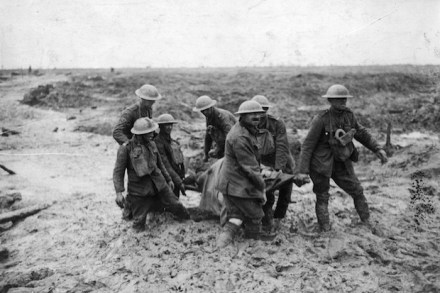
Here are some statistics about wartime fruit- and vegetable-growing in England which this book tells us. In 1942-3, there were 1,750,000 allotments, amounting to 100,000 acres, or an area the size of Rutland. But in a 1944 survey, it was discovered that only 34 per cent of urban gardens were growing fruit and vegetables, and only 10.9 per cent of households cultivated an allotment. The north-west of England turned out the worst figures, with only 28 per cent of households growing vegetables. As Ursula Buchan writes, ‘Picking sun-warmed greenhouse tomatoes to add to a salad is a pleasure; weeding round shot-holed brassicas on a windswept allotment is not.’ And this was what weary English householders worked out for themselves, as the war wore on.

Leaving Sussex

I read William Nicholson’s new novel in proof before Christmas. ‘The must-read book for 2013 for lovers of William Boyd and Sebastian Faulks,’ it said on the back. Well, I like Boyd and Faulks, but I positively love William Nicholson, so I found that come-on slightly grating. Then I saw what the publicity people meant. Nicholson has broken out of his small, square two inches of ivory. His previous three novels were set over the course of a few days in the southeast of England. A typical chapter was called ‘Saturday’. Motherland spans 11 years, set in Sussex, France, India, Jamaica and New Orleans. Part One is called ‘War: 1942-45’. The pivotal scene of the book is a seaborne raid on the beaches of Dieppe.

Telling tales out of school

The difficult thing about writing a memoir is this: how do you avoid numbing the reader with endless thumbnail sketches of the hundreds of characters who have crossed your path? It’s easier in a novel, where you might have seven to ten main characters and can take time to delve deeply into each one.  In a memoir which spans a long life from pre-war Eton to modern-day Yorkshire, you need to be a very good writer indeed to bring alive, for instance, Mrs Tedder, who did the washing-up at Sunningdale School in 1953. Are you interested? Well, I’m happy to tell you that you are. Wild Writing Granny is a book full of delight. It is shot through with love, anguish, light, darkness and fun.

As dark and heavy as plum pudding

Dressed up as a child-friendly, pocket-sized hardback, just the right size for a Christmas stocking and with a pretty front-cover illustration of two dear little children in a snowy fir forest, Inventing the Christmas Tree (Yale, £12.99) is actually a learned 90-page thesis on the history of the Christmas tree by the German author Bernd Brunner, who has also written monographs on bears, the moon and snowmen. As it’s translated into American, we have gray, color, luster, skeptics and travelers. But rather than reading it in an American accent, I read it in a German one.

Keeping calm and carrying on

An ordinary woman, rather like yourself.’ These were Peter Fleming’s words when he commissioned Jan Struther to write what became her ‘Mrs Miniver’ columns for the Times. Critics complained then, and have complained ever since, that Mrs Miniver is no ‘ordinary woman’. She rings the bell for tea, takes taxis everywhere, and has a second home in Kent. As I read These Wonderful Rumours, the 1938-1945 diaries of a Derbyshire schoolteacher in her twenties called May Smith, I kept thinking, ‘Here is your perfect ordinary woman.’ And I was not being pejorative. Ordinary does not mean dull. It means unpretentious and normal.

Radio insomnia

It’s 2.43 a.m. Unable to sleep, you reach out into the night for company: literally. Out goes your arm, towards the radio on the bedside table, and you grope for the ‘on’ button. You bring the radio close to you: a hard, cold, rectangular cuddly toy with an aerial instead of ears, and you turn the volume down as low as you can so that it won’t wake your sleeping companion, if you have one. When a radio is this close to your eyes, you see two of each of its parts. If Radio 4 is your daytime listening, you’ll find yourself in World Service Land at this time of the night.  The first sentence you’ll hear will be something like, ‘The group is believed to have carried out a number of attacks in northern Nigeria.

There’s something about Mary

I like books which have their own linguistic microclimate. Fictional first-person narratives are where you tend to find these.  The moment you step inside a good one, you enter a distinctive country as encountered by the narrator, using his or her limited vocabulary. It’s the very constrictedness of the vocabulary that makes the story gripping: it forces you to live inside the narrator’s mind. Blinkered fictional characters created by unblinkered authors can make for surprisingly illuminating books.   How about this for a microclimate to step into? this is my book and i am writing it by my own hand. in this year of lord eighteen hundred and thirty one i am reached the age of fifteen and i am sitting by my window and i can see many things.

A hymn to the organist

Some people swoon over film stars. I swoon over organists. Good organists, that is, not bad organists. Bad organists I refer to as ‘dominant males’, because the only two chords they play are the tonic and the dominant. Good organists are upholders of some of the highest musical expertise in the land. When you hear the stops being pulled out for the voluntary on Easter Sunday (will it be Bach? Will it be Widor?), spot the organist, and see if you experience a frisson. Here are ten reasons for my partiality. The muscle at the far edge of the palm of each hand. (The one giving strength to the little finger.) It’s amazingly strong. I’m much more interested in this muscle in a man than in his abdominals or, worse still, his biceps.

Travel: Opened secret

Once, Avignon was hell to get to. Now it’s an easy train journey. Let Ysenda Maxtone Graham, who has known it for decades, show you around The interminable car journeys to Avignon of my childhood! Crammed into the back of the Mini with my sister. ‘Are we nearly there?’ when we were only at Dijon. Hard-boiled eggs and sausages in a polythene bag. The heart-sinking moment when my parents stopped the car for a few hours to have a ‘little sleep’. The bliss of a glace from the Elf petrol station. Not being nearly there even when you were going through the Lyon tunnel. Still at least two hours to go. Now, if you get the 07.17 Eurostar from St Pancras on a Saturday morning in summer, you can be having a late lunch in the square at Avignon at 2 p.m.

Rather a cold fish

Published first novel (Salmon Fishing in the Yemen) at the age of 59, Richard and Judy choice, won Bollinger Everyman Wodehouse Prize for Comic Fiction; spent his whole career in industry; lives in Northumberland, wears tweed cap, likes fishing…These are the facts you read about Paul Torday time and again, and he must be getting tired of them.    That first book really was good: the kind of novel you wish you’d written yourself, all done in emails, extracts from diaries and letters, snatches of Hansard, articles in newspapers, transcripts of interrogation sessions. It was a charming satire, about politicians, entrepreneurs and fish. His late career-change and success gave hope to thousands of 59-year-olds.

Revving up

The C of E’s pioneer women priests are waiting anxiously for their first female bishop Diocese by diocese, the Church of England is voting in favour of women becoming bishops. Last week Truro, Norwich, Blackburn, Rochester, St Albans, Wakefield and Winchester gave their ‘yes’ vote to the draft legislation, bringing the total to 29 dioceses out of 44 in favour, well over the 50 per cent mark needed to allow it to go back to the General Synod for final approval next year. So far only two dioceses have voted against: Chichester and London. And even London (a notoriously prickly diocese on this issue) very nearly voted in favour. House of Bishops: two in favour (Kensington and Stepney), one against (Edmonton) and one abstention (the Bishop of London himself).

The Golden Hour by William Nicholson

He’s got a winning formula, this writer, and he’s sticking to it. Set the action over seven days, in and around the Sussex town of Lewes, with occasional day trips to London; write about what you know (Sussex, script-writing, being 54, long marriages, worrying about your post-university children as well as your aged parents with Alzheimer’s, career anxiety, dinner-party anxiety); keep the chapters short (never more than ten pages) and avoid slabs of prose, so the pages are broken up into highly readable short paragraphs and dialogue; write in the present tense; and, within each chapter, keep a strict observance of the Unity of Person, so that the reader steps inside the mind of one character and sees the world solely through his or her eyes.

Textbook error

If young people don’t want to learn languages, it might be because the teaching materials are so drearily trendy Tonight’s homework: learn ‘Bonjour’, ‘Je m’appelle,’ ‘Comment t’appelles-tu?’ ‘Ça va?’ ‘Ça va bien’, ‘Pas mal’, and ‘Qu’est-ce que c’est?’. And the tired child, already sick to death of French, having been taught it since the age of three but never methodically, starts climbing the Everest of trying to master these horrible, spiky phrases, with their sudden apostrophes, their ­unexplained hyphens, and the dangly fives under some but not all of the ‘c’s.