The Spectator

Hilary Mantel, 1952 – 2022

From our UK edition

Hilary Mantel has died at the age of 70. She became the first-ever winner of The Spectator/Shiva Naipaul Memorial Prize for travel writing in 1987. Mantel wrote for The Spectator as its film critic until 1991. She went on to win the 2009 and 2012 Booker Prize for Wolf Hall and Bring Up the Bodies. Below is Hilary's prize-winning piece on Saudi Arabia; the judges 'particularly admired her ability to convey not only the discovery of a culture new to her but also the distaste which the discovery aroused', said then-editor of The Spectator Charles Moore.

In search of Trussonomics

From our UK edition

When Liz Truss entered the leadership race there was no such thing as ‘Trussonomics’. She began her campaign with no real expectation of winning and without any serious guiding philosophy. Rishi Sunak did her a great service by portraying her throughout the leadership campaign as a crazed tax-cutter, a disciple of Ronald Reagan. But in truth, her economic policy was nowhere near as coherent as Sunak made out. Truss just about scraped through the soundbite war of the debates, but without any real pro-growth, tax-cutting agenda. All she pledged to do during her campaign was to freeze forthcoming corporation tax rises and shave 1 per cent off National Insurance. This she did mainly because the 2019 Tory manifesto promised not to raise tax.

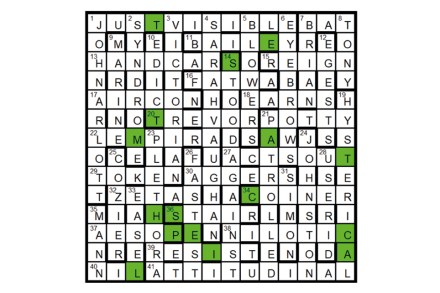
2571: 10” – solution

From our UK edition

The TEN unclued lights are Scottish islands – or ‘INCHES’. First prize Mrs F.A. Bull, Canterbury Runners-up Susan Hay, Wolverhampton; J. and F.

Who had the most highly attended state funeral?

From our UK edition

The namesakes Some of history’s other Charles IIIs: – Charles III, King of Naples (1382-86): forced Pope Urban VI into exile, then moved to Hungary, whose throne he had assumed through marriage. Was assassinated. – Charles III, King of Navarre (1387-1425): made peace with France. – Charles III, Duke of Savoy (1504-53): lost when France invaded Savoy in 1536. Remained king in name but spent the rest of his life in exile. – Charles III, Duke of Bourbon (1505-21): tried to regain independence from France by partitioning the kingdom. Fled to Italy when the plot was discovered. – Charles III, King of Spain (1759-88): invaded the Kingdom of Naples and claimed it for Spain.

Letters: Why the Union may not be so secure under Charles

From our UK edition

The Queen’s kindness Sir: Last week’s Spectator (17 September) was thoughtful, insightful and at times hilarious; just the tonic I needed. Many reading this will have their own memories of the Queen, but I would like to tell a personal story recounted by Christopher Chessun, the Lord Bishop of Southwark, in his address to the House of Lords of my sister’s meeting with her. He said: ‘My late sister-in-law, who was profoundly deaf, accompanied me during my time as Bishop of Woolwich when the Royal Artillery moved from Woolwich down to Salisbury Plain. Her Majesty the Queen was there for the occasion and spotted that my sister-in-law was wearing a Duke of Edinburgh gold badge.

America’s touching tributes to the Queen (1901)

From our UK edition

The United States hasn’t always reacted rather snidely to the death of the British monarch. Below is The Spectator’s lead piece following the funeral of Queen Victoria in 1901, available on our fully-digitised archive. Nothing has been more striking, nothing more moving to the British as a nation, than the way in which the Queen has been mourned and her memory reverenced in the United States. The English-speaking people of America almost with one voice have joined the English-speaking people of the British Empire in their expressions of affection for the Queen.

The complete guide to the Queen’s funeral

From our UK edition

Today, the world says farewell to Her Majesty Queen Elizabeth II. World leaders, including US president Joe Biden, French president Emmanuel Macron, and royals from across the globe have gathered in London for the country's first state funeral in decades. Here is how the day will unfold: 10.35 a.m. The coffin bearers from the Queen’s Company, the 1st Battalion Grenadier Guards, will lift the coffin from the catafalque in Westminster Hall.  10.44 a.m. The Queen's coffin will be taken via Parliament Square to Westminster Abbey. The coffin will be carried on the state gun carriage, drawn by 142 Royal Navy sailors.

How The Spectator reported the Queen’s life

From our UK edition

The reason the British people love the Queen, and are willing to die for her, is that they can understand what she is about, in a way that they cannot understand what the constitution, cabinet and parliament are about, or the Courts of Justice or the Bank of England, or any of the other abstractions which comprise our so-called system of government. Monarchy is credible, as Bagehot said, because it is personal. Seeing is believing. That is why all the old royal ceremonials are important: not because they are incomprehensible and mysterious, but because they are intelligible and familiar. All that talk about the magic of monarchy is very misleading.

Letters: My childhood memory of the Queen

From our UK edition

Majestic memories Sir: The sad news of the death of Queen Elizabeth II took me back 70 years to my earliest memory. I was three years old; the location was the Fleet Review at Spithead and the date was 15 June 1953, 13 days after the coronation. Some 325 ships of the Royal and Merchant Navies, including vessels from many other countries, were lined up at anchor between Gosport and Ryde. The assembled fleet was reviewed by HM Queen Elizabeth and many members of her family on board the ‘stand-in’ royal yacht, HMS Surprise. There was a 21-gun salute and cheering from the ships’ crews as the Surprise proceeded up and down the rows of vessels. My father was second officer of the Shell tanker Velletia and I was on board with my mother and older brother.

Portrait of the week: The death of Queen Elizabeth II – and the accession of King Charles III

From our UK edition

Home The body of Queen Elizabeth lay in state at Westminster Hall, in a coffin draped in the royal standard on which were placed the orb and sceptre, before her funeral in Westminster Abbey on 19 September, declared a bank holiday. She had died at Balmoral on the afternoon of 8 September, two days after appointing Liz Truss Prime Minister there. The new King took the name Charles III. In a televised address the next day, he said: ‘As the Queen herself did with such unswerving devotion, I too now solemnly pledge myself, throughout the remaining time God grants me, to uphold the constitutional principles at the heart of our nation.

The Queen’s act of Union

From our UK edition

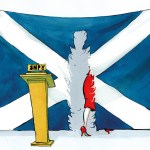
In death, as in life, Elizabeth II has been a unifying force for her country. For all the political rancour of recent years, this week has revealed a country at ease with itself. People of all political persuasions have come together to show their respect – in Scotland just as much as in England. It has been a reminder of what a force for good a monarch can be when he or she devotes their life to service. After the Queen’s coffin was transferred from Balmoral Castle to Holyroodhouse, up the Royal Mile to St Giles’ Cathedral, members of the public lined up to see it as it lay in state. Nicola Sturgeon was as effusive in her tributes as any Westminster politician. The new King was heard by the Scottish parliament with respect.

2570: Short story – solution

From our UK edition

Arthur C. Clarke (31/45) said that Ernest Hemingway (35/12) won a bet from fellow writers for the shortest story: FOR SALE. BABY SHOES. NEVER WORN. (30/14/15). First prize Nicholas Grandage, London W11 Runners-up Magdalena Deptula, Eton, Berkshire; R.P.

Liz Truss can’t ignore the issue of NHS reform

From our UK edition

It’s hard to think of any Prime Minister who has entered office surrounded by such low expectations. Liz Truss was backed by just over half of Conservative party members and secured barely an eighth of MPs in the first ballot. Her critics dismiss her as a lightweight, wholly unsuited to tackling the problems now facing the country. The presumption is not just for trouble, but calamity: the fastest drop in living standards in living memory, followed by prolonged recession and worse. So if Truss manages to send inflation into reverse and makes a noticeable cut to taxes by Easter, it will be seen as quite an achievement. She has also been helped by Rishi Sunak’s somewhat wild exaggeration of the risk her tax cuts posed to the public finances.

Letters: Why we obeyed lockdown

From our UK edition

Why we allowed it Sir: In her article ‘Why didn’t more people resist lockdown?’ (3 September), Lionel Shriver partially answers her own question. Priti Patel told us it was our public duty to shop our neighbours if they had three friends to tea, and our previously invisible police force started to patrol parks and beaches with unprecedented vigour, with a threat of £1,000 fines for malfeasance. There was no eagerness, but the public were glued to the nightly broadcasts from No. 10, where the PM told us we would be little better than murderers if we didn’t obey the diktats. The fear all this created is still evident as I walk round Sainsbury’s every week and see masked shoppers disinfecting their trollies as if their life depended on it.

Portrait of the week: Truss in, Johnson out and Nord Stream 1 off

From our UK edition

Home Liz Truss, the new Prime Minister, said in a speech outside 10 Downing Street: ‘Boris Johnson delivered Brexit, the Covid vaccine and stood up to Russian aggression. History will see him as a hugely consequential prime minister.’ For her part: ‘I am confident that together we can ride out the storm.’ Earlier, on being elected leader of the Conservative party, she had said: ‘I know that we will deliver, we will deliver, we will deliver.’ She had been elected by party members ahead of Rishi Sunak by 81,326 votes to 60,399 (57.4 per cent to 42.6). Turnout was 82.6 per cent.

2569: Anadad – solution

From our UK edition

The quotation was ‘I WAS BORN TO SPEAK ALL MIRTH AND NO MATTER’ from Much Ado About Nothing (II.i.321) by WILLIAM SHAKESPEARE. BEAT/RICE (23D/17) is the speaker and BENE/DICK (12/31) the sparring partner. Title: Much Ado About Nothing in cryptic form. First prize R.R.