26-8
From our UK edition
From our UK edition
From our UK edition
From our UK edition
From our UK edition
From our UK edition
From our UK edition
From our UK edition
From our UK edition
From our UK edition
From our UK edition
From our UK edition
From our UK edition
Pension schemingSir: As a pensions professional who has witnessed his once-mighty industry’s sustaining of blow after blow, I was heartened to read The Spectator’s call for Conservatives to resist the temptation to make ‘yet another raid on pension funds’ (Leading article, 25 February). The government’s lack of understanding of pensions tax relief was revealed in the Chief Secretary to the Treasury’s reported comment on how much ‘we spend’ on higher-rate relief on pension contributions. The government is not ‘spending’ at all; the contributor is simply being allowed to retain more of his own money, as a reward for putting some away for exposure to future taxation.
From our UK edition
Sister shipsThe Costa Allegra, sister ship of the Costa Corcordia, suffered a fire off the Seychelles. Are families of ships jinxed? —The Titanic had two sister ships. The Olympic collided with a naval vessel off the Isle of Wight soon after its maiden voyage in 1911, and again with a lightship off New York in 1935. It survived both incidents, though the lightship sank, killing seven crew. The second sister ship, Britannic, was sunk after being torpedoed off the Greek island of Kea in 1916, a year after being launched, while serving as a hospital ship. —The Lusitania, which was torpedoed by a U-boat off Ireland in 1915 with the loss of 1,198 lives, had a sister ship, the Mauretania.
From our UK edition
HomeNick Clegg, the Deputy Prime Minister, lent his support to a series of amendments to the government’s Health and Social Care Bill that he said would limit its adoption of competition and privatisation. The British Medical Association said that two thirds of members had approved some form of action over plans to make them contribute more to their pensions. Len McCluskey, the General Secretary of Unite, called for industrial disruption during the Olympics. Police and bailiffs removed tents from a protest camp at St Paul’s Cathedral set up on 15 October. The BBC found that thousands of illegal immigrants from India were living in sheds, particularly in Slough and the London borough of Ealing.
From our UK edition
Professor Hamid Ghodse, president of the UN’s International Narcotics Control Board, is not the first to observe that Liverpool, Manchester and Birmingham have acquired ‘no-go’ areas of ‘fractured communities’ ruled by gangs. But if he were brave enough to venture just a little bit closer to the frontline of Britain’s drug problem he would realise that much of the rest of his analysis, delivered with the board’s annual report this week, is bunk. Making a case for a shift towards treatment and rehabilitation programmes, he claims that Britain offers proof that ‘it is no good to have only law enforcement, which always shows it does not succeed’.
From our UK edition
This week’s bookbencher is Keith Simpson, the Conservative MP for Broadland. He tells us about a book which argues that the Cold War might have been avoided, and of his desire to be Tom Jones — the Fielding variety. Also, he wouldn’t save Shakespeare from the flames, because someone else would. Which book's on your bedside table at the moment? Donna Leon’s novel Wilful Behaviour, which is one of her excellent ‘Commissario Guildo Brunetti’ series set in Venice and Frank Costigliola Roosevelt’s Lost Alliances: How Personal Politics Helped Start the Cold War. His thesis is that FDR, Churchill and Stalin all valued personal relationships and if FDR had lived, maybe the Cold War might not have occurred. Maybe.
From our UK edition
Here is a selection of articles and discussions from this week on Spectator.co.uk... Most read: Matthew Parris calling on believers to be aware of the patronage of unbelievers. Most shared: James Forsyth reporting that Europe is being strangled by the Franco-German alliance. Most discussed: James Forsyth on Len McCluskey versus the Olympics. And the best of the rest.. Fraser Nelson suggests Michael Gove will never be party leader, and announces the Matt Ridley Prize for Environmental Heresy. James Forsyth imagines if Cameron hadn't vetoed, and urges a private sector revival in Northern Ireland. Peter Hoskin asks what the UK's proposed ECHR reforms will come to, and reports that the conflict over 50p tax has escalated again.
From our UK edition
In April 1982, as the Falklands War got underway, HMS Antrim steamed south through the Atlantic. On board was 28-year-old Lieutenant, Chris Parry. Parry kept a diary for ten weeks which recounted in vivid detail the action at sea and in the air, as well as daily life on board ship. 30 years later Down South: A Falklands War Diary has been published. Parry spoke to the Spectator about why the sinking of the Belgrano boat was justified, how talking about war prevents suicide, and the role the British press played in the conflict. When and why did you start keeping a diary? I began my diary on 3 April 1982, the day after the Argentinians invaded the Falklands because I thought that we might be about to embark on an unusual deployment.
From our UK edition
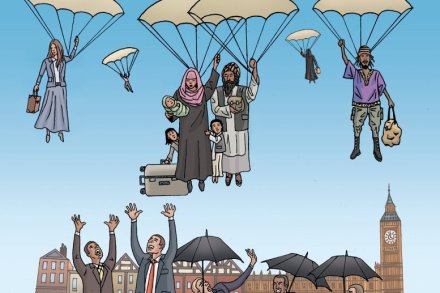
‘Immigration: enough is enough.’ That's the motion for The Spectator's next debate, and also a major concern for many disgruntled voters. The Tories are currently miles off course for achieving their aspiration of reducing net migration from the ‘hundreds of thousands’ to the ‘tens of thousands’ in this Parliament. Should they do more to meet it, so that the UK's economic and cultural fabric isn't frayed irreparably? Or should we be glad that that they're not, because immigration is a crucial ingredient for growth? These will be the questions at hand for our panellists, who are Dominic Raab, Frank Field and Kiran Bali speaking for the motion, and David Aaronovitch, Oliver Kamm and Jenni Russell speaking against.
From our UK edition
...here are some posts made on Spectator.co.uk over the weekend: Fraser Nelson says that the government should raise the income tax threshhold and let youth prevail. James Forsyth explains why Nick Clegg wouldn't be averse to a Boris victory in May, and details the two types of Tory modernisation. Peter Hoskin watches David Willetts try to dampen the flames around Les Ebdon, and reports on the ruckus over Lords reform. Rod Liddle recommends the ‘the best bit of writing I’ve seen for a bit’ (and it's from The Spectator, natch). Alex Massie has some Saturday Morning Country for your listening pleasure. The Spectator Book Blog features Alistair Darling as its latest Bookbencher.