The Spectator

Letters | 1 March 2018

From our UK edition

Corbyn and the zeitgeist Sir: Your leading article is right about university tuition fees and the fruitlessness of Tory half-measures, name-calling and then unedifying policy-swapping (‘Corbyn’s useful idiots’, 24 February). But I believe the writing is on the wall for the wider involvement of ‘free markets’ in the public sector. We have seen growing public support for taking the railways and water companies back into public ownership as people justifiably ask what is in it for them under the current system. In the NHS, as Max Pemberton makes clear (‘Wasting away’, 24 February), the internal market has been a wasteful disaster. We were told that costs would be driven down as standards went up. All too often the reverse has been the case.

Portrait of the week | 1 March 2018

From our UK edition

Home Crisis loomed over Brexit negotiations as Theresa May, the Prime Minister, travelled to the north-east to explain ‘this Government’s vision of what our future economic partnership with the European Union should look like’. Jeremy Corbyn, the leader of the Labour Party, had announced that its Brexit policy was now ‘to negotiate a new comprehensive UK-EU customs union’ that would still (somehow) ‘ensure the UK has a say in future trade deals’. Sir Keir Starmer, Labour’s Brexit spokesman, had said earlier that the party would back an amendment to the Government’s delayed Trade Bill hatched by the Conservative Remainer Anna Soubry, to keep Britain in a customs union.

Back off, Barnier

From our UK edition

There’s an unwritten law governing Boris Johnson in Westminster: every-thing he says or does is a gaffe, or can be portrayed as one. Yet actually Johnson has an uncanny knack for conjuring similes which sum up the political situation precisely. So it was for his much-ridiculed remark, in response to a question about the Irish border, that there are no border posts between London boroughs even though they have different business rates and policies on various other things. His phrasing was careless but the point stands: it is nonsense to claim that different regimes must mean border patrols. There are significant tax and excise differences on either side of the Northern Irish border, but they’re managed without any need for checkpoints.

to 2345: Counterclaim

From our UK edition

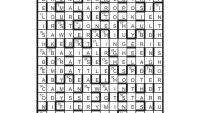
The puzzle’s NUMERICAL DESIGNATION (3 41) is preceded by 7A and followed by 7D 12 33 37 to form the first two lines of a NURSERY RHYME (4): ‘One, two, three, four, five/ Once I caught a fish alive’. Thematically caught fish, in entries at 1D, 5, 19, 26, 31, 32 and 34, are lant, rigg, maid, ide, ahi, ai and carp.   First prize Michael Pigden, Barnet, Hertfordshire Runners-up C.

Triumph of the spirit

From our UK edition

From ‘A moral test’, 2 March 1918: The nation, in spite of all the silly talk about our war aims not having been stated, is more united now as to the minimum principles for which we have to fight than at any moment during the war. In spite, again, of most of the talk about revolution, the mind and spirit of the working men are sound… Whatever suffering there may be, it cannot last indefinitely. Right will certainly triumph, and when that glorious day comes we shall recognise that what was grievous to endure is sweet to remember.

How the West got China wrong

From our UK edition

This week, Xi Jinping is close to achieving what Bill Clinton tried and failed to do: to remove the restriction on an individual serving more than two terms as leader of his country. It will mean that Xi is able to remain in charge of China beyond 2023, when his second five-year term will expire, and to become the longest-serving leader since Mao Zedong. Already, the Chinese constitution is being rewritten to incorporate his personal thoughts so a personality cult, too, is being created. For anyone who remembers the hell of the Cultural Revolution, it’s quite a step. Yet it’s one that’s being greeted with a yawn in the West.

Full text: Jeremy Corbyn’s Brexit speech | 26 February 2018

From our UK edition

It’s great to be speaking here in Coventry, which has long been at the core of Britain’s industrial heartland and is now set to be our next city of culture. Next month, the government will embark on the second and most crucial phase of negotiations to leave the European Union to set the terms of Britain’s relationship with the EU for the long-term. We are now 20 months on from the referendum that voted to leave and a year on from the triggering of Article 50. But the country is still in the dark about what this divided Conservative government actually wants out of Brexit. They can’t agree amongst themselves about what their priorities are or what future they want for Britain after Brexit. They’ve got no shortage of soundbites and slogans of course.

Letters | 22 February 2018

From our UK edition

How to save charities Sir: The sexual abuse scandal is merely one aspect of the morally compromised status of large charities such as Oxfam (‘The dark side of charity’, 17 February). Oxfam receives a large part of its income from the government, which necessarily makes it a delivery agency for the state. It spends a proportion of its income on political campaigns, often critical of the same government from which it gets money and on whose behalf it acts. The self-serving hypocrisy of biting the hand that feeds it seems not to bother its senior management. Oxfam and others also rely on many small donations, often from people of modest means. Others work — for free — in their shops.

Portrait of the week | 22 February 2018

From our UK edition

Home Someone called Jan Sarkocy said that, as a Czech Security Service agent in London under the name Jan Dymic, he met Jeremy Corbyn several times in 1986 and 1987 and gave him money; Mr Corbyn called his account false and warned newspapers that reported such allegations ‘change is coming’. Henry Bolton, 54, was removed as leader of Ukip at a special meeting, and then returned to his girlfriend, 25, whose text messages about black people had caused him trouble. Theresa May, the Prime Minister, launched a year-long review of higher education, but ruled out abolishing tuition fees, which Labour promised to do.

Barometer | 22 February 2018

From our UK edition

The great indoors How to get the Winter Olympics experience without leaving England: — The Snow Centre, Hemel Hempstead: ‘London’s closest indoor real snow slope.’ A 160-metre slope with alpine restaurant. — SnowDome, Tamworth: ‘The original and ultimate snow, ice and leisure experience.’ Includes Santa’s Winter Wonderland. — Chill Factore, Stretford: A 180-metre slope with button lift and seasonal moguls. Parents go free in Mini Moose Land. Crowded house The government is considering early release for prisoners to cut overcrowding. How many people do we incarcerate compared with other countries? — The UK’s imprisonment rate is 143 per 100,000, putting us 109th out of 222 nations.

to 2344: I’m away

From our UK edition

The unclued lights can be preceded by or followed by the unclued word DOCTOR, which explains why I (Doc) am away in the title of the puzzle.   First prize Pam Dunn, Sevenoaks, Kent Runners-up Tim Hanks, Douglas, Isle of Man; R.C.

The European Research Group’s Brexit letter, in full

From our UK edition

Dear Prime Minister, We are writing to thank you for your reassuring comments about Britain's approach to the upcoming trade negotiations with the EU27, and to underline our support for both your Brexit leadership, and for the vision of your speech at Lancaster House a year ago. We share your view that free trade lowers prices, creates jobs and economic growth, and that leaving the European Union will create opportunities for freer trade with many more countries around the world. We also agree with you that we can only grasp those opportunities if we can negotiate trade deals with as many other countries as possible, which we will be legally barred from doing if we remain inside the EU Customs Union and Single Market.

Direct Debit guarantee

From our UK edition

This Guarantee is offered by all banks and building societies that accept instructions to pay Direct Debits. If there are any changes to the amount, date or frequency of your Direct Debit The Spectator (1828) Ltd will notify you 10 working days in advance of your account being debited or as otherwise agreed.

Is a tax on property the solution to Britain’s housing problems?

From our UK edition

This letter was first printed in this week's issue of The Spectator. Sir: Matthew Parris is correct (10 February). There is no shortage of housing stock, and no feasible programme of housebuilding will fix the housing market. The generations endowed with housing wealth through tax and lending policies continued by all parties since 1959 have no incentive to use it productively; the next generation competes for a disproportionately small portion of the stock. But there is a solution to be explored. Someone who invests in improving the productivity of their labour will pay tax (including employee and employer NI) at a marginal rate of around 40 to 60 per cent, while someone who invests in under-occupied property pays no tax on the gain in value.

Why we shouldn’t try the jihadi ‘Beatles’ in Britain

From our UK edition

The success of the military campaign against Isis in Syria and Iraq has left behind a diplomatic and legal problem: what to do with the British citizens who travelled to join and fight with Isis, but who have survived hostilities. The problem has been brought to a head by the capture, by a group of Syrian Kurds, of El Shafee Elsheikh and Alexanda Kotey — two Londoners who were members of ‘the Beatles’, a group which tortured and beheaded at least 27 hostages. There is little use in looking to the government for consistent guidance as to what should happen to the two men, who have been stripped of their British citizenship.

Letters | 15 February 2018

From our UK edition

Suffragette setbacks Sir: Jane Ridley (‘Women on the warpath’, Books, 10 February) claims that Millicent Fawcett and her suffragists had ‘got nowhere’ by the time the militant suffragettes came on the scene in 1903. In fact Fawcett’s law-abiding movement, with a membership of some 50,000 (far more than the quarrelling Pankhursts ever managed), had won round the majority of MPs by 1897. Between that date and final victory 20 years later, there were always more MPs in favour of women’s suffrage than against it, though the gap shrank during the years of the suffragette campaign. Its violence has to be high on the list of factors that delayed victory.

Barometer | 15 February 2018

From our UK edition

Museums of curiosity The former culture secretary Ed Vaizey suggested that there are quite enough museums in Britain, and that they should attempt to display their treasures in more visited places like shopping centres. Some suggestions for an educational day out. — British Lawnmower Museum, Southport. — British in India Museum, Nelson, Lancashire. (Received 109 visitors in 2016, according to VisitEngland.) — Dog Collar Museum, Leeds Castle, Kent. — Derwent Pencil Museum, Cumbria. — Teapot Island, Yalding, Kent. ‘The largest teapot exhibition in England with more than 8,200 teapots to be seen.