Tanya Gold

Tanya Gold

Tanya Gold is The Spectator's restaurant critic.

Killing comedy

From our UK edition

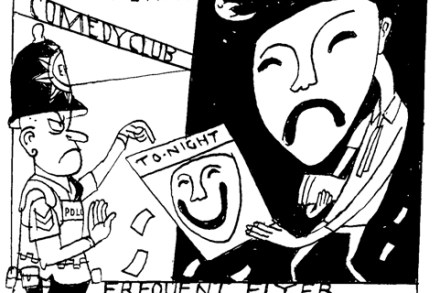
There is a ban on comedy flyering in Leicester Square. Westminster Council has decided that flyers are litter and that the flyerers — usually anxious baby comedians – ‘harass’ the tourists. This is ridiculous. Most comedians would scream at their own reflection in a pint. Even so, if the council finds any flyers it will remove the venue’s licence. As if comedians did not have enough woes — manic depression, calm depression, depression that is not really depression but suppressed rage, poor rates of pay, joke theft, Frankie Boyle — their solitary reason for living, which is attention, is now at threat.

Food: Bistro battleground

From our UK edition

The Hotel du Vin is a mini chain of tasteful hotels, usually found in ‘heritage’ cities — Henley, Cambridge, wretched Tunbridge Wells. The Hotel du Vin is a mini chain of tasteful hotels, usually found in ‘heritage’ cities — Henley, Cambridge, wretched Tunbridge Wells. They have baths in bedrooms, rush-matting and white linen, and, although the name is French, they feel amazingly class-conscious, and therefore English. I like them, principally because of what they are not — neither unknown and dangerous boutique hotels, nor the dreaded Marriott. I fear the Marriott, because its ancient founder, J.W. Marriott, who looks like a cadaverous gnome, has his own in-house TV channel, on which he does a 24-hour talking head about himself.

Food: Frankie Vaughan deserves better

From our UK edition

The Savoy Grill is a famous restaurant in a famous hotel and it knows it. Although it is managed by Gordon Ramsay, with his TV horns and tabloid nightmares, it is still reeling with self-importance, an elderly debutante who once jumped on John Wayne in the loo. The view is of a taxi rank and a queue of tourists in sports jackets being shepherded by a man dressed as a penguin. But still the very name is awe. The refurbishment is done and the piles of brown leather that made me think of camels have gone. It is art-deco glossy now, gloomy and sexy, with chandeliers and lustrous walls, which are possibly aubergine. I didn’t know aubergine could do lustre, but now I do. It is an exhibitionist, a date restaurant, for late-night negotiations with lovers. And I am with my mother.

Food: Rick’s place

From our UK edition

I am in Padstein. It used to be a fishing village, just north of Newquay. It was Padstow then. But then came Rick Stein. Padstein has the smell of a theme park. This is a village made over by one man; it belongs to him. In my hand I have a map of every Rick Stein outlet in town, numbered for ease of access — four restaurants, five hotels, a cookery school, a cottage, a pub, a gift shop, a patisserie, a delicatessen. People queue to buy Rick Stein chutney, drink Rick Stein-endorsed wine, eat Rick Stein chips or sleep on Rick Stein pillows. He is expanding into Falmouth, opening a bookshop. Perhaps he will write all the books. Who knows? He actually lives in Australia, which makes me wonder how much he likes the town he created.

Food: Hampstead grief

From our UK edition

It is an old London fairytale that there are no good restaurants in Hampstead. When the good restaurants were being handed out, Hampstead was ignored, betrayed, disgraced — given only a Carluccio’s, a Café Rouge and a quite disgusting Chinese place that has a ridiculous water feature and its own bridge. This is the story, anyway, as told to frightened children in north-west London. I thought I would try to break the spell, and find a restaurant worth paying for, so I do not have to go to Camden and fight my way through fetish boots and tall angry men who smell. There may be one, it is said — just one restaurant in Hampstead that passes. The Villa Bianca. It is an Italian restaurant that looks like a white Dickensian shop on a charming paved lane.

Food: Blood and guts

From our UK edition

Rules is the restaurant where Edward VII ate himself to death and, in a way, it looks like him. It is spacious and regal and covered in velvet. His personal dining room upstairs is a cocktail bar now, with a lump of Stilton as focal point and memorial. Downstairs there are stags’ heads and a painting of Margaret Thatcher as Britannia, with pointy breasts. From a distance, it looks as if she is topless. The customers are the sort of people who like to watch powerful women topless. That is, they are powerful men, in groups or, quite often, alone. Rules has single booths for these lonely creatures — well, they can accommodate two small people, or one very fat man, and it is always one very fat man who is there, wiping the blood from his mouth with a blinding white napkin.

Only prigs wear mini-skirts

From our UK edition

Uncle Norman likes to talk about the year the mini-skirt was born. (The name has been changed to protect him.) It was 1965 and he was a law student living in Chelsea. And when the skirt arrived, he took a year off university, and spent it on the No. 22 bus on the King’s Road, following women up the stairs. At this point in the anecdote Uncle Norman usually closes his eyes. I mention Uncle Norman’s contribution to social history because mini-skirts are in the news again, this time in Italy, which I always thought was a place where men liked women. But if this was ever true, and it probably wasn’t, it is now obvious that this amazing, never-to-be-repeated liking of women was, like the Enlightenment, a blip.

In bed with politicians

From our UK edition

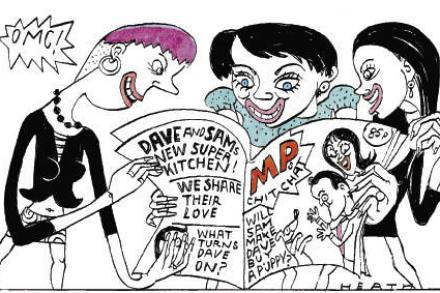
Who on earth wants to know about the leaders' children, pets, kitchens and favourite biscuits? I am sitting in the audience at Labour party conference, watching a tribute video to Gordon Brown. As Brown smiles, walks, talks, scowls and moves his limbs up and down, giving a fairly decent impersonation of a soon-to-be-discontinued toy, I have a sudden realwisation. I don't know if Stanley Baldwin liked Murray Mints. I have never seen Winston Churchill sob on Piers Morgan's lap, like cheese melting on toast. And I - I - I have no idea whether Clement Attlee had a nice kitchen. Why is this? Is it because the private lives and decoration choices - the mood boards, if you will - of politicians used to be yucky, but shrouded?

‘I never talk to anybody’

From our UK edition

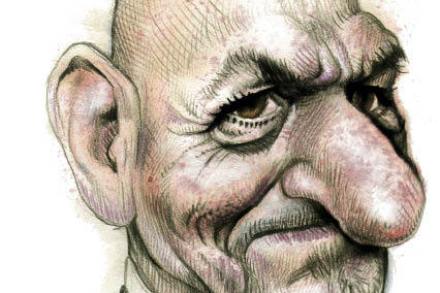
So Ben Kingsley, or, as he apparently demands to be called, Sir Ben Kingsley, who are you? I’m sitting in a windowless corridor in the Dorchester Hotel, waiting for him. It’s amazingly pink, this corridor. It looks like a cake. He comes out to collect me and he doesn’t look like he belongs here at all. Perhaps it’s because misery clings to all his famous roles — Gandhi, Simon Wiesenthal, Otto Frank, the sociopath gangster Don Logan, the accountant Itzhak Stern in Schindler’s List. And now he’s neither in prison nor a concentration camp, but standing behind an enormous teapot, looking as Home Counties as a John Lewis valance. We sit down and I am slightly tongue-tied because I think he’s a great actor, one of the best.

All aboard the Bada Bing Bus

From our UK edition

‘Can anyone name Tony Soprano’s horse?’ says Marc Baron, our tour guide, standing in the aisle of a leaking coach at the start of The Sopranos Bus Tour of New Jersey. The answer of course is Pie-O-My, and because we’re all addicts of the TV series, The Sopranos, we all know the name and shout it out. The Sopranos are New Jersey gangsters with suburban issues. The show finished its US run a few weeks ago and the adventures of Tony Soprano, an obese but strangely sexy Mafia boss, are now sleeping with the fishes — but the fans take longer to die. The last episode will air in Britain in September and I am on the Bada Bing Bus (the Bada Bing is Tony’s lap-dancing club) with a damp assortment of English, Dutch and Australian coach-potatoes.