Stuart Kelly

Puzzle Pieces: Cowboy Graves, by Roberto Bolaño, reviewed

This might seem an odd confession, but the work of Roberto Bolaño gives me very good bad dreams. When I first read his epic masterpiece 2666 I had three nights of fractured nightmares. This happened with every other book as well — usually dreams about reading a book by Roberto Bolaño, except the words melt and shift and are land mines or tripwires on the page. It happened again with Cowboy Graves: 3.08 a.m., and I’m re-reading the central piece, convinced there is a character and a scene in it that doesn’t exist. In an eloquent afterword, Juan Ródenas gives a plausible reason for Bolaño’s seeming capacity to hack the subconscious.

Escape from reality: How to Survive Everything, by Ewan Morrison, reviewed

Ewan Morrison is an intellectually nimble writer with a penchant for provocation. His work has included the novels, Distance, Ménage and Swung, which looked at the conditions of desire, normality and love under capitalism, and a hybrid collection of essays, reportage and fiction, Tales From the Mall. This new novel forms the final part of a loose trilogy, which is concerned with various forms of eccentric utopias. Close Your Eyes involved a spiritual commune with strict rules; Nina X was an uplifting book about a young woman freed from a Maoist cult and bemused by modernity.

All change: The Arrest, by Jonathan Lethem, reviewed

This is an Exquisite Corpse of a novel — or if you prefer another name for that particular game, Heads, Bodies and Legs, or Combination Man, or perhaps most appositely Consequences. The parlour game involves creating something and then passing along the hidden creation to which another then adds, and The Arrest reads like Jonathan Lethem playing the game against himself. He is a novelist whose work has always experimented with, and evaded, genres. In this one, he is juggling dystopia, Thoreau-like idealism, science fiction, folk horror, sentimentality, revenge plot and quite a lot more. It is also very funny. I did want to say that it is like Cormac McCarthy animated by Hanna-Barbera, but Lethem gets there first, since one scene is a — loving?

Spotting the mountweazels: The Liar’s Dictionary, by Eley Williams, reviewed

There is a particular sub-genre of books which are witty and erudite, comic and serious and often of a bibliophilic nature: such novels as Elaine di Rollo’s The Peachgrower’s Almanac, Pasi Ilmari Jääskeläinen’s The Rabbit Back Literary Society or Brock Clarke’s An Arsonist’s Guide to Writers’ Homes in New England. The problem with this form is that it can go badly wrong and teeter into pretentious whimsy. But when it goes right, as with Eley Williams’s The Liar’s Dictionary, it is sheer joy. Although I cantered through the book and welcomed its distraction during lockdown, there are enough hidden jokes and cunningly disguised rabbit holes to make one want to return to it.

Mysteries of English village life: Creeping Jenny, by Jeff Noon, reviewed

I doubt whether any book would entice me more than a horrible hybrid of crimefiction, speculative fantasy, weird religion and postmodernism. If that makes Jeff Noon’s third outing of the private detective John Nyquist sound like a niche affair I apologise, as it is a rollicking and goose-flesh- inducing novel. Writers such as the late Gilbert Adair have already used the forms of the murder mystery to explore avant-garde ideas, especially in his Evadne Mount trilogy. Noon — the author of those modern classics Automated Alice and Vurt — has created the ultimate mash-up with his Nyquist novels. There is a small joke for bibliophilic readers on the back cover.

Philip Hensher’s latest novel is a State of the Soul book

This is a very nuanced and subtle novel by Philip Hensher, which manages the highwire act of treating its characters with affection and anger at one and the same time. Politically, ethically and emotionally it places the reader in a kind of vertigo by addressing a singular moral question: is it better to be steadfast to your principles or to change tack as history twists? The narrator is ‘Spike’, whom we first meet when he is 16 at the school assembly — featuring a recruiting officer who is blind-sided by one of the pupils. Spike is invited into a group of idealistic and pretentious people. Whether their politics are classical Marxist, anarcho-syndicalist, Trotskyite or some mishmash of all three is probably even a mystery to themselves.

Will Self’s memoir of drug addiction is a masterpiece of black humour

Well, it was always going to be called Will. More than once in this terrifying, terrific book, Will Self refers to ‘nominative determinism’ — the idea that a name somehow foretells a life. That he chooses Will, not Self, is indicative and ambiguous. This memoir — not an autobiography — starts in May and ends in August 1986, but also spirals back to 1979, 1982 and 1984 in the kind of chronological fracturing that has typified his later fictions. It is a chronicle of addiction, and the ‘will’ is everything, from the insistent desire, to a futureless future, to the psychological horror of being called ‘Little Willy’ by his mother. Throughout, he normally refers to himself as Will, but this is not Caesar-style self-aggrandising.

Haunted by a black cat: Earwig, by Brian Catling, reviewed

Genuinely surrealist novels are as rare as hen’s teeth. They are a different form from the magic realist, the absurdist, the wacky, the mimsical and the nastily satirical. But Brian Catling is a genuine surrealist novelist, and it no doubt helps that his artwork is surreal (he is professor of fine art at Ruskin College, Oxford: how Ruskin would have loathed him). He has previously written a trilogy of novels, The Vorrh, which has been among my highlights of the past few years. This is a more slender book, but it is slender like a stiletto. If there is one defining feature of truly surreal literature, it is that it defies the imposition of meanings while retaining an affective hold on the reader. Oh, and horrifying them.

Spot on target

This is an ebullient, irreverent and deeply serious novel in the noble tradition of Mark Twain, Sinclair Lewis (especially Babbitt and Elmer Gantry) and John Kennedy Toole. Sam Lipsyte certainly hits his prime target — the cultish behaviour around mindfulness, motivational speakers and pallid spiritual beliefs — but one of the joys of the novel is that over and above that there is a scatter-gun sniping at various fads. Although it is laugh-out-loud funny, it swerves towards the end (the reasons would be too much of a spoiler) into slightly more melancholy and mystical modes. At the novel’s centre is the eponymous Hark, a strange, naive man who has developed a sort of lifestyle therapy he calls ‘mental archery’.

Relocate or emigrate

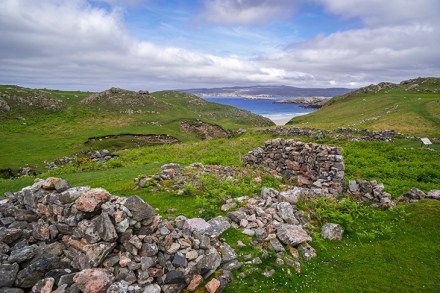
There is a degree of irony in the opening chapter of T.M. Devine’s history, lambasting popular previous depictions of the Clearances and citing ludicrous comparisons to Nazi genocide and the misty-eyed melancholy of John Prebble. Though it does not mention such iconography as Thomas Faed’s painting ‘Last of the Clans’, used for the paperback of Prebble’s book, or Erskine Nicol’s ‘An Ejected Family’ in all its schmaltzy Victorian glory, such depictions are clearly the target. Yet the book itself is called The Scottish Clearances: A History of the Dispossessed and not, which would actually be more accurate, ‘Patterns of Land Ownership, Agricultural Change as well as Internal and External Migrations in Scotland, 1600–1900’.

Alternatives to God

K. Chesterton, in one of his wise and gracious apothegms, once wrote that ‘When Man ceases to worship God he does not worship nothing but worships everything.’ John Gray, one of the most pernickety and carnaptious of contemporary philosophers, presents here a kind of taxonomy of not atheism, per se, but of the vacuums and nothings into which the loss of belief has rushed. It is, as one would expect, an exhilarating read. The title winks to Empson’s Seven Types of Ambiguity, and he appears as one of the figures in these essays. One might think that atheism is a fairly simply proposition. There is no God.

It’s grim up north

Andrew Michael Hurley’s The Loney was one of the surprise stand-outs of last year, and a worthy winner of the Costa First Book Award. His new novel, Devil’s Day, is equally good, even though its similarities slightly muffle the surprises. Like his debut, it is a work of gooseflesh eeriness. The Loney artfully described the north-west coast of England; Devil’s Day as proficiently conjures the fells of an area hazily between Lancashire and Yorkshire. The Loney featured a damaged family on a religious retreat encountering old paganisms; Devil’s Day has our protagonist, John Pentecost, returning to the family farm for the funeral of his grand-father, the Gaffer, which coincides with a ritual for placating the devil before the flock is brought in for the winter.

A barren prospect

In many ways this is a very old-fashioned novel. Jerome is 53, and a lacklustre professor at Columbia; his wife, Sylvie, 35, is a former topless dancer and aspiring film-maker. Sylvie has a dog but wants a baby. Together they will cross the former Soviet bloc looking for a child of their own, despite Sylvie having already had three abortions: Romania is their chosen finale, where, of course, orphans are two-a-penny. There is much to admire in it; but the clever bits aren’t funny and the funny bits aren’t clever. The novel is littered with references to continental theorists. Blanchot, Lefebvre, Baudrillard, Deleuze, Guattari, Lacan all show up — poor old Derrida, left out! — but they are there as intellectual window-dressing.

Homer Simpson in a chasuble

This is one of the most remarkable, hilarious, jaw-droppingly candid and affecting memoirs I have read for some time — not since, perhaps, Dave Eggers’s A Heartbreaking Work of Staggering Genius or Rupert Thomson’s This Party’s Got to Stop. Patricia Lockwood is a poet — dubbed ‘The Smutty-Metaphor Queen of Lawrence, Kansas’ — who, after unexpected and costly medical bills, was forced to move, with her husband, back to her parents’ home. Her mother is more than mildly neurotic, fretting over things like children jumping out of windows in imitation of Superman.

A surreal caprice

At the start of this novella the protagonist, Thibaut, is ambushed by Wehrmacht soldiers between the ninth and tenth arrondissements. That the year in 1950 is not the strangest aspect, as he is rescued by the appearance of the Vélo, a bicycle-like contraption with a queasily organic prow. It is, in fact, a living version of Leonora Carrington’s 1941 sketch ‘I Am an Amateur of Velocipedes’. In this initially joyous, fundamentally chilling book, the art of the surrealists has been weaponised in the fight against Nazism. Surrealism billed itself as a liberation; now is it part of the Liberation.

Everyday unhappiness

This is an extraordinarily compelling novel for one in which nothing really happens but everything changes. Sara Baume’s narrator is Frankie, a 26-year-old art school graduate, who has fled Dublin to live in her dead grandmother’s rural bungalow. What happened to her ‘started with the smelling of carpet’ in her bedsit; she feels such a failure that she ‘can’t even do mental illness properly’. It is all ‘because of nothing… because there’s nothing right with me. Because I cannot fucking help it.’ Over the course of part of a year, she acquires a bicycle from a born-again Christian, allows her father to mow the lawn, takes care of a guinea-pig for her sister, and tries to summon the ghost of her grandmother.

Weird and wonderful

The Un-Discovered Islands could not be more different in substance — though it is similar in style — to Malachy Tallack’s debut, Sixty Degrees North. In that he book he took a revealing pilgrimage around the places which lay, like his home of Shetland, on the 60th parallel, and found a range of concerns about ecology, land ownership, both solitude and community, and what it means to be considered peripheral. This book is an account of 24 non-existent islands, yet is suffused with the same elegiac frostiness as before. Tallack’s style is precise without being perjink, and the overwhelming feeling is of something lost, or disappearing. It’s just this time, what is lost never was.

Rich in legend and song

There is an immediate problem for anyone producing a guide to places in Scotland with literary connections: as Walter Scott wrote in Marmion, ‘Nor hill, nor brook we paced along/ But had its legend or its song.’ Many years ago when the Scottish Borders was marketing itself as the ‘Land of Creativity’ I assembled a database of references which stretched to well over 1,000 entries — for example, the village of Yetholm crops up in a strange extended simile in Malcolm Lowry’s posthumous October Ferry to Gabriola. Then there is Scotland’s propensity for memorialising its own writers. The Scott Monument is only the most obvious example.

Into a cloud-scratched sky

There have been a number of attempts to graft the style of the so-called new nature writing onto the novel: works such as Melissa Harrison’s Clay, for instance, or Amy Sackville’s Orkney. Tom Bullough’s Addlands is a very creditable contribution to this genre. The form does have an intrinsic problem: how does one dramatise seeing? The solution here is that the characters — the reserved Idris Hamer, his stoical wife, Etty, and their son Oliver, a principled bruiser — are farmers in the Welsh borders. Their livelihood depends on being attuned to changes in the environment. The novel has an elegant structural conceit.

The elegiac and the exuberant

Discussions about the short story too often fall into a false dichotomy that can be characterised, in essence, by a quibble over a consonant. Carver or Carter? On the surface, it would be easy to present Philip Hensher as the Raymond Carver-like elegiac naturalist, giving glimpses of disappointed lives and misunderstood epiphanies, and Helen Oyeyemi as the Angela Carter-ish exuberant fabulist, all giddy metamorphoses and yarns within tales within stories. It would be a disservice to both collections to read them in such a manner. All the stories in Tales of Persuasion have an exquisitely tweezer-y feel to them.