Steven Barrett

Steven Barrett is a barrister.

The vaccine row shows the EU doesn’t understand contract law

From our UK edition

The EU rejects 'the logic of first-come first-serve,' said the EU's health commissioner Stella Kyriakides. 'That may work at the neighbourhood butcher's but not in contracts, and not in our advanced purchase agreements'. Contract law is an area of law I know well. And it is not a political comment to say the commissioner is wrong. We don't know precisely what the contract between AstraZeneca and EU member states says. But the EU did publish another vaccine supply contract here. All this makes it very difficult to see what case the EU has In any would-be-case involving this contract, the EU has two massive hurdles to jump. Firstly, contractors undertake to use their 'reasonable best efforts' to manufacture enough supply.

Why the ECJ still has a role to play in Britain’s lawmaking

From our UK edition

Now that Britain has left the EU, we are no longer bound by the European Court of Justice. Some may view that as something to celebrate. Yet there may also be downsides. The ECJ is the final court of the EU. It hears lots of cases about EU member states who break EU law. It then reaches conclusions which form case law. All 27 members of the EU are bound by this, but Britain, outside the EU, is not. But here’s the catch: some of those decisions might actually be good ones. The solution is that we should borrow these good ones for ourselves. English law is a magpie. We pick up shiny bits of ‘good law’ that other places have and we make them ours. It is what lots of sensible sovereign states do, and there is nothing wrong with this. There is no copyright in law.

The small print of Boris’s Brexit deal makes for reassuring reading

From our UK edition

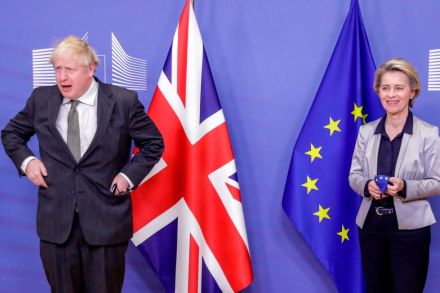
The new UK/EU Treaty is needlessly long and turgid in its prose: this document was not drafted by people who think the law should be understood by all. Close inspection of the small print reveals that none of the details undermine sovereignty. It has been restored and the UK has the power to control its own laws. To understand what’s happened, consider the last two big treaties. Under the Maastricht Treaty the EU’s ability to control UK law was extended on what came before but was confined to specific areas only. That was called 'spheres of competence'. The 2007 Lisbon Treaty vastly expanded the EU’s power and the idea of restricting EU writ to areas of its competence fell away.

Most-read 2020: Why didn’t the EU punish Germany when it broke international law?

From our UK edition

We're closing 2020 by republishing our ten most-read articles of the year. Here's No. 8: Steven Barrett on Germany and international law Boris Johnson's proposal to break international law 'in a specific and limited way' has sparked uproar. But do you remember when the UK broke the Geneva Convention? Oh. Well we did. The government-ratified Geneva Convention on the Sea came into effect in Britain on 10 September 1964. From then the UK was bound forever by the treaty and bound by international law. On 25 September 1964, we were not. No explanation was given. No explanation was asked.

Does the EU understand what sovereignty really means?

From our UK edition

The UK never tried to have our constitution written in one big session. We made it up by responding to each crisis when it happened. Brexit is just the latest. The remaining sticking points on a deal are fish and something called the level playing field. Fish is very interesting, I assume, but it is politics, not law. So, as a lawyer who chooses not to speak on politics (some do), fish is none of my business. But the Level Playing Field (LPF) – which is a legal problem – is. It is the elephant in the room. And yet the EU's response to this issue is deeply unhelpful. Rightly or wrongly, the public voted for Brexit. Brexit is about sovereignty and sovereignty is a legal question.

The House of Lords must stop blocking Boris’s Brexit bill

From our UK edition

Boris Johnson's internal market bill is back in the House of Lords next week, but will peers let it through?  The bill gives the government an express power (a written one in a statute) to break an international treaty. The Lords do not like that the government might break a specific treaty. Where you stand on those are political, not legal questions — so not for a lawyer like me to answer. But what is for law, is to firstly recognise (whether peers like it or not) that the power to break a treaty, does exist. Think of it like a physical thing; it is in our constitution and we’ve lost track of exactly where it is. We let the EU use it for us. But we know it is there. It is in the EU’s constitution, via a court case.

Why the EU can’t sue the UK

From our UK edition

Michel Barnier has very politely confirmed that the EU will be suing the UK in a respectful manner. That has all the validity of a child using his younger brother's arm to hit his own face while stating, 'why are you hitting yourself?'. Passive aggression is still aggression. Suing someone is an aggressive act. Now, as I sue people for a living, it would ill behove me to argue that the EU must not ever sue the UK. It is a political question on which people will naturally disagree. There is however an important legal question — whether or not the EU can sue the UK in law. It is unfortunate for the EU that a consensus has emerged amongst lawyers that the EU has no grounds for suing the UK; it has no case.

Did Ruth Bader Ginsburg’s talents go to waste?

From our UK edition

Ruth Bader Ginsburg has passed away. America has lost one of its finest lawyers. An outstanding lawyer is a gift to a nation. But RBG is one America never actually used. The same is equally true of her friend Antonin Scalia. Two brilliant lawyers that most nations would give their right arm for. I think it is fair to highlight how little law either actually did. Both were sadly reduced by the constitution they lived under, to being mere politicians. They both contrast sharply with how we have tried to practice law here. A month ago, I had lunch in a pub with a friend and three children. At the end the bill came. It was incorrect. Not uncommonly for someone who fights over bills for a living, I let my non-lawyer friend take up the issue.

Why didn’t the EU punish Germany when it broke international law?

From our UK edition

Boris Johnson's proposal to break international law 'in a specific and limited way' has sparked uproar. But do you remember when the UK broke the Geneva Convention? Oh. Well we did. The government-ratified Geneva Convention on the Sea came into effect in Britain on 10 September 1964. From then the UK was bound forever by the treaty and bound by international law. On 25 September 1964, we were not. No explanation was given. No explanation was asked.

The Begum Appeal is a fundamental error of logic

From our UK edition

There has been an emotional response to the case of Shamima Begum, quite rightly. It is not clear to me that lawyers are better equipped than politicians to navigate such emotions, but sadly we live in an age which is increasingly demanding legal answers to political questions. What is perhaps surprising is that, with uncharacteristic vigour, our Court of Appeal have jumped headfirst into the maelstrom. The Special Immigration Appeals Commission (SIAC) – created to consider cases like these – found against Ms Begum in February, which seemed largely uncontroversial at the time.

The German courts have just made Brexit talks easier

From our UK edition

The old division of leaver and remainer will not serve the best interests of the country as we go forward. That truth might be emotionally hard to accept, but it will remain true. We need now to adapt to the real challenges the future holds. One of the most pressing is our future relationship with the EU – and that is being negotiated again on Monday. I have written on how we should support the EU given the recent judgment of the German Constitutional Court on the question of the European Central Bank bond scheme. The case is complicated and while I enjoy a good legal fight over complex financial products, I appreciate many do not. But, as is often the case in law, the reason it is important has nothing to do with its subject matter.

Was Dominic Cummings acting legally?

From our UK edition

As a lawyer, I am firmly against the politicisation of law. It is important to remember that we who serve justice do so for everyone - not merely for people we like or to advance political causes. ‘Lockdown’ has so far been three different legal regimes, and for ease, I’ll restrict myself here to the first one. Under that, we all had the power in reg. 6(1) to leave the house whenever we had a “reasonable excuse”. What it said was “During the emergency period, no person may leave the place where they are living without reasonable excuse”. What that means is: provided we had a reasonable excuse, we could leave the house. It was not then for parliament to tell us what a reasonable excuse is. It is for the courts.

Don’t blame Boris for lockdown rule confusion

From our UK edition

There has been much chatter about people being puzzled by the lockdown rules. Critics of Boris Johnson are partly right: the law is confusing. But this isn't necessarily the Prime Minister's fault. And nor should it come as a surprise. Why? Because the law can never give absolute clarity about what you should do. Only a totalitarian dictatorship could even try – and even then it would almost certainly fail. Lockdown is not martial law. It is made up of many factors, only one of which is the law. The law spelling out what we can and can't do under lockdown is The Health Protection (Coronavirus, Restrictions) (England) Regulations 2020.

Britain must back the EU in its fight with German judges

From our UK edition

Germany's highest court has plunged more than just the European Central Bank into crisis with its ruling on the legality of the ECB's public sector purchase programme. The decision by the German constitutional court effectively means the Bundesbank won't be able to participate in the ECB’s bond-buying programme, at least not unless either the law or the treaties are changed. This decision risks blowing up the EU's entire legal setup. But the schadenfreude felt by some critics of the EU is nothing to celebrate. Instead, it's vital that the UK sticks up for the EU in this messy dispute. Until now the ECB has been independent of nation states and controlled by the EU (under EU law).