Simon Courtauld

The radical history of The Spectator

From our UK edition

A newspaper – it would be more than 100 years before it became a magazine – calling itself a spectator of events, while consistently standing up for individual freedom, was bound to fall out with its readership from time to time. In the early years, under the editorship of its Scottish founder, Robert Rintoul, The Spectator’s support for the Tolpuddle Martyrs, for the Chartists and for the abolition of slavery in the colonies did not cause too many raised eyebrows. Thanks to Rintoul’s enlightened imperialism, a fund was established to settle labourers and young married couples in Australia and New Zealand.


Trains in Spain

From our UK edition

The first railway line in Spain, from Barcelona to Mataro a few miles up the coast towards the French border, was built in 1848 by British workers and with British expertise. I was reflecting on this, and the huge difference today between the services provided by our two countries’ railways, as the train passed through Mataro on the way to Girona. The 90-minute journey, for those of us of a certain age with a tarjeta dorada, cost five euros. The return journey to Barcelona by express train took 38 minutes and cost less than ten euros. Train travel in Spain is not only amazingly cheap; it is comfortable, efficient and almost always punctual.

Towering tree of God

From our UK edition

In his biography of Gaudí, published in 2001, Gijs van Hensbergen opined that ‘we should never try to finish the Sagrada Família, otherwise we undo the web of power that is elaborately woven into this mysterious religious spell’. But he now appears to take the view that it should, and will, be finished by 2026, the centenary of Gaudí’s death (though the sculpted decoration will take considerably longer to complete). If indeed this extraordinary building is ‘topped out’ in nine years’ time, it will have taken 144 years to build, which is a good deal less than many medieval cathedrals (Toledo’s took more than 250 years).

‘Above all else, fun’

From our UK edition

Alexander Chancellor’s ‘Long Life’ is over; but it was not nearly long enough. I was feeling rather gloomy last Friday, having just had our old terrier put down, when I opened The Spectator and was immediately cheered up by the first paragraph of Alexander’s column. It was so typical of the way that he often looked at the world, and of his delightfully quirky sense of humour, that he should relate a children’s song to the new President of the United States. Recalling Nellie the elephant and her trumpety-trump, he wrote: ‘I’m hoping against hope that Donald Trumpety-Trump will also say goodbye to the circus in Washington and return to the jungle whence he came.

Bullfighting

From our UK edition

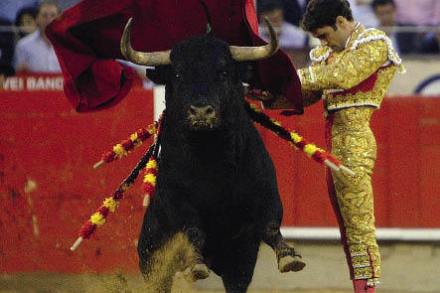
Looking at the programme for the feria of San Isidro in Madrid this month (bullfights are being held on 31 consecutive days), it may be hard to believe that there is any threat to the future of the spectacle — it is not a sport — of what in Spain is called la corrida (the running of the bulls). But its popularity has undeniably been declining in recent years, due to two factors: growing opposition, in the sometimes spurious name of animal welfare, and Spain’s economic crisis. The decision taken in 2010 to ban bullfighting in Catalonia had considerably less to do with the welfare of bulls than with the Catalans’ wish to distance themselves from the rest of Spain and Spanish traditions.

Why Gibraltar needs its hunt back

From our UK edition

The British overseas territory of Gibraltar, or, as some would have it, the wart on the bottom of the Iberian peninsula, is not an exciting place for a holiday. You don’t go for the food (mostly English pub grub and pizzas), or the nightlife (there isn’t any) or the beaches (overcrowded, with sand imported from the Sahara). But there are a few interesting legacies of three centuries of British occupation of what was known in Greek mythology as one of the Pillars of Hercules.

Verdi’s Don Carlos is the tops

From our UK edition

I go to about half a dozen operas a year, mainly by 19th-century Italian and French composers, plus some Mozart, bits of Handel, Richard Strauss and Britten and, most recently, Wagner. Having seen my first Don Carlos — the memorable Luchino Visconti production — more than 50 years ago, I thought then that it had all one could wish for in an opera, and it remains my favourite. Hearing the live broadcast from New York of the Met’s Don Carlos in March, I was reminded once again of the treats in store as the Nicholas Hytner production (which had its first outing in 2008) returns to Covent Garden this month. The seven performances at the Royal Opera House begin this weekend.

Art and the raging bull

From our UK edition

In these days of growing concern at the methods of factory farming and the welfare of the animals which are raised and killed for our consumption, it is instructive to compare the life of domestic beef cattle with that of a Spanish fighting bull. The cattle may have less than two years of life in cramped conditions, while the toro bravo roams free and unmolested on pasture for five years. Alexander Fiske- Harrison makes the comparison succinctly: ‘Five years on free-release and then the arena, or 18 months in prison and then the electric chair’. He maintains (there is some evidence for this, to do with beta-endorphins) that the fighting bull’s suffering is reduced because, once in the ring, it feels no fear, only aggressive anger.

Cherchez la femme

From our UK edition

The 22nd Earl of Erroll, Military Secretary in Kenya in the early part of the second world war, was described by two of his fellow peers of the realm as ‘a stoat — one of the great pouncers of all time’ and ‘a dreadful shit who really needed killing’. The 22nd Earl of Erroll, Military Secretary in Kenya in the early part of the second world war, was described by two of his fellow peers of the realm as ‘a stoat — one of the great pouncers of all time’ and ‘a dreadful shit who really needed killing’.

Farewell to a noble figure in Spectator history

From our UK edition

Ian Gilmour was not the only proprietor of The Spectator also to be its editor, but he was unquestionably the best. Patrician, wealthy, high-minded, unassuming, the 28-year-old Etonian ex-Grenadier Guardsman raised a number of eyebrows when he bought the magazine in 1954 and took over the editorial reins himself. However, the five years of his editorship were to cause a lot more surprise when, in fostering The Spectator’s libertarian tradition, he not only espoused radical causes but frequently opposed the Eden and Macmillan governments. In some important respects The Spectator under Gilmour’s direction anticipated the free-thinking mood of the 1960s.

Who wants to buy our old office?

From our UK edition

‘A unique opportunity to purchase the home of a famous weekly magazine.’ Thus might an estate agent market No. 56 Doughty Street, London WC1, now up for sale after more than 30 years as the offices of The Spectator. But an estate agent cannot know how des a res is this early-19th-century house in Bloomsbury. It should be sold not so much for its fabric — handsome as it is, if slightly worn — as for its recent history, for the rich variety of people who have passed through its doors and the voices which may come out of the now possibly rotting woodwork.

Small is beautiful | 13 January 2007

From our UK edition

My grandfather used to enjoy eating ortolans in Biarritz, sometimes in the company of Rudyard Kipling. In London, it amused him to ask for these little birds of the bunting family when dining at the Savoy, though I don’t think they were ever on the menu. Ortolans have always been a French delicacy: la chasse aux petits oiseaux, which involves trapping small birds in nets, may continue in parts of south-west France, but their sale for the table has been banned for some years. President Mitterrand, no great respecter of the law, was said to have had ortolans for one of his last meals, a week before he died — almost fulfilling the wish expressed by a character in Disraeli’s novel, The Young Duke, that he should die ‘eating ortolans to the sound of soft music’.

Talking turkey

From our UK edition

There won’t be any wild turkeys eaten in Britain this Christmas. There won’t be any wild turkeys eaten in Britain this Christmas. However, a few of these birds, which are indigenous to north and central America, are being reared in south-west England. It is possible that one or two dark-plumaged turkeys may be seen in flight over Salisbury Plain or the hills of Devon, though no one is yet treating them as game birds, which they are in the USA. In the eastern states, in Texas and New Mexico, the male birds are shot — when strutting about they have beautifully fanned tails — and no doubt their gamey taste was enjoyed at a few tables in celebration of Thanksgiving last week.

Good hare day

From our UK edition

In my early days as editor of the Field, I read an article submitted by one of the magazine’s venerable hunting correspondents In my early days as editor of the Field, I read an article submitted by one of the magazine’s venerable hunting correspondents — the subject was harehunting and a day out with, I think, the Cambridgeshire Harriers — which mentioned that, in the course of the chase, ‘puss clapped’. This slightly disconcerting expression apparently means, in the recondite language of the harehunter, that the quarry stopped and ‘froze’, trying to make itself invisible.

A little snack

The countryside writer Ian Niall, a columnist in these pages some 50 years ago, told in his classic work, The Poacher’s Handbook, of one of the fraternity known as Black Bill who had an affection for partridges and could never bring himself to kill them. ‘The partridge is the one bird I don’t touch,’ says the sentimental old poacher, expressing his contempt for those to whom it is ‘just a little snack on a plate with gravy runnin’ round it’. One can understand Black Bill’s feelings as he listens to and watches a partridge collecting its family together, huddling in a furrow when danger threatens.

King of the moor

The red grouse is a resilient little bird. Prone to an unpleasant disease called louping ill which is transmitted by sheep ticks, and vulnerable to attack by nasty, invasive little worms, its population may crash in some moorland areas for several years; and then it will reappear in healthy numbers as if nothing had happened. Grouse-shooting in Scotland has suffered a serious decline recently, due in part to the increased population of red deer, which may also be infested with ticks, and to cold, wet weather during the hatching season. (I have only just learnt that the Dr Edward Wilson who did so much valuable work in the early 20th century on the causes of grouse disease is the same Wilson who perished with Scott in the Antarctic.

Eat your hart out

From our UK edition

The Countryside Alliance, through its Game-to-Eat campaign, has been doing some good work in promoting venison. It is higher in protein and lower in fat than other red meat; some supermarkets are now offering venison steaks and sausages, but fewer than 10 per cent of the population buy the meat. Since deer numbers in Britain have apparently never been so high, and the government has been advised that they should be reduced by a third, wild venison, generally with a better flavour than deer that have been farmed, should be more generally available. Thanks to friendly persuasion by the Alliance, wild venison was introduced last year on the menus of Great Western and Anglia trains.

Free for now

From our UK edition

If, as I was told the other day, much of the frozen chicken and duck meat brought into this country comes from the Far East, it may be that some of us have already been exposed to the risk of contracting avian flu. But I don’t suppose that this will weigh with the government when there is another major scare — a couple of chickens found to have the dreaded virus in a heavily populated part of southern England. With its instinct for over-reaction, the Department for the Environment, Food and Rural Affairs will order that all poultry be kept indoors. When shall we then be able to enjoy a free-range chicken or a free-range egg again? Not wishing to be a Jeremiah, I would rather describe the joys of eating this remarkable domestic bird.

Always around

From our UK edition

There never seems to be any shortage of pigeons. Whether feeding in a field of corn or rape by day or coming into woodland at dusk, they are always around. Depending on the weather and the time of day, you may have to wait a while for them, but, as William Douglas-Home once wrote in a memorable article for the Field on pigeon-shooting, ‘they always turn up in the end’. They may be shot over decoys in spring and summer or from the shelter of trees on a winter’s afternoon; with no close season there should always be a plentiful supply for the table. These, of course, are wood pigeons.

Crashing boar

From our UK edition

While we are all worrying about the threat to poultry from an alien virus which has now reached these shores, there seems to be little concern at the threat to our countryside and livestock from an alien animal now roaming free in England. I am referring to wild boar, hundreds of them, which are inhabiting forested areas of Kent, Sussex, Dorset and Gloucestershire, having escaped from farms and bred in the wild. If nothing is done about them, there could be many thousands of wild boar in 20 years’ time, marauding through woodland, threatening walkers, destroying crops and pasture, and spreading diseases — swine fever, bovine tuberculosis — to domestic pigs and cattle. The spread of avian flu may be easier to contain than the proliferation of these dangerous wild beasts.