Ross Clark

Ross Clark

Ross Clark is a leader writer and columnist who has written for The Spectator for three decades. He writes on Substack, at Ross on Why?

The abandoned revolution: has the government given up on Brexit?

From our UK edition

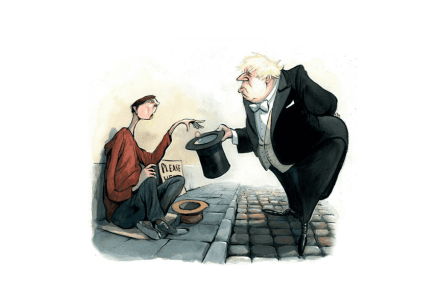
There is a lesser-known Robert Redford film, The Candidate, in which he plays a no-hope Democrat taking on a popular and well-liked Republican in a Californian election. After engaging unexpectedly well with the public and winning an improbable victory, he turns to one of his aides and asks, bewildered: ‘What do we do now?’ The question is left hanging in the air like the back end of the bus in The Italian Job. The script might as well have been written about Boris Johnson and the Brexit referendum campaign. It is nearly six years on from that victory, and two years on from Brexit itself. And yet it is still far from clear what — if anything — the Prime Minister intends to do with his victory. We thought we knew what he wanted from Brexit.

Don’t bet on interest rates rising

From our UK edition

So is this really it: the end of the era of virtually zero interest rates? There was a marked pullback in US markets on Wednesday when Jay Powell, the chair of the Federal Reserve, indicated that yes, he really did mean it: interest rates are on the way up, if not quite yet. ‘The committee is of a mind to raise the federal funds rate at the March meeting assuming that conditions are appropriate for doing so.’ Share prices, which earlier in the day had risen in expectation of a doveish stance, fell back sharply. The very idea that a central bank might increase interest rates to tackle rising inflation seemed to catch investors unaware – so used have we all become to ultra-low borrowing rates.

Did Plan B work?

From our UK edition

Today is England’s last day under Plan B restrictions, brought in by the government at the beginning of last month to curb the spread of Omicron. Work-from-home guidance was scrapped last week, while mandatory face coverings in shops and on public transport — as well as the need to show vaccine passports at large venues — are to be lifted tomorrow. Was there any point in these restrictions in the first place? We will never know, of course, what would have happened had the government not brought them in — no one has conducted a controlled experiment on an identical England where Plan B was never introduced.

Entitled motorists have ruled the roads for far too long

From our UK edition

Last week it was ‘operation red meat’, designed to recapture wavering Tory voters. This week something very different: changes to the Highway Code are coming into effect, which threaten to upset the not-insignificant number of car owners. Sure enough, the Alliance of British Drivers, the trade union for Mr Toads, has complained bitterly. Responding to a new clause reminding that cyclists and pedestrians have the right to use any part of the road, the Alliance complains: 'This is a recipe for anarchy and accidents. It is unworkable. Greater clarification is needed as it appears to give pedestrians total control over the entire road network.

Ousting Boris Johnson now would be a mistake

From our UK edition

There must come a time when even Beth Rigby starts to ask whether she is too fixated on a small staff party which happened nearly two years ago and not quite enough on the highest inflation rate in 30 years and the prospect of a Russian invasion of Ukraine. But to be fair to Sky TV’s political editor – who herself was taken off air for three months last year for attending a party which broke Covid rules – she is hardly the only one. As well as every other media outlet pursuing the same story to the point of absurdity the story is being fed by a number of covens of Conservative MPs who are determined to use this opportunity to oust the Prime Minister.

Banning tomato ketchup sachets won’t save the planet

From our UK edition

Warning to the working classes: the government is coming after your pleasures again. It is you who are being blamed for environmental degradation and you who will be made to pay the price. The latest wheeze of environment secretary George Eustice is to ban plastic sachets of tomato ketchup, soy sauce and whatever else from takeaways. Evidence has shown, he says, that these little sachets 'can cause considerable harm to the marine and terrestrial environment when disposed of incorrectly'.  Fair enough, in that we would all be better off if food manufacturers could find biodegradable substitutes for their packaging. But why is it always what might be described as common pleasures which ministers fixate upon when trying to solve social and environmental problems?

Does Boris believe in Brexit?

From our UK edition

For once, yesterday’s Downing Street press conference included a worthwhile question, and not of the 'why aren’t you locking us down?' variety. In fact, it had nothing to do with Covid at all. Harry Cole of the Sun asked why, given that the Prime Minister had once cited the ability to remove VAT from fuel bills as a tangible benefit of leaving the EU, he was not now taking advantage of his new-found freedom, especially as bills are heading sharply upwards. Boris Johnson mumbled something about not wanting to help people who could easily afford their energy bills and that the government might consider more targeted help instead.

The problem with ‘vaccine equity’

From our UK edition

'A stain on our soul'. That was how Gordon Brown, in his latest missive on the subject, described the failure of the west to ensure that the whole world is vaccinated. In a previous attack on western policy — at the end of November, just as Omicron was emerging — he wrote of “hoarding” and 'vaccine nationalism'. Take Africa: it is certainly true that vaccination rates in many countries are very low. While the UK has managed to deliver 195 doses per 100 people, Nigeria has only managed seven, Ethiopia and Somalia nine, and Chad and South Sudan two. Can all this be blamed on the failure of western nations to donate vaccines?

Does Warwick’s Omicron modelling make restrictions more likely?

From our UK edition

Two weeks ago, the London School of Hygiene and Tropical Medicine (LSHTM) and Imperial College both published modelling showing frightening scenarios if the government did not react to the Omicron variant by imposing immediate restrictions on our day to day lives. The former suggested that hospitalisations could peak at 7,190 a day in January in its most pessimistic scenario; the latter was reported as suggesting that deaths might peak at 5,000 a day in January. Both figures, however, were made on the assumption that Omicron was every bit as virulent as the Delta variant. Since then, several UK studies have suggested that this is not the case, with data showing it is between 20 per cent and two thirds less likely to land us in hospital.

Why warmer days in Alaska are not a sign of climate armageddon

From our UK edition

It’s climate panic again. This time, under headlines such as ‘Baked Alaska’, we are informed that the most northerly US state has experienced ‘absurd’ temperatures for December. ‘In December when temperatures would normally be well below zero,’ states the Independent, the town of Kodiak has registered a temperature of 67 degrees Fahrenheit (19.4 Celsius). ‘In late December I would not have thought such a thing possible,’ a climatologist is quoted as saying on CNN. ‘When smashing a temperature record it’s normally by a fraction of a degree,’ tweets the Met Office, ‘not by 20 degrees. But that is what happened in Kodiak, Alaska.

Remember panic-buying? Here’s what will happen next time

From our UK edition

It’s post-Christmas, and there are already murmurs about supermarkets with empty shelves. Just as with the petrol shortage in September and shortages of loo paper at the beginning of the first lockdown, these things can rapidly develop into major crises, purely as a result of panic-buying. Tesco, whose store on the Isle of Wight is reportedly especially empty post-Christmas, denies it has any problem with its supply chain — which had been threatened with disruption thanks to an industrial dispute involving the company’s lorry drivers in early December. People may, on the other hand, have stocked up more than usual in response to fears of a post-Christmas lockdown — a fear which appears for the moment to have gone away.

Sage modellers start to accept that Omicron is milder

From our UK edition

Public health officials in Britain and South Africa were on different planets for about a fortnight. While those in South Africa kept presenting data suggesting that Omicron caused less severe disease than earlier variants, scientists in Britain continued to claim it was too early to say. Scenarios published by the London School of Hygiene and Tropical Medicine (LSHTM) last week pictured a frightening picture of January, suggesting that hospitalisations could peak above previous waves. An assumption was made that Omicron was just as likely to land you in hospital or kill you compared with Delta. As LSHTM admitted, quite a big assumption:- Due to a lack of data, we assume Omicron has the same severity as Delta.

Why Omicron may not lead to a surge in hospitalisations

From our UK edition

There were two takeaways from last night’s press conference: firstly, the hard data showing that the number of recorded cases of Covid had surged by 19,000 – or 28 per cent – in a single day. Second was the assertion that, as a result, the NHS is in danger of being overwhelmed. What was lacking was the hard data on hospitalisations and the number of people in hospital. Although you would never have guessed from the tone of the conference, these both fell. The number of people admitted to hospital – a figure which runs a few days in arrears owing to a delay in the four constituent nations of the UK collating their data – fell from 800 to 774, the lowest figure recorded in a week.

Are a growing number of Brits choosing not to work?

From our UK edition

It wasn’t long ago that we were fearing the end of the furlough scheme might be accompanied by a significant rise in unemployment. According to the latest labour market figures released by the Office of National Statistics (ONS) this morning, that doesn’t appear to have happened. What they do show, however, is that the pandemic has led to growth in a section of the population which generally receives little comment: adults of working age who are economically inactive – i.e. not in work and not seeking work either. Moreover, those who are in work are working fewer hours than they did before the pandemic. The figures cover the period August to October, the last month of which falls after the end of the furlough scheme on 30 September.

What does this South African study reveal about Omicron?

From our UK edition

While the government’s policy on Omicron is being driven by modelling suggesting the possibility of a huge wave of hospitalisations in January, some more real-world data has come in from South Africa.  A presentation by the South African Medical Research Council this morning has offered evidence that while Omicron does indeed appear to be more transmissible than the Delta variant, the trajectory of hospitalisations is flatter.  This would appear to confirm earlier data from hospitals in Gauteng province that Omicron is causing a milder disease than previous variants.

Boris’s booster jab plan comes at a price

From our UK edition

If you haven’t yet been approached about having a Covid booster jab, your phone is about the spring into life – and it is unlikely to let you forget it until you agreed to have your third dose of the vaccine. The Prime Minister’s announcement on Sunday evening that every adult is to be offered a jab by the end of December, as opposed to the end of January as previously planned, will mean averaging a million jabs a day – even more than the peak of the inoculation programme in the spring. But there is a price to pay, and health secretary Sajid Javid admitted as much on this morning’s Today programme.

Does Taiwan hold the answer to the lab leak theory?

From our UK edition

It is nine months since the World Health Organisation (WHO) dismissed the possibility that the Covid 19 pandemic could have originated in a laboratory leak, calling it ‘extremely unlikely’. Since then, much scientific opinion has been moving in the direction that it is at least a possibility – especially given that the Wuhan Institute of Virology has been accused of engaging in ‘gain of function’ research into coronaviruses, involving manipulating the viruses into making them possibly more transmissible. Moreover, far from being rare, as the WHO intimated, the original SARS virus is known to have escaped from a laboratory on a couple of occasions. But if Covid did get into the human population, how might it have escaped from the Wuhan lab?

Should we be scared of the Omicron variant?

From our UK edition

Why is the government so scared of the Omicron variant? So far, most of the evidence we have for transmissibility and virulence of Omicron is based on very limited data from South Africa, but the UK Health Security Agency (UKHSA) has now published its own preliminary study of the variant — the results of which will presumably have been available to ministers and scientific advisers prior to Wednesday’s decision to enact ‘Plan B’. They appear to show a variant which is more transmissible, more likely to evade vaccines and more likely to reinfect people who have previously had Covid. But there is a very big caveat: they are based on tiny numbers of Omicon cases.

Has Boris seen the Omicron data?

From our UK edition

There was nothing but gloom about the Omicron variant at yesterday’s No. 10 press conference. But with reporters preoccupied with last year’s Christmas parties, no one thought to bring up a statement by Tedros Adhanom Ghebreyesus, the head of the WHO, who earlier told reporters that there is ‘some evidence that Omicron causes milder disease than Delta, but again it’s still too early to be definitive.’  You don’t want to make decisions before you have good evidence, but if it does turn out that Omicron is a milder disease, won’t the government’s efforts to suppress it with travel bans and restrictions be counter-productive?

Fact check: are cycle lanes really making traffic worse?

From our UK edition

London is the most congested city in the world and it’s the cycle lanes wot done it. That is the impression you will pick up from the headlines this morning.  'Cycle Lanes Blamed as City Named Most Congested,' reads a BBC headline, to take but one example. The story emerges, it turns out, from a global index published by transport consultancy Inrix, which claims that motorists in London spent an average of 148 hours in traffic jams this year, more than in any other country in the world. In the past year, the city climbed from being the 16th most-congested of those studied to the most congested of that lot.