Ross Clark

Ross Clark

Ross Clark is a leader writer and columnist who has written for The Spectator for three decades. He writes on Substack, at Ross on Why?

Tesco, I hate you — and you need to know why

From our UK edition

For the vociferous band of Tesco-haters, waiting for the supermarket giant to slip up on one of its own homogenised banana skins has been a long and frustrating business. OK, you can clutch on to the failure of Tesco to achieve the 4 per cent year-on-year increase in sales during the Christmas period which analysts had predicted (it only managed 3.1 per cent). You can point out that its shares have plunged by 20 per cent since December — but which retailer’s shares haven’t? You can crow that a remarkable number of its executives over the past year have been scattering to jobs in rival businesses (one of them, dammit, to Sainsbury). But it is all pretty desperate stuff. Tesco still takes £1 in every £8 spent in shops by British consumers.

Don’t let them kill off the cheque

From our UK edition

Next month I will break the habit of a lifetime and wait until the red reminder before paying my telephone bill. I will do so because BT has decided to charge me £33 a year for the audacity of paying my bill by cheque. BT is penalising people who pay by cheque because it wants us all to pay by direct debit. As it happens, I’m happy enough to pay by direct debit for some things: namely bills which are for a fixed amount of money every month. I would be perfectly happy to pay my telephone bill online, too, so long as I was in control of the transaction. What I refuse to do is to open my bank account to BT and say: ‘Here, take what you like.

Monopoly: the dangers of playing Gordon Brown’s special edition

From our UK edition

There is one thing I have never understood about the property developers of 1930s Atlantic City. How come — at least to judge from the game they inspired, Monopoly — they never borrowed so much as a dime? Few provincial towns these days are considered so inconsequential that they have not spawned a special edition of the Monopoly board, featuring their own street names. But there is one version of the game you won’t find in the shops: the ‘Gordon Brown’s Britain’ edition. This is a game in which, unlike the original, you can borrow money — lots and lots of it. Until, that is, property prices collapse and you’re left in a credit crunch. Here’s how you play. All you need is an ordinary Monopoly set and a calculator.

Too much security makes us all a lot less secure

From our UK edition

Here is a little paradox. For 30 years during the Troubles you have been taking the Belfast to Stranraer ferry. No one asked you for identification: you just bought your ticket and off you went, even though it is quite possible that among your fellow passengers on one of those journeys was a terrorist smuggling bomb-making equipment into mainland Britain. Eventually, peace is restored to Northern Ireland. And what happens? Suddenly you can’t travel without a passport or ID card, and all your luggage is scanned. Once in Belfast you decide to take a train to Dublin, a journey you have been making unhindered for 30 years.

Losing our heritage

Surely, I said, the RAF cannot have bombed them all. No, she said: it was the ‘economic miracle’ which had done for them. Wealthy West Germans had spent the 1960s bulldozing fuddy-duddy old houses and building nice modern chalet bungalows in their place. Soon we will be able to give the same answer in response to the question, why is there not a single fireplace or original architrave left in the whole of Chelsea, Kensington or Hampstead? The answer is London’s own economic ‘miracle’. The City is so wealthy now that you cannot show off your wealth simply by buying a nice house and living in it: you have to gut it and fill it with all the latest fashion accessories.

More bad news: no housing shortage

From our UK edition

While all eyes were on the crash of Northern Rock last week, something even scarier was happening. Two of Britain’s many house price indices — there were eight competing in a crowded market last time I counted — reminded us that property prices can fall as well as rise. The Royal Institution of Chartered Surveyors reported that a net balance of 1.8 per cent of its members say house prices fell in August. Then Rightmove, the property website, reported that asking prices in England and Wales had fallen by an average of 2.6 per cent. If you have just bought a job lot of buy-to-let apartments in Docklands on the never-never, no doubt this is worrying news. But not half so worrying as the figures I have had my eyes on.

The West is running a protectionist racket against the developing world

From our UK edition

The West’s new greenness conceals a giant protectionist racket On 27 September, President George W. Bush will finally come in from the cold over global warming. On that day he will host a conference in Washington to be attended by what he has defined as the world’s 15 most polluting nations. He intends, for the first time, to commit the United States to slashing its carbon emissions. That, anyway, is the positive spin. Alternatively, one might put Bush’s multilateralist initiative like this: he is fed up with being depicted as the bad boy of climate change.

London matches the glory of Venice in its prime

From our UK edition

Ross Clark says that our capital has the geographical, economic and social conditions that made the Venetian city-state of the 14th century — but all this is vulnerable When Tony Blair secured the agreement of the Scots and — only just — the Welsh for devolution in the referendums of 1998, it was supposed to herald a great revival of the regions. Britain was to be reborn as a kind of West Germany, whose constitution included a reference to ironing out the economic disparities between Hamburg and Munich, Frankfurt and Hanover. Instead, the opposite seems to have occurred.

Red tape and big money

From our UK edition

There aren’t many people who can say that Gordon Brown has cut their taxes. In fact, as far as I’m aware there are just managers of private equity funds — and me. The Chancellor’s introduction of the flat-rate VAT scheme in 2002 was so uncharacteristic that it took me a whole year to work out that I could simplify my VAT returns and save several thousand pounds a year. Sadly that simple reform, which allows small businesses to reclaim VAT as a fixed percentage of turnover rather than on each item — and rewards cheapskates like me who run up very low expenses — was to be a one-off. Otherwise, for small businesses the Blair years have been about just three things: regulation, regulation, regulation.

Hatred of the rich is back in fashion

From our UK edition

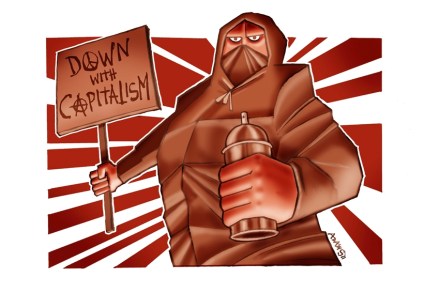
Ross Clark says that the anti-globalisation rioters protesting at the G8 summit in Germany and Labour’s deputy leadership contenders are part of a new and dangerous trend towards wealth-bashing One of the little-remarked side effects of 9/11 was the eclipse of the anti-globalisation movement. It is not easy to remember that in the summer of 2001, the year in which protestor Carlo Giuliani died during rioting at the G8 summit in Genoa, the growing venom of anti-capitalism protestors was seen as such a threat to society that, briefly, on the afternoon of 11 September commentators on the live radio and television coverage discussed the possibility that the attacks could have been carried out by enemies of globalisation. After 9/11, however, the movement suffered a precipitous decline.

A way out of this Kafkaesque world

From our UK edition

The regulator of premium-rate telephone services, ICSTIC, is investigating television companies which dangle prizes before viewers’ eyes and then make it extremely difficult to claim them. When it has finished with that, perhaps the watchdog might turn its attention to a similar scam: Gordon Brown’s tax credits. In last month’s Budget, the Chancellor held out the promise that 5.3 million people who will be left worse off by the abolition of the 10 pence starting rate for income tax will be able to offset some of their losses by claiming enhanced tax credits. What he didn’t say was that tax credits are so fiendishly complicated that millions fail to claim the money to which they are entitled.

The OFT’s recipe for fecklessness

From our UK edition

Next month the Office of Fair Trading will produce its long-awaited report into parking fines. It is expected to rule that charging motorists £60 for overstaying their welcome at a parking meter is unfair, and that in future councils must charge motorists only what it costs to issue the parking ticket. Actually, that’s not quite right: hell will freeze over before councils stop raising revenue through parking fines. What the OFT is really going to produce is a report on what it considers to be the ‘unreasonable’ practice of banks charging customers up to £39 for going into unauthorised overdraft.

Will you have a place in the bio-bunker?

From our UK edition

Ross Clark investigates the government’s plans to deal with a human flu pandemic, and finds that the preparations for mass drug treatment are in a scandalous mess — unless, that is, you are on the right list In its early days, New Labour was likened to a ‘big tent’, in which there was room not just for the party’s traditional supporters but just about anybody else too. There is one government tent, however, in which there is certainly not yet room for everyone: the tent which offers some protection in the event of an influenza pandemic caused by a human strain of the H5N1 bird flu virus.

Enough, says Blair — but is anyone listening?

From our UK edition

Given that the government’s lust for setting targets has done so much to increase bureaucracy in public services Given that the government’s lust for setting targets has done so much to increase bureaucracy in public services, one could be forgiven for a little scepticism regarding the Prime Minister’s latest target: to reduce red tape by 25 per cent. Presumably a new quango will be set up to measure the exact length of red tape which binds the country, so that Blair will be able to pronounce victory once precisely a quarter of it has been chopped off. I don’t hold out a great deal of hope that this latest initiative will achieve anything. We’ve heard it all before.

Demolition crazy

From our UK edition

While Tony Blair was making his valedictory speech to the Labour party conference in Manchester on 27 September, 60-year-old Elizabeth Pascoe was ecstatic. Not because she was impressed by the Prime Minister’s self-composed list of glorious achievements, but because the High Court had just stopped the government from running a bulldozer through her house. Miss Pascoe’s misfortune had been to live in Adderley Street, Liverpool, in one of 500 homes scheduled for demolition in Liverpool under the so-called Pathfinder scheme. The Liverpool Land Development Company, the quango responsible and misleadingly disguised as a private company, had argued that the area needed to undergo ‘regeneration’ because many homes were lying empty and abandoned.

Monetary genius? I beg to differ

From our UK edition

Amid the growing mutterings over his suitability to be prime minister, Gordon Brown has managed to preserve his reputation in at least one quarter. It has become received wisdom that the Chancellor played a blinder on his first day in the job in 1997 by making the Bank of England independent, giving us perpetually low interest rates and bringing an end to boom and bust. Indeed, this is one Labour ‘success’ that David Cameron has promised to leave intact. It is not hard to see why Gordon Brown has managed to portray himself as the genius who brought low, stable interest rates to Britain. To anyone over 40, the Brown years must seem a golden age of stable money.

The real case against Tesco

From our UK edition

Corporate success can generally be measured by the size and strength of the campaign to boycott your business. But until very recently there was a remarkable exception to this rule: Tesco. For a supermarket group which now accounts for a remarkable one in every eight pounds taken by retailers in Britain, opposition has been remarkably light. Where are the student demos, the bricks flying through Tesco windows on May Day? Even tapping into www.boycotttesco.com is something of a disappointment; the site was bought up some time ago by a bunch of American libertarians who object to the way loyalty cards are used to spy on our shopping habits — not exactly an issue which excites the British public’s imagination.

Down with the new morality

From our UK edition

It was John Major who came a cropper while trying to restore the nation’s moral values: his ‘back to basics’ campaign was mocked to death before it had really got started. Yet Mr Major’s attempt to influence the nation’s morals was nothing compared with that of Tony Blair, who has overseen a Sexual Offences Act, a law against discrimination on the grounds of sexual orientation, the introduction of civil partnerships for gay couples, and a gambling Bill. Moreover, Mr Blair seems to have got away with it. It is not entirely obvious why we should be happy to allow a preachy Tony Blair to tell us what is right and wrong when we sneered at the merest suggestion of John Major doing the same.

Trial by tabloid

From our UK edition

I have no idea whether Sion Jenkins — the former Hastings deputy headmaster who was this week acquitted of murdering his foster daughter after juries in two successive trials failed to reach a verdict — committed the foul deed or not. I wasn’t there. Maybe Jenkins suffered one of the fits of rage which his former wife, Lois, now claims are part of his character and slugged poor Billie-Jo over the head because she had spilled paint on the carpet, then stuffed a piece of black bin-liner up her nose in a deliberate attempt to implicate the mysterious ‘Mr B.’, a lowlifer with a plastic fetish who used to frequent the park outside the Jenkinses’ home.

Reefer madness

From our UK edition

After some consideration I am not sure that I can get excited about the debate as to whether cannabis should be classifed as a Class B drug or whether, as the Home Secretary Charles Clarke decided last week, it should remain Class C. Rather, I am coming round to the conclusion that it should be declassified as a drug altogether — and reclassified as a banned foodstuff. Instead of being handled by a bunch of creepy do-gooders from the drugs’ charities, the battle to keep it off the streets would then be run by the zealots of the Food Standards Agency.