Rory Sutherland

Rory Sutherland

Why are bosses so suspicious of remote working? 

From our UK edition

The swimmer Michael Phelps is the most decorated Olympian of all time, with 28 medals, 23 of them gold. He is a former world record holder in the 200m freestyle, 100m butterfly, 200m butterfly, 200m individual medley, and 400m individual medley. But let’s just analyse his world-record time for the 200m freestyle – an amazing one minute and 42.96 seconds. Amazing, that is, until you do the maths. Over 200 metres I make that 6.99km/h or 4.34mph. Here’s my problem. I am a fat 58-year-old man, and I can run faster than that. In wellies. In Alabama there are 300lb, heavily tattooed chain-smokers who can pull a Mack Truck for 200 metres faster than Phelps can swim it. It’s true that Michael Phelps is an amazing swimmer.

The insanity of banning vape flavours

From our UK edition

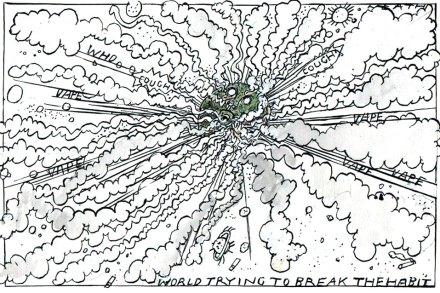
Nicotine may have some deleterious and costly health effects, but so do winter sports, mountaineering, motorcycling and many other activities we leave to personal choice. (I have never been asked to work on a government anti-skiing campaign, though if the opportunity arose I would happily volunteer my services for free.) But it is absurd that vaping is now the target of much more opprobrium than alcohol. I suspect part of the explanation can be found in an HM Government health warning which appeared on cigarette packets in the 1980s: ‘Most Doctors Don’t Smoke.’ Indeed so. Most doctors don’t vape either. But, in my experience, doctors drink a lot.

The lesson AI must learn from nature

From our UK edition

What’s the difference between a café and a restaurant? It’s not as simple as it seems. Yes, the food at a restaurant will be fancier and more substantial. But there is a social distinction too: a restaurant places you under an obligation; a café does not. When you enter a café you order something out of courtesy – but it can be as insubstantial as a cup of tea. How long you stay, and what you choose to eat or drink, remains up to you. A café, as Nassim Taleb would say, is ‘high in optionality’. By contrast, entering a restaurant is like missing the Wrotham exit on the westbound M26 – you’re stuck there for ages with no chance of escape. Once you sit down in a restaurant, you’re in for at least two courses and a bottle of wine.

The box-tickers shall inherit the Earth

From our UK edition

Back in the late 1960s, a Welsh surgeon was returning home late, fell asleep at the wheel and fatally crashed into a tree. My aunt, a doctor, remarked that 30 years earlier a surgeon of such eminence would have had his own driver, and the accident would not have happened. Probably true. And it reminds us of a time when people who did useful things were given people to work for them so they could do useful things more easily. These were drivers, secretaries, assistants and orderlies. They made useful people’s lives easier. What is the great-grandson of the 1930s chauffeur doing? There is a worryingly high chance that he is working in hospital administration, perhaps in HR or compliance, and is adding to the surgeon’s workload with every click of his mouse.

Kitchen renovations are a zero-sum game

From our UK edition

Writing a few weeks ago in The Spectator, Toby Young slightly begrudged his wife’s decision to install a new kitchen in the Acton home they have shared for 15 years. As Toby explained, the original kitchen ‘had been done to quite a high standard in the style known as “Victoriana”, which meant William Morris wallpaper, antique-glass light shades and a small, dimly lit kitchen… This was the height of fashion in the late 1980s and will probably be bang-on trend again when we put the house back on the market in ten years’ time. But my efforts to persuade Caroline to wait out the fashion cycle came to nought.

Cryptic crosswords are hard – but so is life

From our UK edition

As regular readers will know, I am an inveterate fan of cryptic crosswords. At the everyday level, they are the perfect way to kill 20-50 minutes of otherwise boring time. There is a refined elegance to clue-setting: the best are little works of art. Crossword-solving also cultivates the useful talent of looking beneath the clue’s explicit surface meaning to the meaning lurking beneath – which trains solvers in the essential creative act of seeing the same thing from different perspectives. Cryptic crosswords instil the very important idea that problem-solving is rarely linear But there is perhaps something even more valuable about the habit. There are many ways of solving any given clue, hence much of the skill lies in switching between various angles of attack.

We need to talk about cannabis

From our UK edition

Before we celebrate the ban on tobacco sales to people below a certain age, we need to consider what habits might take its place. And it might not only be vaping. Approaching the Holland tunnel in New York a few summers ago, I lowered my car window and was hit by the stench of cannabis smoke. It came from a car full of youths in the adjacent lane. More alarmingly, the smoker was also the driver of the car. In the last few years, uninhibited toking has become an increasingly common sight – or smell – everywhere.

The beauty of mid-range products

From our UK edition

Once or twice, when on a crowded overnight flight, I have taken a sneaky stroll through the different cabins for the purpose of comparison. My reaction on first peering into each cabin goes like this. First class: ‘Gosh, this is fabulous. It’s like a restaurant in the air.’ Business class: ‘Ooh, this is nice; they get flat beds and everything.’ Premium economy: ‘Well this is OK; the seats seem comfy and it’s all pretty civilised.’ Economy: ‘It’s the “Raft of the Medusa”.’ Now here’s the thing. In terms of comfort, the biggest gap between two adjacent flight classes is between economy and premium economy.

Are we asking the wrong questions about HS2?

From our UK edition

I am not sure there was much else Rishi could have done to salvage HS2. But I come bearing good news. There is no reason why HS2 cannot still be a great railway, even if it travels along the wrong route at the wrong speed and was constructed in the wrong direction to solve a problem which no longer exists. All you need to do is redefine what the railway is for. Perhaps it can be the right answer to a different question. A useful precedent for reinvention here might be what was originally called the Millennium Dome. Though hopeless at fulfilling its original purpose, once reinvented as the O2 it has proved an asset to London.

Is there such a thing as too much empathy? 

From our UK edition

Back in the 1970s, a less politically correct age, there was a standby formula for television advertising known as 2Cs in a K, which would feature two women by a washing machine engaged in unlikely conversation about some wondrous new detergent. Since The Spectator is a family publication, I shall pretend that 2Cs in a K stood for two ‘consumers’ in a kitchen, although it did not. If you are still trying to puzzle this out, the male equivalent is two dicks near a fence, a routine in which one man implausibly explains to his neighbour the many virtues of a particular woodstain, say, or one of those natty electric pressure washers which allow you to jetwash your patio while pretending you are wielding a flamethrower during the Tet Offensive.

Judgment call: the case for leaving the ECHR

From our UK edition

42 min listen

On the podcast this week: Lord Sumption makes the case for leaving the ECHR in The Spectator's cover piece. He says that the UK has strong courts and can pass judgement on human rights by itself and joins the podcast alongside Dr Joelle Grogan – legal academic and head of research at UK in a Changing Europe – to discuss whether the Strasbourg has lost its appeal. (01:22). Also this week:  Rory Sutherland takes a look at the rise of dynamic pricing in the magazine, a new trend where prices can surge at peak times and a phenomenon which has now made its way into pubs. He says that it’s not necessarily the cost that matters, but the way it is framed and is joined by Times business columnist Ryan Bourne to debate.

Why we hate surge pricing – but love happy hour

From our UK edition

A Dominican and a Jesuit were chain smokers. Both were eager to be allowed to smoke while performing their devotions, but needed to gain permission from a higher authority. ‘I tried asking the Prior, but he was dead against it,’ said the Dominican. ‘What did you ask, precisely?’ enquired the Jesuit. ‘Well, I asked him whether it was acceptable to smoke while I was praying.’ ‘Wrong question,’ replied the Jesuit. ‘I asked my Abbot whether I could pray while I was smoking. Permission granted.’ To economists, price is a number. To everyone else, price is a feeling This is called a framing effect and is one of the best attested findings in the psychological sciences.

Why driving above the speed limit is a mug’s game 

From our UK edition

Imagine you are choosing between two proposed road-improvement plans, but have the budget for only one. Both of the roads mooted for improvement are 20 miles long, and your sole aim is to reduce average journey time by as much as possible. Which would you choose? Someone travelling slowly to begin with has more time on the road to profit from any gain in speed 1) Improving Road A, which increases the average speed from 20 to 25mph (i.e. 25 per cent faster). or 2) Improving Road B, which increases the average speed from 40 to 65mph (62.5 per cent faster). The majority of people, including many experts, instinctively plump for B. Unfortunately they are wrong.

What a full English breakfast can tell us about the state of the NHS

From our UK edition

Among devotees of the full English breakfast, few things polarise more than the inclusion of baked beans. Some people are unrepentant berfs (beans exclusionary radical foodies) whereas others consider beans a coda to close the symphony. My own view is conciliatory: provided the beans are in a separate pot, I’m happy. ‘Hash brown technologies’ seem like useful additions, but end up destroying time-tested alternatives What worries me more is the arrival of the hash brown. This is a transatlantic invader: the grey squirrel of the breakfast world. Not particularly objectionable in itself, it risks eradicating the more attractive indigenous option, which is fried bread. Before you know it, you have nowhere to squish your tomato and the harmony of the plate is destroyed.

You won’t know it, but a school trip will be the best day of your life

From our UK edition

‘We need 800 words on a memorial school trip by next Friday. And Taki’s already written one.’ As soon as I agreed to this commission, I started to worry. What if Taki’s childhood involved countless trips to Penscynor Wildlife Park, St Fagans Museum of Welsh Things or Wookey Hole? There would be a risk of repetition. After some reflection, I decided this was unlikely. I had even gingerly lowered the rear step of the minibus to maximise the resulting damage Unlike Longstanton Spice Museum, which is an Alan Partridge invention, Penscynor Wildlife Park, though now defunct, actually existed. It is surprising that it failed financially, since it must have made several million pounds a year from the sale of car stickers alone.

What I learned from being debanked

From our UK edition

My own debanking story concerns a card rather than a bank account. Not the same degree of inconvenience as Nigel Farage, but a similarly telling insight into modern administrative culture. I feel awkward writing this, because in the 30 years I have used American Express, including an enjoyable decade when I also worked for the brand as a copywriter, few companies have impressed me more. They are unfailingly courteous and responsive. On many occasions, such as when arriving at an airport to discover I had to pay £4,000 for an unratified airline ticket, my card has been invaluable; I willingly follow their advice not to leave home without it. But one evening last year Amex didn’t do nicely. There’s a special feeling to having a Platinum card declined.

Just stop HS2!

From our UK edition

I have two suggestions for HS2. Either stop it or make it stop. The spiralling cost and delays are reason enough to rethink the project, never mind the changes to patterns of rail use since 2021. Any economic case based on pre--pandemic projections needs to be revisited. So one option would be to stop the project completely. But what if the project goes ahead in a reduced form to save face? Well, in this case, the need for speed is questionable. The value of speed to passengers is far from linear. For instance, cutting a journey time from four hours to two, as the TGV did between Paris and Lyon, is a game-changer. Reducing a journey from 80 minutes to 40, on the other hand, isn’t that big a deal.

How to increase your home’s value – with a sandwich

From our UK edition

It is a tenet of neo-liberal economics that there is no such thing as a free lunch. This is obvious baloney. There are free lunches everywhere. The problem is that those free lunches are no longer served to people doing useful work. They are instead handed out to the owners of a few favoured asset classes through untaxed gains. We have created far more tax breaks for rent-seeking than for productive work… and then we wonder why Britain has a productivity crisis. Under a future Sutherland regime, there would be no tax paid on beer drunk in a pub I must admit I enjoy a few free lunches myself – literally.

Light bulb moment: the flaw in the petrol car ban

From our UK edition

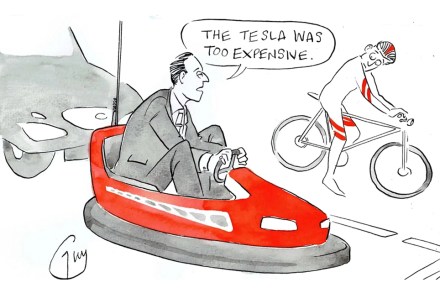
This week, writing in the Daily Mail, Matt Ridley produced a devastating takedown of the government’s 2030 ban on the sale of new conventionally powered cars. He plans to pre-empt the ban himself by buying a brand-new petrol car in 2029. Innovation happens gradually and delivers its benefits unevenly – therefore it is stupid to impose it on everyone all at once  I thought he was right about almost everything, except perhaps that final prediction. He’s right to be sceptical about the environmental benefits of electric cars – especially in countries such as China (and, to a lesser extent, Germany) where electricity is largely generated from the filthier forms of coal.

We are experiencing an unusually high volume of bureaucracy

From our UK edition

I have a hunch why people in late middle age are abandoning the workforce: their jobs, as they once knew them, no longer exist. I don’t mean that there is no longer pay for what they do; it’s simply that corporate bureaucracy has eliminated many of the perks which made work enjoyable in the first place. Doctors hired for their expertise must defer to people with no medical knowledge at all A legal-financial-HR-procurement-managerial commissariat, by ratcheting itself ever deeper into organisations, has eliminated the patronage, autonomy and exercise of knowledge which once came hand-in-hand with professional ability.