Robert Tombs

Robert Tombs

Robert Tombs is an emeritus professor in history at the University of Cambridge and the author of This Sovereign Isle: Britain in and out of Europe (Allen Lane, 2021). He also edits the History Reclaimed website

In defence of the British Empire

From our UK edition

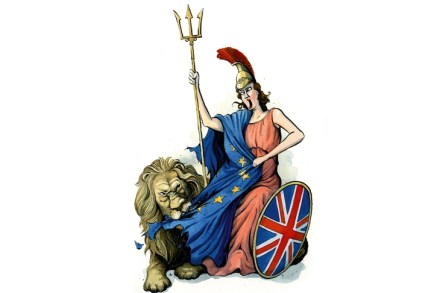
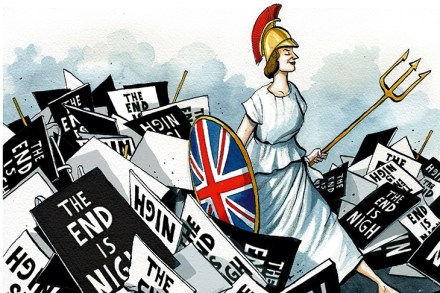
Is it my imagination, or are the whitened bones of the British Empire being yet again dug up and trampled underfoot? The latest Labour party manifesto promised ‘an audit of the impact of Britain’s colonial legacy to understand our contribution to the dynamics of violence and insecurity across regions previously under British colonial rule’. The New York Metropolitan Museum of Art is redesigning its British galleries to link every statue and teapot to the Empire ‘with all of its systems of exploitation’. Jesus College Cambridge intends to return a bronze cockerel seized from Benin in a punitive expedition in 1897.

Britain after Brexit: it’s time to decide on our place in the world | 12 January 2020

From our UK edition

‘Global Britain’: a phrase that provokes mockery and even indignation. As an alternative to EU membership many consider it impossible and worse, undesirable. Are we capable of true independence, or is this an illusion? Does ‘global Britain’, as its bitterest critics accuse, draw on imperial nostalgia and nationalistic arrogance? Or is it a rational response to a changing world? It is certainly not a new response. Britain has been a global player since the 1730s. Since the early 1800s we have had to be: with a population of 14 million we were no longer able to feed ourselves, and Britain’s enemies looked forward to the day when it would starve.

Britain after Brexit: it’s time to decide on our place in the world

From our UK edition

‘Global Britain’: a phrase that provokes mockery and even indignation. As an alternative to EU membership many consider it impossible and worse, undesirable. Are we capable of true independence, or is this an illusion? Does ‘global Britain’, as its bitterest critics accuse, draw on imperial nostalgia and nationalistic arrogance? Or is it a rational response to a changing world? It is certainly not a new response. Britain has been a global player since the 1730s. Since the early 1800s we have had to be: with a population of 14 million we were no longer able to feed ourselves, and Britain’s enemies looked forward to the day when it would starve.

This election will change Britain – and Europe – for good

From our UK edition

This election campaign feels unreal. Commentators focus on spending plans and personal foibles, but what will make next week’s vote historic is something else, something so momentous that we draw back from discussing it seriously. The Lib Dems boast of Stopping Brexit, knowing that as things are now they will never have to try. Jeremy Corbyn pleads neutrality: the first leader not sure which side he was on since poor Henry VI in the Wars of the Roses. The Conservatives, whose hopes of office depend entirely on this issue, downplay its importance: ‘Get Brexit Done,’ ministers repeat, as if it were a tiresome distraction from real politics. Perhaps it is, if ‘real politics’ is only about mending potholes and recruiting nurses.

The good, bad and ugly of Boris Johnson’s Brexit letter to the EU

From our UK edition

Boris Johnson has written to European Council president Donald Tusk, setting out key aspects of his government’s approach to Brexit. The four-page letter has a number of positive points but also some worrying ones. The good bits: The letter condemns the Irish backstop as undemocratic and inconsistent with both UK sovereignty and the Good Friday Agreement. It also rightly notes that the backstop would lock the UK into a customs union with the EU indefinitely with no means of escape. The letter also states that the UK government cannot continue to endorse the commitment its predecessor made in the Joint Report of December 2017 to ‘full alignment’ with wide areas of the single market and customs union.

Time warp

From our UK edition

How we love bringing history into our political debates. It may seem strange in a country where so little history is taught at school, but perhaps that makes it easier. We grab hold of vague notions of the past for a Punch-and-Judy brawl. There could hardly be a better example of this than Brexit, in which we skim through the whole of our history to search for analogies to batter the other side with. The Roman empire, the Norman conquest, the Wars of the Roses, the British Empire, appeasement, the second world war, Suez… Leavers have fulminated against ‘traitors’ who deserve the Tower for flouting Henry VIII’s assertion of sovereignty. Remainers have accused Leavers of being racists, imperialists, indeed, worse than Nazis.

What Sir Ivan Rogers gets wrong about Brexit

From our UK edition

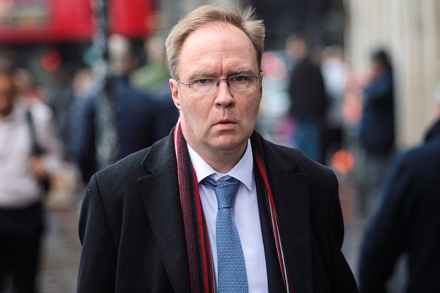
When so much of the Brexit debate has consisted of slogans and unexamined assertions (‘cliff edges’, ‘crashing out’ and the rest), it is welcome that a more substantial argument has been made by Sir Ivan Rogers, former UK ambassador to the EU. He has been making a series of well-received speeches, some of which have been so popular that they have been published as a book (and recently, on The Spectator’s website). He has long been pessimistic about the chances of reaching a Brexit settlement any time soon, and resigned in January 2017 when his concerns became public. He deplores the referendum decision but regards it as necessary for it to be carried out. But he is deeply pessimistic about the outcome.

Fatalist error

From our UK edition

When so much of the Brexit debate has consisted of slogans and unexamined assertions (‘cliff edges’, ‘crashing out’ and the rest), it is welcome that a more substantial argument has been made by Sir Ivan Rogers, former UK ambassador to the EU. He has been making a series of well-received speeches, some of which have been so popular that they have been published as a book (and recently, on The Spectator’s website). He has long been pessimistic about the chances of reaching a Brexit settlement any time soon, and resigned in January 2017 when his concerns became public. He deplores the referendum decision but regards it as necessary for it to be carried out. But he is deeply pessimistic about the outcome.

Brexit is about renewal, not just leaving the EU. And there’s no time to waste

From our UK edition

None of us can predict the potential fallout from Brexit, good and bad. What began as a vote of confidence in our institutions has shown them to be dangerously fallible. A country where people usually rub along together is now marked by a cultural and emotional rift. If Brexit does continue to dominate our politics for years, will it mean a reform of our institutions, or a battening down of the hatches by a beleaguered elite? Will the House of Lords, having alienated its natural defenders, at last be seriously reformed? Shall we try to restrain the dangerously capricious powers of prime ministers? Shall we empower local government? Both Brexiteers and Remainers will be in a rather militant mood.

Beyond Brexit | 13 December 2018

From our UK edition

None of us can predict the potential fallout from Brexit, good and bad. What began as a vote of confidence in our institutions has shown them to be dangerously fallible. A country where people usually rub along together is now marked by a cultural and emotional rift. If Brexit does continue to dominate our politics for years, will it mean a reform of our institutions, or a battening down of the hatches by a beleaguered elite? Will the House of Lords, having alienated its natural defenders, at last be seriously reformed? Shall we try to restrain the dangerously capricious powers of prime ministers? Shall we empower local government? Both Brexiteers and Remainers will be in a rather militant mood.

Right side of history

From our UK edition

How nice it would be, in this season of good cheer, to find something hopeful to say. Being a historian, I shall try: history often helps us to see our problems in proportion. But let us grit our teeth and begin with the depressing news. Worst is the sudden emergence — or re-emergence? — of an unusually angry division within our politics and society. A large part of the political class, and seemingly a sizeable proportion of the country’s educated elite, have distanced themselves from the majority of the country. Never in modern times has there been such an overt and even contemptuous attempt to deny the legitimacy of a popular vote.

The nation’s state

From our UK edition

Did any of us, whatever our opinions, expect the level of blustering indignation that has emerged since the 2016 referendum? It seems to be reaching ever new heights — or depths — of invective and reciprocal disdain. On one side, ‘fantasists, crackpots, dunderheads… jabbering braggarts’ (as a Telegraph columnist described Leave MPs last week). On the other, a gaggle of ‘enemies of the people’, cowards and time-servers. Not so long ago, the sophisticated laughed that only a few eccentrics ‘banged on’ about Europe. Now we seem to have become a nation of head-bangers. As social media spreads extreme and insulting language far and wide, it is easy to think that we are in the midst of an unprecedented cultural war.

Holiday Notebook

From our UK edition

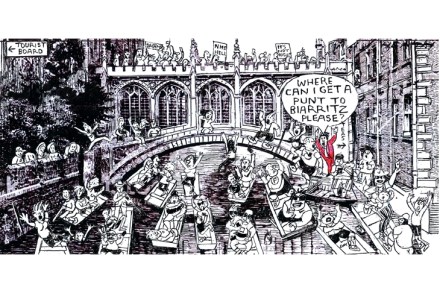
Sharing a plate of oysters with a three-year-old: where could this be but France, where children are brought up not to be faddish. The fads are for adults. It’s a relief to be away from Cambridge, where summer is bad for the soul. I find myself getting constantly annoyed: with suicidal cyclists, psychopathic taxi drivers, imbecilic pedestrians and double-decker buses allowed to hurtle through narrow streets belching diesel fumes. And hundreds of thousands of tourists trooping gormlessly up and down King’s Parade with not much to do. Here in Biarritz, the streets are calm, the traffic is regulated and people do not shout at each other in the street — a regular occurrence in Cambridge (and, mea culpa, one of the shouters is sometimes me).

Happy is England

From our UK edition

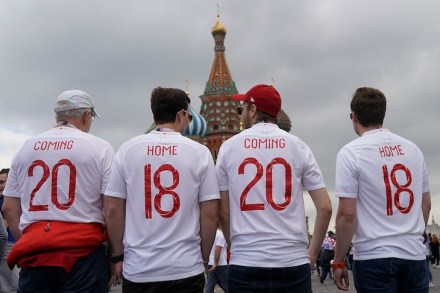
Buying fish at Cambridge market on Sunday, I found myself chatting to the fishmonger about the prospects for England in the World Cup. Another customer, a middle-class woman, joined in. None of us, I think, was a habitual fan. But we found ourselves enjoying a few minutes of spontaneous shared pleasure. It was not mere satisfaction in winning, but shared pride in a team of nice young men, seemingly unassuming, modest, sporting, decent. English, we might have said (though we didn’t). But English as we would like to think it should be — perhaps the Englishness of another time. A once and future Englishness, let us hope. It’s not every day that one has this un-sought sense of shared ‘identity’.

Getting to know the General | 14 June 2018

From our UK edition

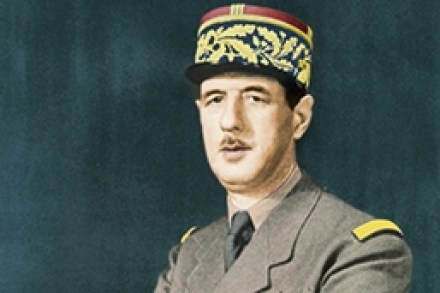
When General de Gaulle published the first volume of his war memoirs in 1954, he signed only four presentation copies: for the Pope, the Comte de Paris (France’s royalist pretender), the President of the French Republic and Queen Elizabeth II. One of his associates remarked: ‘All de Gaulle’ was in that gesture. But what was de Gaulle? Catholic? Conservative? Romantic? Arrogant? All these, surely, and not least ideologically eclectic. His political beliefs were not only enigmatic but were often vague in his own mind. When he took the world stage in June 1940 it was unclear whether he was a royalist, a Christian Democrat or even a proto-fascist. This uncertainty was a major reason why many were suspicious of him — most damagingly, Franklin Delano Roosevelt.

Universities challenged | 10 May 2018

From our UK edition

British universities have serious problems. The recent strikes protesting against a sudden reduction in pension rights were unusually effective, and a symptom of wider discontent. Yet international comparisons invariably show our universities to be among the best in the world, and incomparably the best in the European Union. This apparent paradox is easily resolved: universities in other countries have problems too, and often worse. Our problems are serious nevertheless.

Michel Barnier’s arrogant inflexibility over Brexit comes from a long Gallic tradition

From our UK edition

If Michel Barnier and David Davis, in their regular dialogue of the deaf, seem to be inhabiting different mental universes, that is because they are. The British and French have often found each other particularly difficult to negotiate with. Of course, Barnier represents not France but the EU, and he has a negotiating position, the notorious European Council Guidelines, on which the veteran British diplomat Sir Peter Marshall has recently commented that ‘I have never seen, nor heard tell of, a text as antipathetic to the principle of give and take which is generally assumed to be at the heart of negotiation among like-minded democracies’.

Lost in translation | 19 October 2017

From our UK edition

If Michel Barnier and David Davis, in their regular dialogue of the deaf, seem to be inhabiting different mental universes, that is because they are. The British and French have often found each other particularly difficult to negotiate with. Of course, Barnier represents not France but the EU, and he has a negotiating position, the notorious European Council Guidelines, on which the veteran British diplomat Sir Peter Marshall has recently commented that ‘I have never seen, nor heard tell of, a text as antipathetic to the principle of give and take which is generally assumed to be at the heart of negotiation among like-minded democracies’.

Down with declinism

From our UK edition

On the anniversary of Britain voting to leave the European Union, the Principal of Hertford College, Oxford, found some words to sum it up. ‘An entire society crucified by the delusional ambitions of Brexiteers chasing moonshine,’ wrote Will Hutton. ‘An anniversary to mourn.’ One might agree or disagree with his position on the European Union, but has British society really committed suicide? It’s a theme we have heard rather a lot recently: that Britain is a mess, an international laughing stock, leader-less and futureless. The case is normally made by Brits. Rapid shocks — terrorism, the surprising election result, the Grenfell Tower disaster — have inspired forebodings just as the Brexit negotiations are beginning.

France wants a new saviour. Will it be Macron or Le Pen?

From our UK edition

After having given themselves and the rest of us a fright, France’s voters have, by a worryingly small margin, stepped back from the brink. Some polls indicated a possible victory for the two extremists, Marine Le Pen and Jean-Luc Mélenchon, either of whom would have meant disaster for France. Instead, the next President will almost certainly be the youthful centrist, Emmanuel Macron, the nearest to a viable establishment candidate. Though this is certainly a far lesser evil, it is evident that the political system of Europe’s oldest large democracy has gone spectacularly wrong.