Richard Bratby

Richard Bratby is the chief classical music critic of The Spectator

Dated and wasteful: Rusalka, at the Royal Opera House, reviewed

From our UK edition

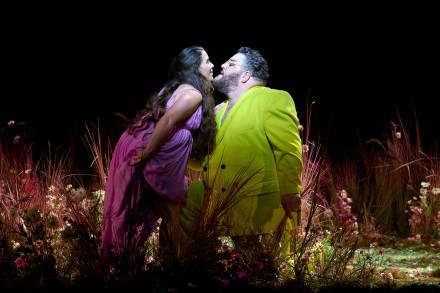
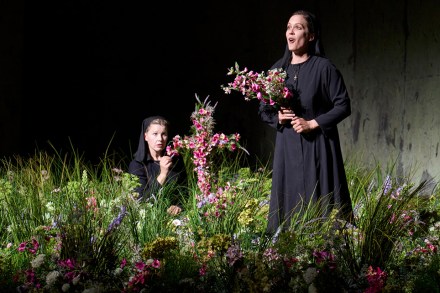
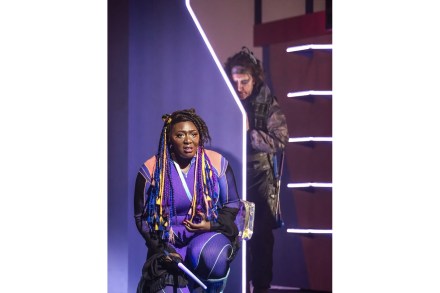
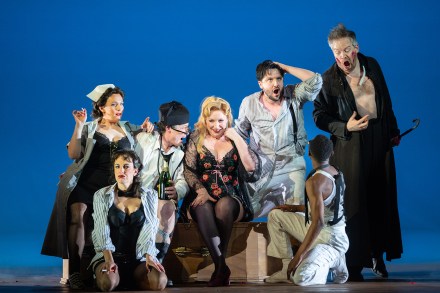
Careful what you wish for. There can be no definitive way to stage an opera, and it’s the critic’s duty to keep an open mind. Still, we’ve all occasionally gazed at a white cube that represents an Alpine meadow, or watched a chivalric hero slouch across the stage in tracksuit bottoms, and felt our hearts slump. Then you pitch up at the Royal Opera House’s new production of Dvorak’s Rusalka and it’s as if some mischievous sprite has magicked you straight back to 1960. The directors are also credited as ‘creators’ (back in your box, composer and librettist!) At first, you don’t suspect much. It’s actually rather enchanting: deep forest darkness and an aerial dancer in rippling, shimmering robes, drifting into the light in an exquisitely realised swimming effect.

Crapcore: ENO’s The Rhinegold reviewed

From our UK edition

Tubas and timpani thunder in The Rhinegold as the giants Fasolt and Fafner, having built Valhalla, arrive to claim their fee: Freia, goddess of beauty and youth. It doesn’t go well. Suddenly Fasolt drops his defences and declares his yearning (the translation is John Deathridge’s) for ‘a woman who’d lovingly and softly live with us lowly mortals’. At those words the music melts, and a solo oboe sings a melody so poignant that Ernest Newman thought it worthy of Mozart. This is the first instance in the whole cosmic drama where Wagner gives us a glimpse, however unformed, of something that an adult human might recognise as love.

The musical émigrés from Nazi-Europe who shaped postwar Britain

From our UK edition

Halfway up the stairs to the Royal College of Music’s exhibition Music, Migration & Mobility is a map of NW3, covered in red dots. It’s centred on the Finchley Road north of Swiss Cottage, and every dot (there are nearly 50) represents a business or an institution associated, in the middle years of the last century, with a refugee from the Nazis. Herr Zwillenberg offers upholstery repairs; a grocer stocks sauerkraut ‘and all Continental Delicacies’. There are adverts for fundraising concerts and political lectures; a Blue Danube Club and a Café Vienna. It’s urban Mitteleuropa in miniature, uprooted, transplanted, and clinging together for comfort and mutual support. They called it ‘Finchleystrasse’.

Close to perfection: Opera North’s The Cunning Little Vixen reviewed

From our UK edition

Opera North has begun 2023 with a couple of big revivals, and it’s always rewarding to call in on these things and see how they’re holding up. The long-lived, endlessly revived classic production is one of the quirks of operatic culture. It actually feels disconcerting, as a regular operagoer, to go to the conventional theatre (you know, the vanilla kind where they don’t sing) and discover that they’ve started again from scratch. A completely new Tempest? What was wrong with the 2016 staging? Possibly it’s to do with the financial realities of an art form that needs to keep a full orchestra and chorus on the payroll. A Year Zero policy every other season simply isn’t economically viable.

Still ugly but worth catching for the chorus and orchestra: Royal Opera’s Tannhäuser reviewed

From our UK edition

A classical concert programme is like a set menu, and for this palate the most tempting orchestral offering in the UK this January came from the Slaithwaite Philharmonic under its conductor Benjamin Ellin. They opened with a suite from Bernard Herrmann’s Vertigo, and the inclusion of Hollywood film music in a ‘straight’ classical programme was interesting in itself. Film music has been around for more than a century now. Many scores are fully as effective in concert as (say) Schubert’s Rosamunde or Beethoven’s Egmont, and yet this almost never happens. Film scores (unless by a big beast of the classical world) are generally hived off into ‘pops’ nights. Snobbery is the most adaptable of vices.

Stirring and sophisticated: RLPO, Chooi, Hindoyan, at the Philharmonic Hall, reviewed

From our UK edition

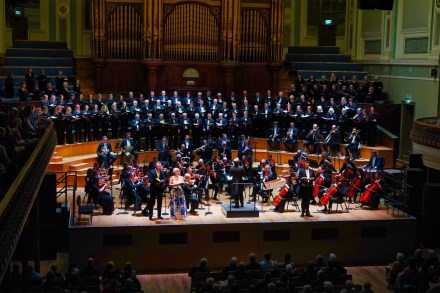
Daniel Barenboim was supposed to perform with the Royal Liverpool Philharmonic Orchestra earlier this month. His recent health concerns made that impossible, but it was a reminder that for the first time since the appointment of the late Libor Pesek in 1987, the RLPO is under the direction of a conductor soaked in the German tradition. Domingo Hindoyan, the orchestra’s chief conductor since autumn 2021, was born in Venezuela and has a soft spot for French music, but Barenboim is his mentor and there’s a gravity – an intellectual centre – to his conducting that made me eager to hear him get to grips with the sacred monsters of German romanticism. It’s something of an RLPO tradition, after all.

Reduced me to a tearful, choked-up mess: Royal Opera’s Magic Flute reviewed

From our UK edition

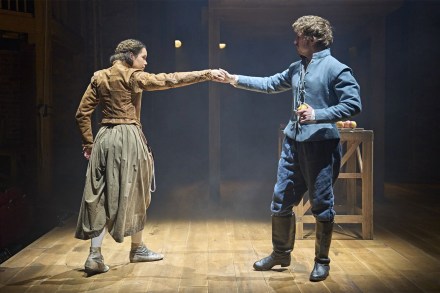
‘The rays of the sun conquer the night’ sings Sarastro, at the end of Mozart and Schikaneder’s Die Zauberflöte. It was the Royal Opera’s first performance of January 2023 and there’s something profoundly consoling about seeing this of all operas at the midnight of the year. The lights dim; five chords ring out and that first triplet from the violins falls quietly into place as Mozart engages the gears and together we move off on our long, sweet journey towards light. In David McVicar’s staging, robed figures process down the auditorium bearing glowing orbs, while Tamino, in late 18th-century frock-coat and knee-boots, clambers out from the boxes and vanishes through a portal in the front-cloth. There is a world elsewhere. And then we’re off.

Do conductors have to be cruel to be good?

From our UK edition

Playing under the baton of Arturo Toscanini must have felt a bit like fighting in the trenches. There are recordings of him rehearsing in the 1930s or ’40s. The orchestra is bowling along; there’s a low muttering, and then suddenly, out of nothing, the explosion. A scream of rage: a huge, operatic, animalistic roar. There’s a barrage of Italian profanities and what sounds like a fist smashing repeatedly on wood. Bernard Shore, who played under Toscanini in the BBC Symphony Orchestra, witnessed him hurling his baton at a cowering viola section. With the NBC Symphony, Toscanini threw his gold pocket watch to the floor and stamped on it.

What makes a Christmas song Christmassy?

From our UK edition

Temperature records for Los Angeles in the summer of 1945 are patchy, but 90 in the shade seems to have been the norm. It was during one such scorcher, presumably, that the songwriters Jule Styne and Sammy Cahn pulled up at a red light on the corner of Hollywood and Vine. Cahn suggested going to the beach. Styne had a better idea: ‘Let’s go write a winter song.’ Driving over to the offices of their publisher Edwin H. Morris, Cahn commandeered a typewriter, glanced out the window and typed the exact opposite of what he saw: ‘The weather outside is frightful.’ The Great American Songbook had acquired another Christmas classic. And ‘Let it Snow!’ is no less classic – and all the more American – for omitting any mention of Christmas.

If Ravel’s Boléro makes you yawn, you’re not really listening

From our UK edition

Only boring people are bored by Ravel’s Boléro. True, the composer – the slyest of wits – left his share of booby traps for the uncomprehending; take his comment, in a letter to Paul Dukas, that ‘I have written only one masterpiece, Boléro. Unfortunately there is no music in it.’ Yet Ravel was a sublime colourist; a master of the instrumental palette who makes Stravinsky’s orchestration sound coarse by comparison, and Boléro is one long twist of a fabulous kaleidoscope. Even its notorious repetitions are a red herring. Take the full score as a whole and you’ll struggle to find two bars that are identical (there are a couple at the start and a couple near the very end, but that’s basically it).

The sonic equivalent of a Starbucks Eggnog Latte: ENO’s It’s a Wonderful Life reviewed

From our UK edition

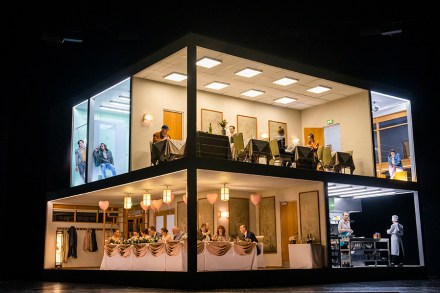
Whoosh! A digital starburst, a sweep of orchestral sound and the stage of the Coliseum is alive with dancing, whirling snowflakes. Floating in the heavens is the soprano Danielle de Niese; below her in the darkness, the truss bridge that we all know – because we’ve all seen It’s a Wonderful Life – is where the turning point of the story will occur, a couple of hours from now. That being the case, the only question is how composer Jake Heggie, librettist Gene Scheer and director Aletta Collins are going to close the circle and get us there. It’s evident from the off that they’re not going to stint either on spectacle or on sentiment. And quite right too: this is a Christmas opera, and there aren’t too many of those about.

Hugely entertaining: Royal Opera’s Alcina reviewed

From our UK edition

A hotel bellboy, the story goes, discovered George Best in a luxury suite surrounded by scantily clad lovelies and empty champagne bottles. ‘George, George’, he sighed. ‘Where did it all go wrong?’. It’s the same deal, essentially, with Ruggiero, hero of Handel’s Alcina. As the curtain rises he’s in the boudoir of Alcina, a smokin’ hot love-witch who lives on a paradise island with her minxy little sister, Morgana, and whose only serious failing – and who are we, really, to judge? – is a fondness for transforming her enemies into animals. This being an epic tale of chivalry, and this being 1735, it’s universally understood that having this much fun simply isn’t on.

A towering achievement: ENO’s The Yeomen of the Guard reviewed

From our UK edition

The screw may twist and the rack may turn: the Tower of London, in Jo Davies’s new production of The Yeomen of the Guard, is a dark place indeed, and that’s as it should be. ‘Men may bleed and men may burn,’ intones Dame Carruthers, as she delivers a magic lantern show about the history of the Tower, complete with colour slides of famous beheadings. In The Mikado Gilbert uses capital punishment as a particularly spiky punchline, but in The Yeomen of the Guard, sentence of death has been passed before the curtain has even risen. The shadows are lengthening from the off, and even Sullivan’s cheeriest melodies have a dying fall.

A total (and often gripping) theatrical experience: Scottish Opera’s Ainadamar reviewed

From our UK edition

Do you remember Osvaldo Golijov? Two decades ago he was classical music’s Next Big Thing: a credible postmodernist with a lush and listenable tonal flair, and an Argentinian with an interestingly complex European heritage in a millennium where everyone agreed – for a while, anyway – that the future was Latin American. Major labels recorded his music as soon as it was premièred; he was popular. Too popular for some – I remember a contemporary music promoter lamenting, with the demeanour of a housemaster who’s just found the head boy smoking behind the bins, that Golijov ‘hadn’t developed as we’d hoped’. Anyhow, Golijov was big, and then something stalled. Commissions failed to materialise, there were rumours of creative block, and the parade moved on.

Bold, self-assured reimagining of Monteverdi: Opera North’s Orpheus reviewed

From our UK edition

You wouldn’t like Tamerlano when he’s angry. ‘My heart seethes with rage,’ he sings, in Act III of Handel’s opera – spraying coloratura about the stage like Silly String on a 1980s kids’ TV show. That’s the deal with baroque opera: the emotional register is extreme and you’re either in the moment or you might as well leave the theatre. Literal realism, clearly, is not the point – making it even more necessary for a modern director to sketch in some hint of a social or cultural framework in which we can locate and comprehend these hyper-real characters. The music is too hot and too strong to work as drama in a purely abstract setting. Pare it back too far and you’re left with five maniacs screaming at each other in a black box.

A miniature rite of a very English spring: a Vaughan Williams rediscovery in Liverpool

From our UK edition

Imagine a folk dance without music. Actually, you don’t have to: poke about on YouTube and you’ll find footage from 1912 (there’s music dubbed on, but it’s a silent film) of Vaughan Williams’s friend George Butterworth in full Morris fig, going through the moves with Cecil Sharp and a pair of pinafore-wearing gals. Note the precision of his movements, that big Kitchener moustache: how seriously Butterworth is taking it, four years before he stopped a bullet on the Somme. And they really were sincere, those folk song pioneers.

Grey, grey and more grey: Aida, at the Royal Opera House, reviewed

From our UK edition

Grey. More grey. So very, very grey. That’s the main visual impression left by Robert Carsen’s new production of Verdi’s Aida. Possibly a few older operagoers still think of Aida as a fabulous spectacle: horses, temples, caparisoned elephants and all the gilded splendour of the Pharaohs. But if you cut your opera-going teeth more recently than 1990 – and unless you’re going to one of the more lavish Ellen Kent efforts – you’ll know by now to expect nothing of the sort. Carsen places the drama within the towering walls of a government bunker in some unspecified modern military dictatorship, with the cast (even Aida and Amneris) dressed almost entirely in shades of khaki.

Why does opera always feel the need to apologise for its plots?

From our UK edition

Leos Janacek disliked long operas, and the first act of The Makropulos Affair is a masterclass in how to set up a drama without an ounce of fat. There’s a prelude: driving motor-rhythms, surges of emotion, and somewhere in the distance – far away (or long ago) – the sound of trumpets. The curtain rises and we’re tipped brusquely into a lawyers’ office in the early 20th century. The lawsuit they’re discussing is long-winded and complex: aren’t they always? No matter. By the end of the act, these blustering professional men have been interrupted by the magnetic and imperious diva Emilia Marty, who knows things about the century-old case of Gregor vs Prus that no living person could possibly know. We’re intrigued. End of Act One.

More depravity, please: Salome, at the Royal Opera House, reviewed

From our UK edition

The first night of the new season at Covent Garden was cancelled when the solemn news came through. The second opened with a short, respectful speech from Oliver Mears, the director of opera, and a minute’s silence in which the houselights were lowered and we could gaze at the curtains, from which the huge gold-embroidered EIIR cypher had already been removed. For the first time in King Charles’s reign, we sang the national anthem to unfamiliar new words. There were shouts of ‘God Save the King!’And then the lights dimmed once more and we proceeded with the business of the evening, and the life of the Royal Opera.

Holds out huge promise for future seasons: If Opera’s La Rondine reviewed

From our UK edition

One swallow might not make a summer, but it certainly helps rounds the season off. ‘Perhaps, like the swallow, you will migrate towards a bright land, towards love,’ sings the poet Prunier to Magda, the heroine of La Rondine, but love itself is the real bird of passage in Puccini’s gorgeous Viennese operetta-manqué. Magda trades in her old lover for a younger, cuter model and after a summer of happiness leaves him too, without undue regret. That’s basically it. No death leaps from battlements, no ritual disembowelling; none of that stuff that we’re meant to find so regressive and problematic in an opera house, and so visceral and cool in an HBO drama. Just a simple, plausible romance, played out to glowing waltz melodies.