Philip Ziegler

And when they ask us how dangerous it was . . .

From our UK edition

As every biographer knows, all evidence is suspect. Probably the diary comes nearer to the truth than any other source: it is subjective and no doubt biased but a least it usually reflects what the author really thought at the time. Letters are second-best. They too are contemporary but they contain what the writer wanted someone else to think, not necessarily what he or she thought themselves. Most problematical of all is oral testimony. Memory plays fearful tricks. With the late Tom Harrisson I once conducted an experiment. From the diaries kept by Mass Observation volunteers during the second world war we picked a few which contained particularly vivid Blitz experiences. We then wrote to the authors, asking them, without referring to anyone or any document, to tell the story again.
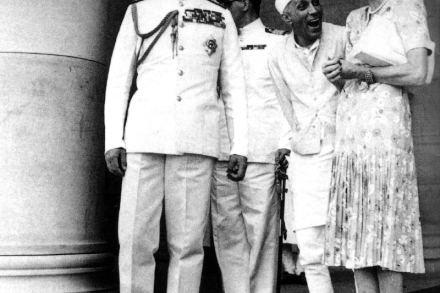
When Edwina met Nehru

From our UK edition

This book falls into two parts. The first is a brisk account of Britain’s involvement with India and of the backgrounds of those people who were principally responsible for unscrambling that relationship. It contains most of the facts that matter, if rather too much social trivia that does not, and is generally fair. Where it is unfair is in its dismissal of Mountbatten as a trivial playboy. It is permissible to make fun of some of the wilder schemes which he championed during his time at Combined Operations — notably the iceberg-aircraft carrier Habbakuk — but unreasonable to dismiss the ingenuity, energy and formidable organising powers which created the machine that made possible the invasion of Europe in 1944.

Succeeding in spite of itself

From our UK edition

This is a success story. In the 60 years since Nehru proclaimed India’s tryst with destiny all has not gone as he would have wished. Only just over 60 per cent of adult Indians are literate, far less than the comparable figure for China. Life expectancy has nearly doubled since independence, but here again China has done much better. Many millions of Indians still live in degrading poverty. Child mortality remains high, leprosy is rife, 15 million Indians suffer from tuberculosis, Aids is a new and yet more fearful threat. The barriers of caste and class have not been exorcised. The open sore of Kashmir remains unhealed. But, against all the odds, India has remained unified. Economically it is flourishing as never before.

Just right for a desert island

From our UK edition

It would be difficult to write a boring book about Michael Foot. As well as being eloquent, imaginative and idealistic he possessed the priceless quality, from the point of view of the biographer at any rate, of intemperance. He did nothing by halves. ‘No attempt is made at impartiality,’ he announced defiantly in the preface to his first book. ‘Impartial historians are as insufferable as the people who profess no politics.’ He was as committed in his politics as in his history; his career consisted of a series of crusades, tilting sometimes at windmills, sometimes at real dragons, but always conducted with courage and panache.

A sharp-eyed, realistic royalist

From our UK edition

He was visited only by his children and grandchildren and one or two very old friends, complained Tommy Lascelles a few years before he died; apart from that, ‘I only see some of the young scribes, who, poor boys, think my opinion of their writing is worth getting, e.g. Philip Ziegler and C. Douglas-Home.’ Lascelles delighted in tantalising this now elderly scribe by extracting from a locked chest a volume of his diaries, reading a few sentences aloud, and then returning it to its repository. ‘That won’t be seen by anyone for 50 years,’ he would pronounce with some relish. ‘It is the duty of the private secretary to be private.’ That was some 30 years ago.

Not so duplicitous as painted

From our UK edition

Narendra Singh Sarila has a theory. Because he is a man of high intelligence and has researched diligently into the sources, his theory must be treated with respect. As one of India’s most senior ambassadors he is well qualified to assess the limitations of state papers and to distinguish between what politicians say and what they really mean. He is moderate in his judgments and, for the most part, fair in his treatment of individuals. The only pity is that he is almost entirely wrong.

Uneasy biographical bedfellows

From our UK edition

The dust jacket of this book shows two heads confronting one another: General MacArthur, aggressive, arrogant, defiantly puffing cigar smoke at the world at large; the Emperor Hirohito, impassive, phlegmatic, quietly obstinate. The subtitle, ‘MacArthur, Hirohito and the American Duel with Japan’, similarly suggests that within the book a double biography will be found. The formula can work effectively. Hitler and Stalin, Wellington and Napoleon, were titanic figures whose careers meshed closely, each having the other frequently in his thoughts, each consciously or unconsciously adjusting his behaviour in reaction to the other. The trouble about this book is that MacArthur and Hirohito do not relate to each other in this way.

A talent for losing

From our UK edition

Wavell was a great soldier and a great man: wise, courageous, clear-headed, an inspired and inspiring leader, a pattern of integrity. It is peculiarly unfair that the three greatest tasks he undertook all ended in near total failure. He made his name between the wars as a thoughtful, forward-looking soldier who did as much to prepare the British army for war as any of the men who were his titular superiors. On one thing all his officers agreed; that with him they were learning all the time. His basic principle, which may appear obvious but seemed daring, even heretical to the more hidebound commanders, was, ‘There is nothing fixed in war, except a few elementary rules of common sense.’ Training must be not for ‘a war’ but for ‘war’.

Deep in the mind of Texas

From our UK edition

Roger Louis, Kerr Professor of English History and Culture at the University of Texas at Austin, former president of the American Historical Association, honorary CBE, editor-in-chief of the Oxford History of the British Empire, is one of those infuriating Americans who know more about our history than we do ourselves. In his fastness deep in the heart of Texas he runs a British Studies seminar. Since the university is also home to one of the finest collections of British 20th-century manuscripts to be found either side of the Atlantic, scholars from all over the world flock to work there. Professor Louis then strikes ruthlessly, bullying or cajoling the visitors into lecturing to his seminar.

An endearing underachiever

From our UK edition

‘I am beginning to see that brain counts for little but that character counts for everything,’ wrote Harold Nicolson, in one of those flashes of self-perception which from time to time brilliantly illuminated his life. ‘It is not a pleasant thought as my character is weak and easily influenced.’ He was only just 17 when he articulated that particular piece of self-deprecation; he would have said exactly the same 60 years later and been right on both occasions. His ability to diagnose his weaknesses, coupled with a total inability to do anything to rectify them, was one of his most endearing characteristics; it also explained why his various careers, in terms of what his talents entitled him to expect, were signal failures.

Some light shone in dark corners

From our UK edition

When Lords Hutton and Butler were successively appointed to enquire into aspects of British participation in the invasion of Iraq, the more sensationalist elements of the media each time rejoiced. Incorruptible, fearless, Hutton and Butler would expose the rottenness at the heart of Whitehall and, if not actually bring down the government, at least give it a fearful pasting. When each enquiry in turn did nothing of the sort, the response was equally predictable. ‘We told you so,’ proclaimed the media. ‘Lickspittle, time-serving lackeys of the establishment! What could be expected but a whitewash?’ After such excesses it is a relief to be confronted by this thoughtful and dispassionate analysis of the issues most in question.

The foundering ship of state

From our UK edition

Henry Fairlie may have coined the phrase ‘The Establishment’ but it was Anthony Sampson who gave it flesh and blood. His Anatomy of Britain, first published in 1962 and revised at intervals over the years, sought to explain how Britain worked, where the power really lay, what covert networks underlay the at first impenetrable surface of society. Now the Sampsonian bear has emerged once more from its lair, sniffing the air uneasily, looking around for landmarks, rootling up the occasional corpse to see what is left upon its bones. The view is dramatically different; even what is superficially unchanged has in fact been profoundly modified.

An early search for WMD

From our UK edition

Any author who subtitles his book ‘The true story of …’ this, that or the other inspires some disquiet in the reviewer. If this is the true story, then the implication is that previous versions have been, if not untrue, then at least seriously misinformed. In his history of the British invasion of Tibet in 1903-4, Charles Allen maintains that earlier writers ‘without exception, have accepted the self-serving line first given out by Sir Francis Younghusband’. In so doing, they have done grave injustice to the military commander of the expedition, General Macdonald, who is usually represented as cowardly and indecisive, while in fact he was merely prudent and responsible. Peter Fleming and Patrick French are the two precursors whom Allen singles out.

Sounding the last post

From our UK edition

The work of the obituarist is not unlike that of the book reviewer. Both have to tell their reader what the subject of their piece is all about; both have to pass judgment on its merits and demerits; both have to provide something which will be entertaining as well as informative. Under the direction of Hugh Massingberd and with the encouragement of the editor, Max Hastings, the Daily Telegraph made obituaries a leading feature of the paper — a fashion which has been followed by most of London’s broadsheets. This book assembles 100 of them, dealing with soldiers who died between 1987 and 2002. Where obituaries and book reviews differ is that if the reviewer dislikes a book he need not be too mealy-mouthed in inveighing against its failings.

An eye for the unexpected

From our UK edition

After his mountainous Gladstone and Churchill and barely less substantial study of the post-1886 chancellors of the exchequer, Roy Jenkins here enjoys himself in what by his standards is a mere jeu d'esprit. His new book is a collection of essays on 12 cities which he has lived in or often visited and which are in some way intertwined with his life. It is not, he emphasises, a disguised second shot at an autobiography: 'One navel-gazing is wholly permissible,' he writes. 'Two would point to self-obsession.' But the essays are intensely personal: this is Jenkins's Paris, Jenkins's Bonn, seen through his eyes and lit by recollections of his visits. There are surprising omissions.

No room at the top

From our UK edition

In the years following the second world war, Tony Crosland, Roy Jenkins and Denis Healey either became Labour Members of Parliament or worked closely with the Labour party. Few parties in so short a time can have gathered three recruits so obviously of prime-ministerial calibre. No other party could have so contrived things that none of them attained that office. The parallels between the three are almost unnerving. Crosland's family was socially a cut above the other two, but none of them was grand and none penurious. All were at Oxford immediately before the war, were involved in politics and were on the Left (unsurprisingly, since out of an undergraduate body of 4,500 a third were members of the Labour Club).