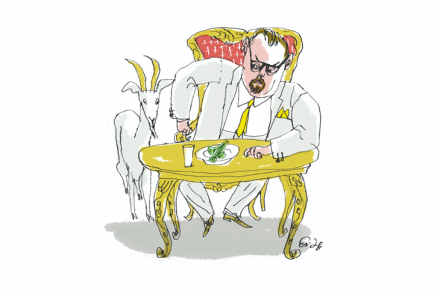
Can the Mayr diet work at home?
From our US edition
It’s amazing, but when you chew something 60 times, a piece of broccoli starts to taste sumptuous, complex, irresistible
Philip Hensher is professor of Creative Writing at Bath Spa University and the author of 11 novels including A Small Revolution in Germany.
From our US edition
It’s amazing, but when you chew something 60 times, a piece of broccoli starts to taste sumptuous, complex, irresistible
From our US edition
Novelists’ careers take different paths, and sometimes don’t look much like careers at all. It’s true that some start publishing between 25 and 35, and write a novel respectably every two or three years until they die, like Kingsley Amis. Others don’t start until they are 60, like Penelope Fitzgerald, or stop abruptly without warning,
26 min listen
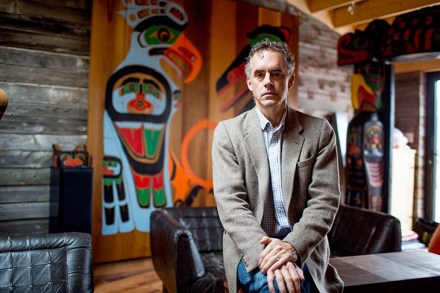
On this episode, Cindy Yu starts by reading the leader – The Spectator has a fight on it’s hands as the Scottish Crown Office threatens a six-figure fine. (01:30) Then, Douglas Murray says the Church of England has morphed beyond recognition. (06:40) Finally, Philip Hensher says Jordan Peterson’s new book, Beyond Order, is ‘pretty odd’. (15:05)
42 min listen
Is Keir Starmer becoming irrelevant? (00:50) Do the Oscars really celebrate the best that film has to offer? (15:55) Jordon Peterson is back with his new book, Beyond Order, but is it beyond readable? (25:40) With the Spectator‘s political editor James Forsyth; broadcaster and former Labour adviser Ayesha Hazarika; writer Fiona Mountford; the Spectator‘s arts
Like most novelists, I am a firm adherent to the W.H. Davies principle of finding time to stand and stare. I was once sauntering down Regent Street when a gentleman hared out of a department store, closely followed by two rather healthier specimens. They flung him to the ground, upon which large quantities of merchandise
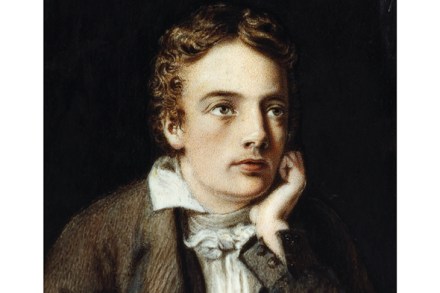
Keats long ago became the meaningless emblem of poetic genius. When the poet Amanda Gorman appeared at President Joe Biden’s inauguration, both detractors and admirers wanted to set her against the highest possible comparison. They didn’t reach for the US’s new Nobel laureate, Louise Glück. They went for Keats: either ‘Amanda Gorman is Keats-level brilliant’
After the storming of Congress last week, numerous American commentators looked at the Proud Boys, the QAnon Shaman and Trump himself and said, in so many words: ‘This is not who we are.’ Undoubtedly true. It raises, however, an interesting supplementary question: who, in fact, are you? Looking through the ranks of those who might
When the estimable Andy Miller, the host of the Backlisted podcast, recommended a new collection of short stories on Twitter, he said just enough about it to pique my interest. Online booksellers didn’t seem to have heard of it and I had to buy it directly from the publisher. I’m very glad I did. Robert
Tennyson’s poem ‘Mariana’ has gone everywhere in the world since 1830. A professional scholar in Uruguay, Papua New Guinea or New Haven, Connecticut, reading the lines ‘Weeded and worn the ancient thatch/Upon the lonely moated grange’ might want to ask a few questions. Do English houses ever have moats? (Yes — Ightham Mote and Madresfield
From our US edition
The Eighth: Mahler and the World in 1910 by Stephen Johnson reviewed
Somewhere or other Martin Amis remarks that the reason we have very little idea of what it feels like to go into space is that no astronaut so far can write. If we know very well what it felt like to go through a tropical typhoon, that’s because there was a Joseph Conrad able to
32 min listen
On this week’s episode, Douglas Murray asks – why would anyone want to be a government adviser, given what’s happened to Tony Abbott? The historian Francis Pike reads his piece on Thailand’s Caligula; and Philip Hensher reviews a new book on Wagner. Spectator Out Loud is a weekly audio collection of three Spectator writers reading
In the early 1920s a French businessman, Leon Bel, was looking for a name for his new brand of processed cheese. He remembered seeing a meat wagon on the first world war battlefields with the sardonic name ‘La Wachkyrie’. Like the Valkyries in Wagner, it brought solace to fallen soldiers in the field. Bel thought
From our US edition
The Polymath: A Cultural History from Leonardo da Vinci to Susan Sontag by Peter Burke reviewed
One of the most striking, and lowering, aspects of lockdown has been the deprivation of human exchange, and especially conversation. We can talk to our immediate families but not properly to a wider range of humanity. The Zoom chat, with so many ordinary conversational features removed, is not the same thing at all. Conversation is
42 min listen
In this week’s Book Club podcast we’re talking about Brideshead Revisited. Evelyn Waugh’s great novel is 75 years old this week, and I’m joined by our chief critic Philip Hensher, and by the novelist’s grandson (and general editor of Oxford University Press’s complete Evelyn Waugh) Alexander Waugh. What made the novel so pivotal in Waugh’s
We live at a time of universal polymathy. We don’t know everything, but there’s not much difficulty in being able to discover any given truth. But it’s worth remembering just how hard it used to be to find things out. Thirty years ago if you wanted to research off your own bat it meant a
From our US edition
The Bilingual Brain: And What It Tells Us About the Language of Science by
In these circumstances there’s a temptation to reach for the longest novel imaginable. If you’re not going to read Proust now, as the days stretch ahead and the horizons shrink to an hour’s walk a day, when is it going to happen? But it seems much more likely that reading is going to contract, and
I like a book that can put its point in four outrageous words and use it as its title. Diana Souhami might be right. Without the women her book is devoted to, literary modernism would have looked very different. A consciously new approach to writing met a body of women who were being heard for