Peter Stanford

The dirt on King David: Anointed, by Michael Arditti, reviewed

From our UK edition

Michael Arditti has never held back from difficult or unfashionable subjects. His dozen novels, including the prize-winning Easter, as well as Jubilate, The Breath of Night and Of Men and Angels, explore faith in an increasingly secular modern world. Half a century ago he would have brushed shoulders with Graham Greene and Evelyn Waugh, but the ‘religious novelist’ is today an endangered species. Critically acclaimed but published by a small imprint, Arditti has an unusual voice and perspective that deserve a larger audience.
To hell with hell: Bart Ehrman debunks the Christian belief in perpetual torment

From our UK edition

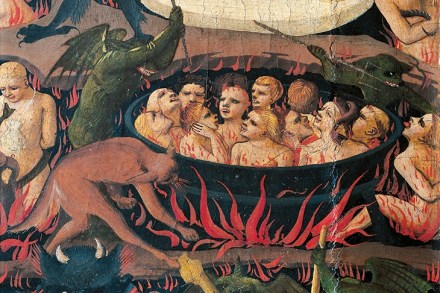
Here is a sobering thought for anyone involved in the world of finance. Those who charge interest when they lend money are doomed to spend eternity in a pit with filth up to their knees. This is not the verdict of some radical, online, anti-capitalist echo chamber but of the second-century Apocalypse of Saint Peter, an early Christian text in the form of a graphic tour of heaven and hell, ascribed to the leader of Jesus’s apostles, though not actually written by him. It offers scant comfort too for those who have sex before marriage: their bodies will be torn to shreds in the afterlife. And for women who have the temerity to plait their hair to make themselves look more attractive: they are damned forever to hang by that same hair over the eternal flames.

A poet in prose

From our UK edition

Literary reputation can be a fickle old business. Those garlanded during their lifetimes are often quickly forgotten once dead. Yet there is a daily procession of visitors to Keats’s grave in the English cemetery in Rome, where the headstone reads, ‘Here Lies One Whose Name Was Writ in Water’, so sure was the poet that the neglect he had suffered up to his death would continue ever after. By any standards, C. Day-Lewis — he disliked Cecil, the name given to him by his Church of Ireland vicar father — was among the most glittering figures on the 20th-century British literary scene, celebrated, well-connected, a bestseller and Poet Laureate for the four years up to his death in 1972.

Holy heroes

From our UK edition

The Reformation is such a huge, sprawling historical subject that it makes sense, in this the 500th anniversary of Martin Luther producing his 95 Theses, to break it up into bite-size pieces in order to sample its distinctive local flavours. Eamon Duffy, emeritus professor of Christian history at Cambridge, takes England as his territory, and quickly deprecates the very word Reformation as an ‘unsatisfactory designation concealing a battery of value judgments’. Instead, he sets out to investigate what he characterises as largely a series of homegrown reformations and counter-reformations. So far, so sensible, but the process of reduction is then taken a step further.