Peter Parker

An outpouring of jaunty black comedy

In 2005 Xandra Bingley published Bertie, May and Mrs Fish, an extraordinarily lively and enjoyable memoir of her childhood on a Cotswold farm during the second world war. Much of the writing was glancing rather than straightforward, its narrative not strictly chronological, while its title hinted at something not fully explained in the text. Dispensing altogether with conventional punctuation, the book contained not a single comma or quotation mark, using instead ellipses. This was brilliantly imitative of both the clipped speech of its upper-class characters, particularly when facing disasters large and small, and the hell-for-leather pace of lives spent galloping on horseback across the Gloucestershire countryside.

Reform’s camp following, masculine rage & why do people make up languages?

51 min listen

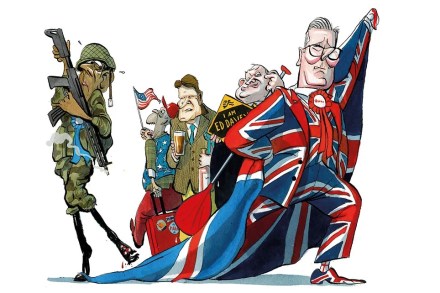
First: Reform is naff – and that’s why people like it Gareth Roberts warns this week that ‘the Overton window is shifting’ but in a very unexpected way. Nigel Farage is ahead in the polls – not only because his party is ‘bracingly right-wing’, but ‘because Reform is camp’. Farage offers what Britain wants: ‘a cheeky, up-yours, never-mind-the-knockers revolt against our agonisingly earnest political masters’. ‘From Farage on down,’ Roberts argues, ‘there is a glorious kind of naffness’ to Reform: daytime-TV aesthetics, ‘bargain-basement’ celebrities and big-breasted local councillors. ‘The progressive activists thought they could win the culture war simply by saying they had won it’, but ‘the John Bulls and Greasy Joans are stirring again’.

The enigma of C.P. Cavafy

C.P. Cavafy, who had a very high opinion of his own work, would no doubt be gratified to learn that he is now one of the most admired poets of the 20th century. This is all the more remarkable because during his lifetime (1863-1933) he did not allow a single volume of his poetry to be published, preferring to circulate privately printed sheets and pamphlets among his admirers. He was also disinclined to co-operate with those who wanted to translate the poems from their original Greek into other languages; but in English alone there have now been more than 30 different volumes of his complete or selected poems.

The Spectator letter that marked a turning point in gay history

On 3 June 1960, a letter appeared in The Spectator which began: Sir, We are homosexuals and we are writing because we feel strongly that insufficient is being done to enlighten public opinion on a topic which has for too long been shunned. The letter was prompted by the government’s failure to act upon the recommendation of the 1957 Wolfenden Report that homosexual acts between consenting adults in private should no longer be a criminal offence. This had led to the founding of the Homosexual Law Reform Society (HLRS) in 1958, and it was for this organisation that the letter’s three signatories worked as volunteers.

The queer traditions of King’s College, Cambridge

Interviewed on television for his 80th birthday in 1959, E.M. Forster said that one of the reasons he was so fond of King’s College, Cambridge, where he had lived as a Fellow since 1946, was ‘a very precious tradition, that the old people and the young can meet here very easily and without self-consciousness’. In this svelte and sprightly book, Simon Goldhill (himself a Fellow of King’s) traces this tradition over some 140 years, and describes the part it played in the creation of a remarkable, ever evolving community of gay men. He begins his story in 1885 when J.K. Stephen, the future tutor to Queen Victoria’s grandson Prince Albert Victor, became a Fellow of the college.

Paul Wood, Sean Thomas, Imogen Yates, Books of the Year II, and Alan Steadman

30 min listen

On this week’s Spectator Out Loud: Paul Wood analyses what a Trump victory could mean for the Middle East (1:16); Sean Thomas gets a glimpse of a childless future while travelling in South Korea (8:39); in search of herself, Imogen Yates takes part in ‘ecstatic dance’ (15:11); a second selection of our books of the year from Peter Parker, Daniel Swift, Andrea Wulf, Claire Lowdon, and Sara Wheeler (20:30); and notes on the speaking clock from the voice himself, Alan Steadman (25:26).  Produced and presented by Patrick Gibbons.

The frustrated life of John Singer Sargent

At Tate Britain this year, for the first time since 1926, nine of John Singer Sargent’s brilliantly painted and affectionately characterful portraits of the Wertheimer family have been displayed together in their own room. This was what the wealthy London art dealer Asher Wertheimer had always intended when he bequeathed these paintings to the nation. Some queried his generous gift on the frankly snobbish and anti-Semitic grounds that it was not for upstart Jewish businessmen to force their likenesses into a national collection. The Conservative MP Sir Charles Oman went so far as to say in the Commons that ‘these clever but extremely repulsive pictures should be placed in a special chamber of horrors and not between brilliant examples of the art of Turner’.

Reeves’s gambit, a debate on assisted dying & queer life in postwar Britain

52 min listen

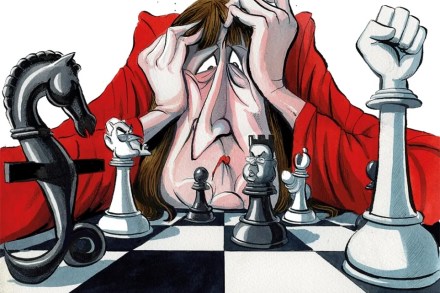
This week: the Chancellor’s Budget dilemma. ‘As a former championship chess player, Rachel Reeves must know that the first few moves can be some of the most important of the game,’ writes Rupert Harrison – former chief of staff to George Osborne – for the cover of the magazine this week. But, he says, the truth is that she has played herself into a corner ahead of this month's Budget, with her room for manoeuvre dramatically limited by a series of rash decisions. Her biggest problem is that she has repeatedly ruled out increases in income tax, national insurance and VAT. So which taxes will rise, given that the easy options have been ruled out? The answers appear to be evolving rapidly when ministers are confronted with the OBR’s harsh reality.

Peter Parker, Wayne Hunt, Nicholas Lezard, Mark Mason and Nicholas Farrell

33 min listen

On this week’s Spectator Out Loud: Peter Parker takes us through the history of guardsmen and homosexuality (1:12); Prof. Wayne Hunt explains what the Conservatives could learn from the 1993 Canadian election (9:10); Nicholas Lezard reflects on the diaries of Franz Kafka, on the eve of his centenary (16:06); Mark Mason provides his notes on Horse Guards (22:52); and, Nicholas Farrell ponders his wife’s potential suitors, once he’s died (26:01). Presented and produced by Patrick Gibbons.

Wannabes: are any of them ready?

36 min listen

On this week's Edition: Wannabes - are any of them ready? Our cover piece takes a look at the state of the parties a week into the UK general election campaign. The election announcement took everyone by surprise, including Tory MPs, so what’s been the fallout since? To provide the latest analysis, The Spectator’s political editor Katy Balls joins the podcast (2:00). Then: Angus Colwell reports on how the election is playing out on social media, and the increasing role of the political ‘spinfluencer’. These accounts have millions of likes, but how influential could they be during the election? Alongside Angus, Harry Boeken, aka @thechampagne_socialist on TikTok, joins us to share their thoughts on who is winning the social media war (15:08).

The heyday of the gay guardsmen

In 1943 the music critic Desmond Shawe-Taylor placed an advertisement in Exchange & Mart offering a pair of trooper’s breeches for sale. A number of men replied, one asking ‘Have they been worn by a trooper or just yourself?’, while another observed: ‘It is always good to see the boys pulling themselves into tight troopers and then admire the “smashing finish”.’ Members of the Household Division of the British Army, in their figure-hugging breeches and scarlet coats, had always held a particular appeal for homosexual men. It was therefore fortunate that, though the military authorities publicly denied it, there was a long tradition in Guards regiments of combining ceremonial duties with casual prostitution.

More Mr Pooter than Joe Orton: George Lucas’s gay life in London

In January 1948, George Lucas, an unremarkable 21-year-old Roman Catholic who had just been demobbed from the Pay Corps, was living unhappily in Romford with his ill-matched parents, who relentlessly taunted him about his homosexuality. He would shortly get a job at the War Office and so embark on a lifetime’s career as a civil servant, commuting to central London every day to work at his desk and spend his evenings in search of sex and companionship, largely among the servicemen who hung around Marble Arch. In later life Lucas would trawl the pubs, streets and urinals of central London, more often than not paying for sex, and always keeping a detailed account of his exploits and expenses in his diaries.

Rooms with little left to view: the queer spaces of E.M. Forster and others

In this intriguing and idiosyncratic book, which aims to present ‘a new history of queer culture and identity over the past 125 years’, Diarmuid Hester recalls how he went to look at E.M. Forster’s former sitting room in King’s College, Cambridge. This once ‘intimate space’, filled with possessions accumulated over a long life, in which Forster wrote and entertained many notable guests from 1946 to his death in 1970, had been repurposed as the college’s ‘grad suite’, filled with battered furniture from Ikea, a football table and a television set. The only remnant of Forster’s residency was a large mantelpiece designed by the writer’s father.

Forgotten books worth rediscovering

Most readers have favourite books or authors they feel have been either forgotten or unjustly neglected. R.B. Russell, an assiduous book collector, did something practical about this when in 1990 he co-founded the Tartarus Press in order to bring the works of the once popular Arthur Machen back into print. Machen’s particular speciality was ‘weird fiction’, novels and stories that inhabit the borderland of this and other worlds, and Tartarus went on to reissue other authors in this genre, notably Robert Aickman and Sarban (otherwise the British diplomat John William Wall), as well as to publish new writers and a handful of classics.

The well of happiness – and despair: Queer St Ives reviewed

In the winter of 1952 the 21-year-old sculptor John Milne travelled to St Ives in Cornwall to take up a temporary job as an assistant to Barbara Hepworth. The arrangement was that he would become her pupil in exchange for helping her in the studio, but he was subsequently paid a small salary and ended up staying in her employ for two years. By this time, Milne had decided to settle in the town, which had become a thriving modernist artists’ colony, and in 1956 he acquired Trewyn House, a three-storey Victorian property next door to Hepworth’s studio.

We could all once tell bird’s-foot trefoil from rosebay willowherb

‘There are a great many ways of holding on to our sanity amid the vices and follies of the world,’ wrote Ronald Blythe in 2008, ‘though none better than to walk knowledgeably among our native plants.’ To many today, when the age-old connection between people and their indigenous flora is in danger of being extinguished altogether, this pronouncement may seem eccentric; but is rightly endorsed by Leif Bersweden in Where the Wildflowers Grow, which vividly describes the botanical journey through Britain and Ireland he undertook last year. He was born in 1994 and, unusually for his generation, has been a keen amateur botanist since childhood.

‘That little venal borough’: a poet’s jaundiced view of Aldeburgh

‘To talk about Crabbe is to talk about England,’ E.M. Forster declared in a radio broadcast in May 1941, but few people today talk about this Suffolk-born poet or indeed read him. This makes Frances Gibb’s slender but thorough account of George Crabbe’s life and work all the more welcome. In his time he was considered a leading, though controversial, figure, who wrote with stark realism about the spiritually and morally impoverished lives of East Anglian villagers and townspeople, in particular the inhabitants of the ‘little venal borough’ of Aldeburgh, where he was born in 1754 and spent an unhappy youth.

Gay and abandoned: A Previous Life, by Edmund White, reviewed

Edmund White’s new novel opens, somewhat improbably, in 2050. This imagined future, however, springs few surprises on the reader and is in fact almost identical to the present. Indeed, the leap forward in time is merely a narrative device, allowing a 70-year-old Sicilian aristocrat to reminisce about his affair 30 years earlier with the elderly Edmund White, now long dead and more or less forgotten as a writer. Ruggero Castelnuovo has subsequently married a much younger American woman, Constance. The couple have made a pact never to talk about their past lives, but they now decide to write their private ‘confessions’, and much of the book is taken up with these largely sexual memoirs, sections of which they read aloud to each other.

A reappraisal of James Courage

James Courage is one of those fine writers who, though he enjoyed considerable success in his lifetime, has now more or less slipped from view. None of the eight novels he published between 1933 and 1961 is in print and most of them are impossible to find secondhand. The same goes for a collection of his short stories published in 1973. He is chiefly remembered for A Way of Love, a bold novel about a homosexual relationship that was published in 1959 and became a minor cause célèbre in New Zealand when it was banned there. Courage was born in New Zealand in 1903, but came to Oxford University in 1922.

How two literary magazines boosted morale during the Blitz

William Loxley’s lively account of ‘Bloomsbury, the Blitz and Horizon magazine’ begins with W.H. Auden and Christopher Isherwood emigrating to the United States in January 1939 and ends with George Orwell dying in University College Hospital in January 1950. Between these two events Loxley explores the often interconnected professional and personal lives of a number of British writers, publishers and editors — principally Orwell, Leonard and Virginia Woolf, Cyril Connolly, Stephen Spender, John Lehmann and Dylan Thomas — during the second world war and its immediate aftermath.