Peter Hoskin

What will Tory tax rises look like?

From our UK edition

As Ben Brogan says in an excellent Telegraph article today, the next government will have to increase taxes.  Although there's plenty of waste in the system, spending cuts alone won't be enough to deal Brown's debt mountain Brown.  So far, the party leaders have avoided saying this - although Ken Clarke's speech yesterday set the ball rolling on the Tory side.  So what might Tory tax rises look like?  ConHome's Tim Montgomerie has prepared a very useful summary of the measures that Team Osborne may be considering: -- Higher taxes on business are unlikely.  “Business taxation was a no no if you’re trying to strengthen a recovery,” said Clarke yesterday.

Gus O’Donnell’s warning

From our UK edition

Heads of the civil service rarely give interviews - especially not to voice their opinions on live political issues - so you know Gus O'Donnell must be worried about the public finances when he brings up the prospect of cuts in conversation with the Times today. Here's the key passage: "Asked whether he agreed with a policy adopted in Canada, where spending was cut by 20 per cent and some departments had much deeper cuts than others, [O'Donnell] said: 'You could envisage a situation where you go for deeper dives on this, most certainly.'" O'Donnell's comments - which go further than pretty much any poltician has managed so far - show how foolish it is to deny the necessity of spending cuts.

Why I remain unconvinced about the Tories’ tax break for married couples

From our UK edition

Ok, Fraser - I'm not going to let this tax 'n' marriage debate rumble on interminably, but I do want the final word!  First, I appreciate your response - it makes a very strong case, but one which fails to convince me.  Why?  Well, largely because I agreed with most of it already.  As I said in my original post, IDS and others have unearthed plenty of statistics which show just how important marriage is to the functioning of society, and to the lives of people within it.  This evidence, much of which you raise, is important and shouldn't be ignored.   But there are still reasons - beyond those set out by Philip Collins today - for being wary of, specifically, tax-breaks for married couples.  For starters, what's to be gained from them?

PMQs live blog | 15 July 2009

From our UK edition

Stay tuned for live coverage of PMQs from 1200. 1202: And we're off.  John Maples asks Brown to clarify our objectives in Afghanistan.  Brown says that "since 2001, our main objective has been to stop terrorism". 1204: In response to a question from Anne Begg, Brown says he is "committed to increasing the diversity of Pariament". 1205: Cameron now.  He asks whether to maintain support for the Afghanistan mission, we've got to "make more visible progress".  Brown repeats his point about "tackling terrorism," and that the mission also aims to bring "social and economic development" in the country.  He adds that the Government will review "equipment and resources" after the Afghan elections.

Love and marriage?

From our UK edition

Ok, I must admit I'm quite wary of Tory plans to encourage marriage via a £20-a-week tax break for married couples.  Not because I don't think marriage is a positive social force.  I do.  And Iain Duncan Smith's usually excellent Centre for Social Justice - who are pushing the tax break proposal, along with other, more convincing, ideas, in their recent Every Family Matters report - has unearthed enough statistics over the years to prove that it is.  But there's something crude and debasing about deploying fiscal incentives to force something which should largely be a private decision, based on sappier motives such as love, between two people.

The slowdown in government

From our UK edition

It's no secret around Westminster that civil servants are giving up on the Labour government and are wait-wait-waiting for the Tories to shuffle into power.  But few articles have captured that process so well as Rachel Sylvester's column in the Times today, which contains this striking passage about the suspended animation along Whitehall: "It is said that the Civil Service has the engine of a lawn mower and the brakes of a Rolls-Royce. And slowly but surely the government machine is coming to a halt. Contracts are delayed, decisions deferred, reviews welcomed. When Alan Johnson, the Home Secretary, announced a U-turn on ID cards recently, he was only catching up with his civil servants.

Public in favour of ringfencing defence spending

From our UK edition

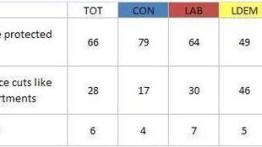
A timely poll from PoliticsHome which finds that two-thirds of the public think defence should be protected from any spending cuts.  Here's their graphic with full results: The question, of course, is whether this kind of public pressure forces any of the main parties to actually shield defence from cuts.  With the debt burden as it is, its difficult to see them doing so while also sticking to their current commitments in other areas. UPDATE: Ok, just to provide a bit of context in the wake of some thought-provoking comments from CoffeeHousers below.

Coulson in the clear?

From our UK edition

It's worth following Andrew Sparrow's typically excellent live blog of the Commons culture committee's first public hearing into the recent NotW "phone-hacking" claims.  So far, the biggest revelation has come courtesy of Nick Davies - the Guardian journalist behind the story last week - and it's one which will please the Tories: "Davies says he has the names of 27 journalists from the NoW and four from the Sun who used a private investigator to get information. Some of the requests were legal, like electoral register searches. But many were not. Davies says he does not want to name the names. "I'm a reporter, not a police officer." But there are a number of senior editorial executives on the list. One was Greg Miskiw, the assistant editor, news, at NoW.

Defending his own premiership

From our UK edition

The Times's story of how Bob Ainsworth came to be Defence Secretary is equal parts extraordinary and disheartening.  Here are the key passages: "Mr Ainsworth’s predecessor, John Hutton, had indicated to Mr Brown in mid-May that he was thinking of leaving the Government. Mr Hutton, recently remarried, had a compelling family reason for wanting to step down. But Mr Brown, preoccupied with the elections and the possibility of a leadership challenge, appears to have spent little time thinking about the vacancy. It wasn’t until around noon the day after the polls that he began to focus on who should oversee Britain’s military and its engagement in Afghanistan.

A burden for future governments

From our UK edition

If you haven't already, it's well worth reading Robert Peston's analysis of the first annual report from UKFI, the government's banking wing.  There are plenty of fascinating titbits in there, but this passage on how long it will take the government to sell its shares in Lloyds and RBS rather jumped out at me: "As the annual report makes clear, flogging perhaps £100bn of stock in Lloyds and RBS - which is what the holdings may easily be worth in a couple of year - can't be done overnight. That's just too big a mouthful for investors to swallow quickly. How can I be certain?

What did Mitchell mean?

From our UK edition

Andrew Mitchell is doing the media rounds to discuss the Tories' new policy paper on international development, and he seemed to let slip with a major claim on defence spending to the BBC earlier.  Here's how the indispensable PoliticsHome reports it: "Mr Mitchell said that it was not a question of choosing between the budgets for defence and international development, adding that the two departments would work much more closely under a Conservative government. 'I don't think that defence will face cuts, but it's not a question of either or, you have to do both," he said. 'The development effort in Afghanistan which hasn't always gone well and so to upgrade we need to have much closer coordination than we've had in the past,' he added.

Equality overdrive (continued)

From our UK edition

Oh dear.  I fear Harriet Harman may be going way beyond the edge of sanity in her quest for positive discrimination:  "Harriet Harman is drawing up plans to stamp out discrimination against Scousers, Geordies and people from Yorkshire.  Labour's deputy leader wants to get more people from the regions on to the boards of major public bodies. Ms Harman is planning to impose special quotas to boost numbers - just as she has done for women, gay people and ethnic minorities. She fears too many organisations are run by executives from London and the South East."   The problem for the government is what this says about the New Labour project.

Public opinion of the Afghanistan conflict

From our UK edition

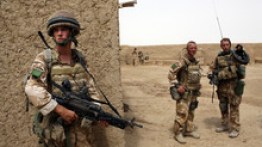
Of course, one poll doesn't make a watertight case, but the results of today's ICM/Guardian poll on the Afghanistan conflict are still worth noting down.  Perhaps counterintuitively, support for the war has actually risen since the last ICM poll on the issue in 2006.  47 percent of people now support the war (up 15 from 2006), against 46 percent who oppose it (down 6).  While 42 percent of respondents want British troops to return this year, against 36 percent who think that they should stay in Afghanistan until they are no longer needed.  And only 6 percent of people say they have "no idea" why British troops are in the region. It would be interesting to see how - if at all - these numbers change now that Afghanistan has returned to the political foreground.

A framework for shelving tax cuts

From our UK edition

So, the News of the World claims that the Tories are planning to shelve some of their tax-cutting proposals - including the inheritance tax cut and tax breaks for married couples - to help combat the fiscal crisis.  Guido suspects that the news came direct from the Blackberry of Andy Coulson, but the Tories have told Tim Montgomerie to "treat the story with a ton of salt". Either way, I do - like Tim - have some sympathy for the idea that commitments will have to be sidelined to overcome Brown's debt mountain.  The longer those terrible deficits remain, the more future generations will be burdened by the Dear Leader's fiscal sabotage, and the more likely that potential investors will turn away from the UK.

So who’s really “playing politics” over troop numbers?

From our UK edition

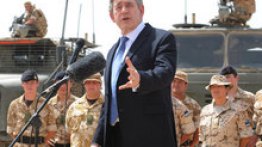
Just when you thought Brown's government couldn't sink any lower, you go and read the Sunday Times's lead story today and the comments it contains from "senior Labour figures", including a minister.  Here are the first few paragraphs: "Senior Labour figures accused the head of the army last night of playing politics as he said that there were too few troops and helicopters in the Afghan war zone. One minister expressed fury that General Sir Richard Dannatt, the chief of the general staff, had attended a private dinner with Tory MPs and suggested an extra 2,000 troops were needed in Helmand province. The general’s remarks put him at odds with the official government line, that the 9,000 British troops already in Afghanistan are sufficient to cope with the offensive.

Smith’s claims call Brown’s political judgement into question

From our UK edition

Ok, let's get the hard, grim facts out of the way first: Jacqui Smith was an ineffective Home Secretary whose expense claims were dubious, to say the least, and who rightly lost her job in government.  But - having said that - it's hard not to feel slightly sorry for her as she discusses the embarrassment caused by her husband's porn rentals in an interview with the Guardian today.  The whole piece is a remarkably candid exchange: she also discusses how she "did wrong" with her expenses, and how she'd "definitely" be voted out "if the general election was tomorrow".  But this passage struck me more than any other:      "[Smith] insists she wasn't forced out - that Brown asked her to stay when she first said she wanted out.

Darling speaks his mind

From our UK edition

You've got to hand it to Alistair Darling: he really does seem to be making the most of his post-reshuffle security.  His interview with the Telegraph's Ben Brogan today is a case in point.  Once again, he goes against the Brown/Mandelson claim that there won't be a spending review before the next election.  But it's this passage which jumped out at me: "In another departure from Mr Brown, he even talks about reversing tax increases, including the planned rise in the top rate to 50p on those earning more than £150,000. 'Looking into the future I would like to be able to reduce tax. Raising the top rate is something I didn’t want to do.'" Brown will be livid.  Just imagine: a Chancellor who speaks against the authority of Number 10.

The extent of Johnson’s loyalty?

From our UK edition

Kevin Maguire's Commons Confidential column in the latest New Statesman contains this intriguing little snippet: "Home Secretary Alan Johnson was a picture of innocence during the plot to oust Brown and replace him with a former postie with the initials A J. Not so his entourage. It has come to the attention of No 10 that one of his team offered a job in Downing Street to a hackette." After his article for the Indy earlier this week - and his fizzy performance in Manchester yesterday (covered by John Rentoul as part of his AJ4PM series) - you suspect Johnson is being a little more active than the Dear Leader would like.

Lansley takes one step forward and two steps back on spending

From our UK edition

Although Andrew Lansley's "10 percent" gaffe may have worked out alright in the end, I can't help but think he's pushing his luck with his latest comments: Andrew Lansley has called on the Government to come clean about their spending plans after it was revealed that the NHS has been asked to plan for efficiency savings of £15-20 billion against its 2010-11 budget. The Department of Health has refused to confirm whether these savings will be available for reinvestment in the NHS - if they are not, it will equate to a real terms annual cut to the NHS budget of 2.3 per cent. Andrew, the Shadow Health Secretary, said, “NHS staff and patients have an urgent need to know whether Labour will match the Conservative commitment to real terms increases in NHS spending after 2011.

No change on the Coulson front

From our UK edition

After the news that there won't be a new police investigation last night, the second thing the Tories feared most hasn't happened either: neither the Guardian nor any other outlet has anything to further implicate Andy Coulson in the phone-hacking scandal this morning.  Indeed, the Guardian's main story concerns how a private investigator working for the NotW collected phone messages from Sir Alex Ferguson and Alan Shearer, among others.  That deepens the media controversy, but hardly fuels the political controversy which was trying to burst into flames yesterday. I should stress - as I did in a comment yesterday - that I think phone-hacking is a disgraceful practice.