Peter Hoskin

Fuel for the political bonfire

From our UK edition

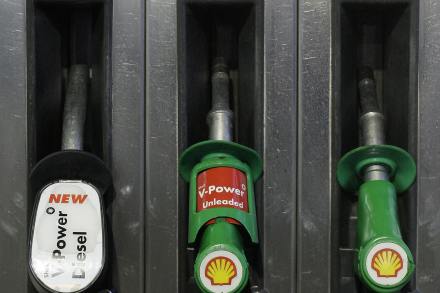
Pasties and jerry cans — who'd have thought that yesterday's politics would descend into a roaring debate about two such innocuous items? And still the hullabaloo goes on. Most of today's front pages lead with one or both of the stories, although I'd say it's the jerry cans that win out overall. Thanks to Francis Maude's suggestion that ‘a bit of extra fuel in a jerry can in the garage is a sensible precaution to take,’ we're seeing headlines such as ‘Pumps go dry as ministers provoke panic’. As with the pasty row, which James discussed yesterday evening, the political dangers of this stretch far beyond the actual matter at hand.
Your guide to Osborne’s fiscal rules

From our UK edition

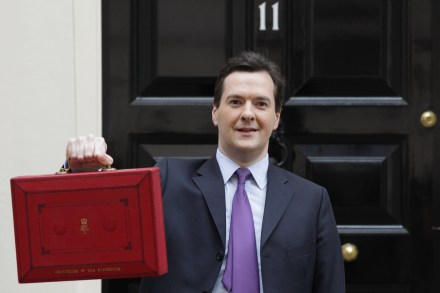
George Osborne's two fiscal rules have been around since his very first Budget, delivered almost two years ago, so they're hardly news. But they do underpin much of what he's done since, including last week's statement, so they're also worth knowing about. Fraser touched on ome of the detail in a post last weekend, but here's a supplementary guide for CoffeeHousers: 1) The deficit rule. This is the one that seems to cause the most confusion, perhaps because it has often been simplified — wrongly — as something like ‘eliminate the deficit by the end of this Parliament’. Fact is, the ‘end of this Parliament’ doesn't come into it.

Another five-point ‘pledge card’ from Labour

From our UK edition

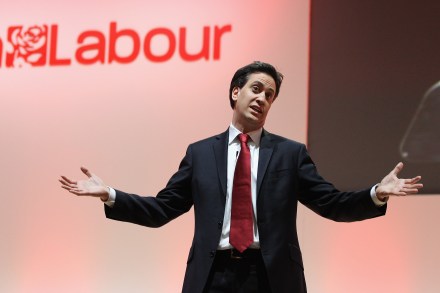
There is no PMQs today, so Ed Miliband is filling the time as gainfully as he can with a speech bashing the Tories. Unsurprisingly, he's making rather a lot of last week's Budget — particularly the 50p tax cut and the frozen personal allowance for pensioners — as well as of Peter Cruddas's recent indiscretions. And so David Cameron will be described as ‘out of touch’ and all that. But there is something else with today's speech: a prop, in the form of a five-point ‘pledge card’. I don't think we've had one of these from Labour for a couple of years now, although they do tend to reserve them for general election campaigns. Miliband's will focus on helping, in his own words, ‘squeezed middle families in these tough times’.

The Tories’ perception problem

From our UK edition

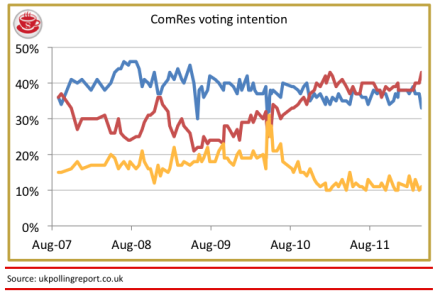
Introducing Ed Miliband, Labour's best hope since Tony Blair. Oh, I'm kidding, of course — but it's still striking that, this morning, Labour have their biggest lead in a ComRes poll for seven years. And the size of the lead? Ten points, but it could be even bigger. The Peter Cruddas revelations fell right in the middle of ComRes's polling. Apparently, those interviews conducted after Sunday had Labour with a 17-point lead. Of course, you can slap every caveat across this that you like: we're still ages away from the election; one poll does not make a trend; the 17-point figure is based on a subset of a subset of people; and so on. But this ComRes poll, and a few others out today, will still jangle nerves and fray tempers along Downing Street.

Cameron u-turns on donor secrecy — but what now?

From our UK edition

One distinct feature of the ‘cash for access’ row is that we've seen it all before. And not just the glutinous mix of politics and money, but also the debate over what should be done to fix it. Last November, Sir Christopher Kelly, chair of the Committee on Standards in Public Life, released a report into the funding of political parties that featured many of the options we're hearing today. It landed on 24 recommendations, of which one stood out: ‘the only safe way to remove big money from party funding is to put a cap on donations, set at £10,000’. But to prevent a subsequent shortfall in parties' funds, it also proposed that state funding be increased to the tune of an extra £23 million.

The problem for Cameron is his proximity to the problem

From our UK edition

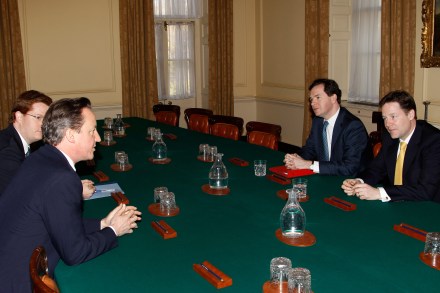
The happiest news for David Cameron this morning is that the ‘cash for access’ story hasn't quite made it onto every front page. But that's it, really, so far as the glad tidings are concerned. All the rest is poison for No.10. The Prime Minister is now fighting off calls — including from his own MPs — to release the names of those donors who enjoyed dinner at his Downing Street flat. Labour are, of course, pressing for him to go further than an internal party inquiry, and launch an independent investigation instead. Today's furore is not going to simmer down after a few days, or even after a few weeks. In several respects, all this is trickier for Cameron than, say, the expenses scandal.

The ‘next big scandal’ detonates under Cameron

From our UK edition

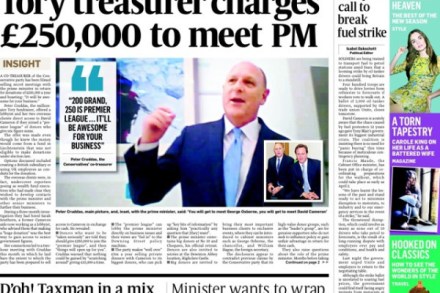
‘It will be awesome for your business.’ So said Peter Cruddas, co-treasurer of the Tory party, as he tried to peddle access to David Cameron for £250,000 a shot. Only he wasn't talking to businessmen this time; he was talking to a couple of investigative reporters from the Sunday Times (£), who were armed with dictaphones and video cameras. And, as the resulting footage shows, he blustered himself over the edge. A ‘premier league’ of donors was spoken of, whose ideas are ‘fed in’ to Downing Street's policy process. There was a claim that the biggest donors can be invited for dinner at Cameron's private flat in No.10, where they can ask him ‘practically any question [they] want’.

Spending will become more significant as 2015 approaches

From our UK edition

Four days after George Osborne signed its death warrant, there is still life in the 50p rate yet. The two main political interviews in today's papers — Ed Miliband in the Telegraph, Danny Alexander in the Times (£) — both focus heavily on the top rate's impending demise. The Labour leader, of course, is continuing to ask whether David Cameron and George Osborne will themselves benefit from the move to 45p, without actually managing to commit his party to a policy. The Chief Secretary to the Treasury is left defending a 45p rate, and does so by borrowing a recent Lib Dem slogan for the coalition as a whole: ‘This is a Budget for the millions, not the millionaires.

Behind Osborne’s 50p tax change

From our UK edition

How significant was this Budget? On an economic level, not very. There's no discernible impact on growth: all of the main forecasts have more or less stayed the same since the Autumn Statement. Borrowing is the tiniest bit lower, mainly thanks to a £23 billion accountancy trick with Royal Mail pensions. And even many of the policies announced today will barely rouse the Exchequer's attention. That cut in the top rate of income tax to 45p? It will mean only £100 million a year less in direct revenues. That stamp duty increase for properties worth over £2 million? It will net only £300 million a year. The overall effect is a fiscally neutral document, as expected. The fuss-to-impact ratio for Budget 2012 is pretty high.

A fistful of questions on Budget morning

From our UK edition

Thanks to Budget purdah, we're all in the dark about what will be in George Osborne's Red Book today. Oh, sorry, that's wrong, don't know what I was thinking. Truth is that, unless the Chancellor has some monumental surprises lined up, we've actually heard about much of the Budget in advance. We know, for instance, not just that he'll cut the top rate of tax from 50p to 45p, but also — courtesy of Andrew Grice in the Independent today — the internal political slog by which he reached that decision. Thanks to the proclivities of coalition government, this has to be one of the most pre-briefed Budgets ever. There are still, though, as James Plunkett demonstrated yesterday, some questions hovering over this Budget — and some of them around the 50p rate too.

Why Labour’s 50p tax wobble is dangerous for Ed Miliband

From our UK edition

Why did Gordon Brown wait until the last few weeks of Labour's thirteen-year reign to implement a 50p tax rate? Easy. Because it wasn't so much a fiscal policy as a fiendish trap, designed to cut into a Tory government's flesh. But now, it seems, the trap has snared another victim: Labour itself. The Telegraph's Daniel Knowles has already neatly summarised the politics arising from Sam Coates' report (£) that Labour will neither back the scrapping of the 50p rate nor promise to reinstate it either. But the basic point is worth repeating: if that's the approach that Labour chooses, then they'll be left in a complete mess. They can attack the coalition all they like for cutting taxes for high earners, but the answer will come back, ‘well, would you keep it?

Tax transparency is a triumph for Osborne

From our UK edition

Transparency marches on, and what a joy it is. According to the newspapers today, George Osborne will tomorrow turn Ben Gummer MP's call for tax transparency into government policy. And so we will all get statements detailing just what our tax pounds are spent on. To use the example being bandied around this morning, a £50,000 earner will learn that they contribute £4,727 towards welfare payments. As James put it at the weekend, George Osborne tends to have both economic and political motives behind his actions — and the two are present, if almost indivisible, here. No doubt the Chancellor hopes that taxpayers, on seeing where their hard-earned ends up, will be keener for cuts in both spending and taxation.

A significant moment for the minimum wage

From our UK edition

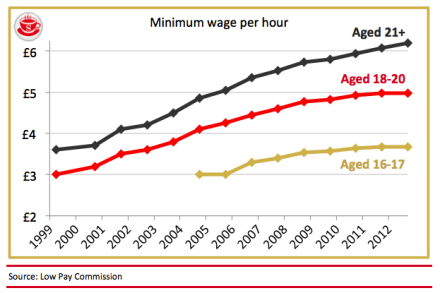
Here are some numbers for you: the adult rate of the national minimum wage will be raised, this October, by 11p to £6.19 an hour, but the separate rates for 16-17 and 18-20 year-olds will be frozen, at £3.68 and £4.98 respectively. I mention this not just because these figures were announced today, but also because it's the first cash freeze in any of the rates that we've seen since 2005 (and even that was when the 16-17 year-old rate was kept at the same level after its very first year of existence): The question is, what now? The government is defending the freeze by saying that, ‘Raising the youth rate would not benefit young people if it meant it was more difficult for them to find a job’ — and rightly so.

Where will Cameron’s road proposal take us?

From our UK edition

Are we facing ‘toll road UK’, as the Mirror suggests this morning? That is certainly a possibility arising from David Cameron's plan to allow private firms to bid for chunks of Britain's motorway system — but I wouldn't get too excited just yet. It's a very distant possibility at the moment. After all, just note the details of the story. The routes that the coalition has in mind are very significant ones, but they still add up to only 3 per cent of the national network — ‘toll road UK’ may be pushing it. And then there's the fact that nothing has been entirely decided yet. We're told that, ‘The Treasury and the Department for Transport will carry out a feasibility study with a view to reporting back to Mr Cameron in the autumn.

Osborne makes his appeal to Britain’s grafters

From our UK edition

‘A Budget for Working People’. That's the headline theme of this year's Budget, says our former editor Matt d'Ancona in the Sunday Telegraph today. And his words are borne out by George Osborne's interview with the Sun on Sunday. ‘We've got to help people into work, particularly young people,’ says the Chancellor, ‘We have to make this a competitive place in the world to set up in business and employ people.’ The measures being broadcast around this morning include a trial suspension of Sunday trading regulations, timed for during the Olypmic Games. At once, this is both an unsurprising and genuinely risky venture from Osborne.

Balls lays into Brown — but why?

From our UK edition

Normally, pre-Budget interviews with shadow chancellors are dry and methodical. But the Times's interview with Ed Balls (£) today is the opposite: frenetic, relatively non-fiscal and utterly, utterly strange. Given that CoffeeHousers are probably waking up to brunch, I thought it might be a bit much for you to wade through his thoughts on food and on crying (‘OK. Crying. What do you want to know about crying?’). So I've pulled out some of the main political points from the interview here: 1) Laying into Brown. The quotation that gives the interview its headline is an eye-opener, coming as it does from Ed Balls. ‘Nobody is going to look back at any point in history,’ he says, ‘and say that Gordon Brown was a great Prime Minister.

Cameron and Obama bargain over fuel

From our UK edition

No wonder David Cameron and Barack Obama were being so chummy: they both knew that they could help each other. The Times carries an intriguing story (£) on its front page this morning, about how the two men discussed a plan to get fuel prices down in the UK and the US. The idea is that both countries — and perhaps more — would release some of their oil reserves. And so supply would go up, and prices would come down. As would our reliance on the oil-rich countries of the Middle East. Apparently, we're some distance from a deal yet, but you can see why both the PM and the President would want one to be struck — and soon.