Peter Hoskin

Can Merkel and Hollande meet in the middle?

From our UK edition

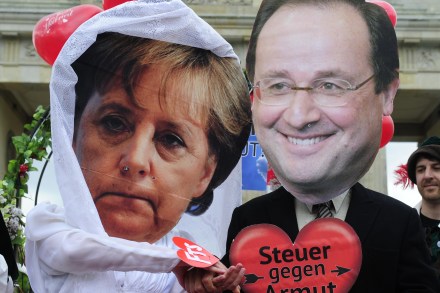
This afternoon, it’s even clearer that the French and Greek elections are a significant moment in the life of the Eurozone. It’s not just the nervous market reaction to yesterday’s results, but also the way how the supranational debate has now changed. More so than ever, there are now two clear oppositional fronts. On one side, broadly speaking, are those who say that austerity is a prerequisite for growth. On the other, those who say that austerity must be relaxed for growth to arrive. It’s a situation dripping with black humour. When David Cameron kept Britain out of Europe’s fiscal pact a few months ago, it was portrayed as a case of us against them. Now it’s more a case of them against themselves.
Balls wants you to trust him

From our UK edition

It's only ten days or so since Ed Balls was last quizzed by Andrew Neil, but there he was rehashing many of the same lines on the Sunday Politics today. Among the things that stood out was this: the shadow chancellor’s argument on the public finances is ever more cleaving into two halves. First, he accuses George Osborne of borrowing £150 billion more over this Parliament than originally planned. (Although there’s a detail that often, conveniently, gets obscured: namely, that borrowing is still going down year-on-year under Osborne's plan). Second, that Balls's plan would decrease borrowing in the medium-term even though it would increase spending and reduce tax revenues in the short-term.

Whatever they say, Lords reform will remain on politcians’ minds

From our UK edition

Have our politicos looked at last week’s turnout numbers, and thought ‘y’know, we might be a bit cut-off after all’? Reason I ask is because they’re all tripping over themselves today to downplay the significance of Lords reform, and focus the conversation on The Issues That Actually Matter. This, as James said earlier, is what George Osborne has been up to throughout the day. Ed Balls did likewise during an appearance on the Sunday Politics with Andrew Neil. And, most significantly, even Vince Cable echoed their sentiments in his interview on Sky’s Murnaghan Show.

The Lib Dems are having a bad day too

From our UK edition

We've heard about those disgruntled Tories, but what about the Lib Dems? After all, the local elections always used to be their psychic salve: they may have struggled to make much progress in general elections, but their fierce local activism could always be counted on to yield council seats. But now that’s less reliable a tonic. After today the party is going to have fewer than 3,000 councillors for the first time since the it was formed in 1988, losing overall control of Cambridge in the process There's even talk that Brian Paddick will slump to fourth place, or possibly fifth, in the London Mayoral race. Of course, all this is unsurprising: the Lib Dems have been struggling against a tide of national hatred and indifference for almost two years now.

A dreadful turnout

From our UK edition

There are two major stories behind the headline results this morning: the rejection of elected mayors and the low voter turnout. Of these, I think the second is the most significant. You can apportion some of the blame to the dreary weather, if you like. But, still, a predicted turnout figure of 32 per cent? That's hardly encouraging. First, though, we shouldn't exaggerate the situation. This wouldn’t be the lowest turnout figure for any local election in history — but the lowest since 2000, when the figure was less than 30 per cent. And it’s also true that turnout has risen for the past three general elections, even if we’re still some way down on the 83.9 per cent achieved in 1950.

Obama’s words meet with the Taliban’s bombs

From our UK edition

Political theatre, that’s what Barack Obama delivered in Afghanistan last night. A year on from the death of Osama Bin Laden, and with the US elections fast approaching, here was the President reheating his existing timetable for withdrawal — and offering it up as reassurance for weary Afghans and Americans alike. There were some new details, courtesy of an ‘Enduring Strategic Partnership Agreement’ signed with Hamid Karzai, but this was mostly about the symbolism and rhetoric. As Obama put it himself, ‘We can see the light of a new day on the horizon.’ Except this ‘new day’ quickly slipped back into night. A couple of hours after Obama had left the country, a suicide bomb attack left at least seven people dead in Kabul.

Their drinks are still on us

From our UK edition

It has been a busy day for Commons committees, and I don’t just mean the education and media select committees either. The John Bercow-chaired House of Commons Commission has released a briefing note outlining some of its recent decisions relating to the running of the House. It covers three areas: ‘Mobile devices for members’ (aka, iPads for MPs); ‘Trees in Portcullis House’ (let’s keep ‘em, so long as we can make ‘em cheaper); and ‘Alcohol policy’ (more on which below). It’s the last of these that will probably get the most attention, not least because of Eric Joyce’s recent misadventures. So what does Team Bercow recommend?

The Lib Dems jostle for airtime

From our UK edition

Yep, they’re inescapable, those Lib Dems. Even when the airwaves are dominated by Rupert Murdoch and Tom Watson, they’re there in the background, quietly adding to the day’s pile of political news. We’ve got Ken Livingstone making a pitch for their votes in the London Mayor’s contest, for instance. And we’ve also got Nick Clegg on what seems like every radio show on air, giving his account of why folk should be Lib Dem voters in the first place. There have been two more significant scraps of LibDemmery than those, though.

MPs squabble over their own phone hacking report

From our UK edition

The education select committee reported earlier, but it is the report of another select committee that will get all the attention today. The culture, media and sport select committee has just delivered its verdict on the phone hacking scandal, naming names and apportioning blame — or at least in theory it has. In practice, ‘its verdict’ may be stretching it a bit. During the press conference just now, the individual members of the committee could barely put up a united front at all. There are the parts of the report that they all agree upon: that the former News International employees Les Hinton, Tom Crone and Colin Myler misled the committee in their testimony, for instance. And then there are the parts that they disagree upon among themselves.

Gove gets covering fire

From our UK edition

Good teaching matters; that’s something we don't need to be taught. But how much does it matter? What are its measurable benefits? Today’s education select committee report collects some striking, if pre-existing, research into just those very questions, and it is worth reading for that reason. There is, for example, the IPPR’s suggestion that ‘having an “excellent” teacher compared with a “bad” one can mean an increase of more than one GCSE grade per pupil per subject.’ Or there’s the American study which found that the best teachers can ‘generate about $250,000 or more of additional earnings for their students over their lives in a single classroom of about 28 students.

The Lib Dems start to pile on Hunt

From our UK edition

One of the key factors in this Jeremy Hunt business was always going to be the ferocity of the political maelstrom around him. After a slow start, the Tories have sought to calm it down, offering fulsome support for the embattled Culture Secretary. For their part, Labour have been calling for his resignation from the very moment the news broke, with Ed Miliband today accusing David Cameron of ‘organising a cover-up’ to protect his colleague. So far, so party lines. But what about the Lib Dems? It's noteworthy that one of their number — Simon Hughes, natch — last night called for an independent investigation into the matter (see the video above). This, of course, is not something that Downing Street is minded to do.

Osborne’s turning point

From our UK edition

As Paul Goodman suggests, there is something significant about Liam Fox's article for the Daily Telegraph this morning. It's not that we haven't heard similar from the former Defence Secretary before — we have. It's more that his economic prescriptions are being made, we learn from the Sun, with the ‘explicit approval’ of his buddy George Osborne. And what are those prescriptions? Well, the main one is for further spending cuts, and Fox also waxes enthusastic about greater deregulation and about protecting the defence budget (at the expense of international aid). He also has some firm advice for the Lib Dems.

Murdoch versus Brown

From our UK edition

Testimony A, from Rupert Murdoch speaking to the Leveson Inquiry today: ‘Mr Brown did call me and said “Rupert, what do you know, what’s going on here?”, and I said “What do you mean?” and he said “The Sun, what it’s doing and how it came about”. I said I was not aware of the exact timing, but I’m sorry to tell you Gordon that we have come to the conclusion that we will support a change of government when there is an election. He said — and no voices were raised — “Well, your company has declared war on my government and we have no alternative but to make war on your company”. I said “I’m sorry about that Gordon. Thank you for calling.

Our economy fell back into recession

From our UK edition

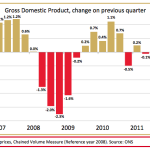
Or at least technically-speaking it did. The figures released this morning suggest that the economy shrank by 0.2 per cent in the first quarter of this year, which is the second quarter of shrinkage in a row after last winter's 0.3 per cent fall. The numbers are tiny, but the politics is huge. It's a double dip — and you can expect Ed Miliband to mention that fact again and again in PMQs later, with dread accompaniment from Ed Balls and his hand gestures. There are some caveats, of course. This is only a preliminary estimate, so the Office for National Statistics could revise it upwards at some point. It's also the slightest of slight downturns.

Hunt: I’m not quitting

From our UK edition

Here's the full statement: ‘Now is not a time for kneejerk reactions. We’ve heard one side of the story today but some of the evidence reported meetings and conversations that simply didn’t happen. Rather than jump on political bandwagon, we need to hear what Lord Justice Leveson thinks after he’s heard all the evidence. Let me be clear my number one priority was to give the public confidence in the integrity of process. I asked for advice from independent regulators — which I didn’t have to do — and I followed that advice to the letter.

The Hunt becomes the hunted

From our UK edition

The Eurocrisis may be nagging at our political class, but it's got nothing on the Leveson inquiry. Today has been James Murdoch’s turn in the hotseat, and it has produced some of the most explosive testimony so far. There was the claim that, contrary to previous Tory insinuations, Murdoch Jr did chat about the BSkyB bid with David Cameron at that notorious Christmas Dinner in 2010. But topping that is the revelation that News Corp had all sorts of contact with Jeremy Hunt about the bid, mainly via their head of public affairs Fred Michel, as it was simmering along in 2010 and 2011. It doesn’t look good for Hunt.

The Eurocrisis persists

From our UK edition

Holland and Hollande; they're the non-identical twins that are causing palpitations across Europe today. Holland, because the country's Prime Minister yesterday resigned after failing to agree a package of cuts for his country’s budget. Hollande, because he's the socialist candidate set to win the presidential election in France, probably eroding that country’s commitment to fiscal consolidation in the process. The markets quivered in fear at this morning’s headlines — and what they mean for the eurozone — even if they have, in some parts, slightly recovered since. It’s all another reminder that the Eurocrisis just isn't going away — neither for countries such as France and the Netherlands, nor for George Osborne.